
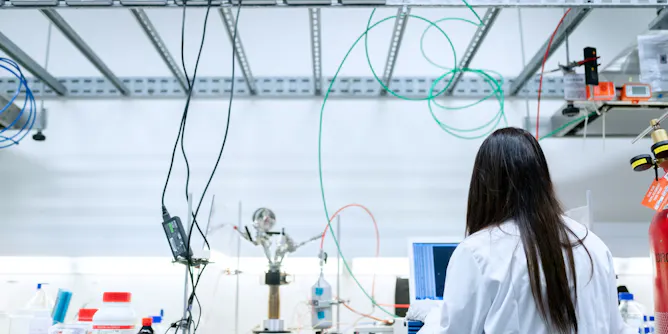
In 2016, women represented just 29% of workers with university qualifications in science, technology, engineering or maths. And that was before the pandemic disruption.
Articles on Women in STEM
Displaying 61 - 80 of 139 articles
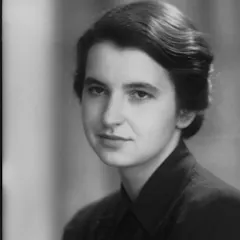
Franklin was born a century ago, and her X-ray crystallography work crucially contributed to determining the structure of DNA.

Findings from a study that followed more than 70,000 high school students in Greece suggest why girls may be less likely to pick careers in science and maths than boys.

A number of programmes now exist that are helping to close the gender gap in African science, technology, engineering and maths.

As schools and daycares are closed because of the coronavirus pandemic, academic mothers are finding themselves less able to conduct research and write articles.
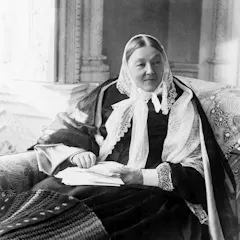
On the 200th anniversary of Florence Nightingale’s birth, we take a look at how her monumental efforts helped shape the way we model health care and disease outbreak data today.

The coronavirus pandemic is highlighting inequalities that exist in academia
Her commitment to the communities she was serving was unwavering. She ensured that research results were disseminated to communities before presenting at conferences.
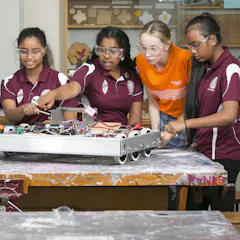
There is no shortage of projects to boost the number of women in science, technology, engineering and maths. But what we need is more hard data on whether and how these schemes are actually working.
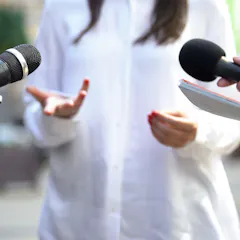
Men still dominate the science media landscape, among both quoted sources and the writers themselves. Confronting this problem is not a job just for women, or just for the media - it’s for everyone.
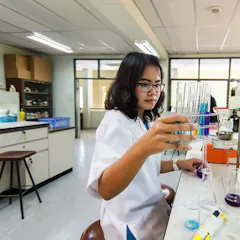
Scientific research can be a daunting career choice for women of colour, according to a recent survey which found they face a “barrage of brief, everyday racial slights” at work.

Building a strong ‘engineering identity’ is a key step towards bringing more women into the field, a new report has found.

Having fewer children is one of the most effective ways an individual can mitigate climate change.
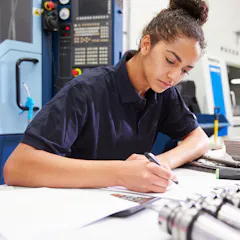
On Dec. 6, 1989, 14 women were murdered at École Polytechnique. Women in a mechanical engineering class were targeted, and 30 years later the ratio of women to men in engineering hasn’t improved much.
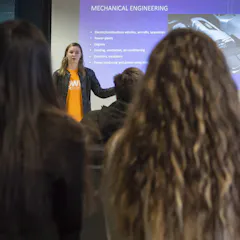
Engineering is in a better place than in 1989. More women are studying the field, and academic administrators and managers want to hire female engineers. But more work is still needed.
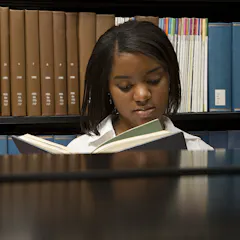
Women face a number of socio-economic challenges that make it harder for them to access higher education.
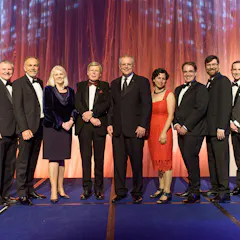
Awards can make scientific careers, but too often award rules and application processes shut women out.
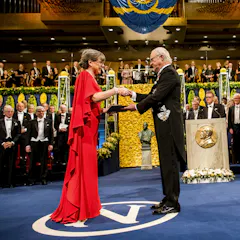
Progress has been made toward gender parity in science fields. But explicit and implicit barriers still hold women back from advancing in the same numbers as men to the upper reaches of STEM academia.
Many college students take math classes they’ve already taken in high school. Why does this happen? Is it a problem?
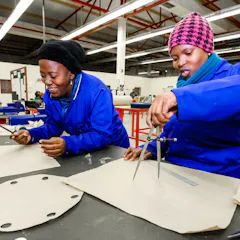
The world of the fourth industrial revolution looks set to be one dominated by forms of knowledge and industries – like science and technology – that have long been dominated by men.
Top contributors
-

Australian Government Women in STEM Ambassador, Professor of Practice, UNSW
-
Professor and Associate Dean - Diversity, Belonging, Inclusion, and Equity, Australian National University
-
Professor and Lincoln Professor of Ethics in Public Affairs, Arizona State University
-
Associate Professor, Interim Pro Vice Chancellor Learning and Teaching, Australian National University
-
Lecturer in Cultural Studies in Health
-
Senior Research Fellow in Antarctic and island conservation science, Queensland University of Technology
-
Professor and Deputy Vice-Chancellor (Research), University of Sydney
-
Australia's Chief Scientist, Office of the Chief Scientist
-
Pro Vice-Chancellor (Academic Innovation & Change), Professor of Astrophysics, Swinburne University of Technology
-
Harold T. Stearns Professor of Earth Science, Wesleyan University
-
Lecturer, Education Futures, Adelaide University
-
Associate Professor of Critical Media Practices and Digital Humanities, University of Colorado Boulder
-
Professor of Mathematics, University of Sydney
-
Professor in Economics, Monash University
-
Research Manager at E61 Institute, Bocconi University