
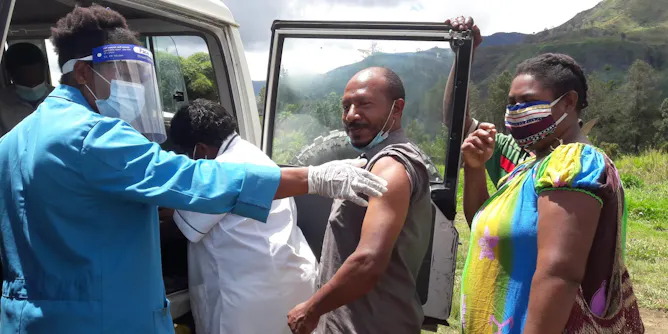
Many in PNG have access to the vaccine, even in the remotest corners of the country. But the problem is a deep-seated fear of the vaccine.
Articles on Vaccine hesitancy
Displaying 101 - 120 of 251 articles
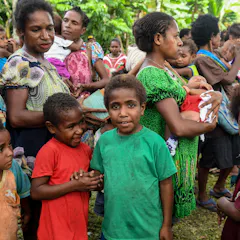
Struggling with a a fragile healthcare system, remote populations and widespread fear of the vaccine, COVID is running rampant in PNG. Australia has done much to help, but is it enough?

An infectious diseases doctor reviews the evidence, discusses hesitancy and concerns about side-effects and explains the overwhelming case for vaccinating five-to-11-year-olds, including his own son.
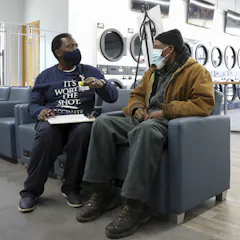
Machine learning algorithms can help public health officials identify areas of high vaccine hesitancy by ZIP code to better target messaging and outreach and counter misinformation.
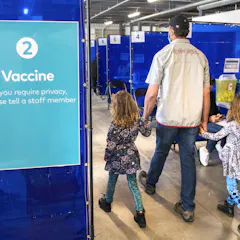
When making the decision whether to vaccinate children aged five to 11 against COVID-19, regulators in Canada must rely on sound ethics as well as sound science.

We surveyed Albertans, and while most were vaccinated, we found certain groups were less likely to be vaccinated than others. Those being people facing economic hardship and political affiliation.
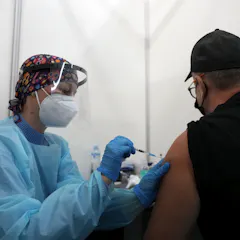
Humans are unable to face the stark reality of death, and often engage in various forms of denial.
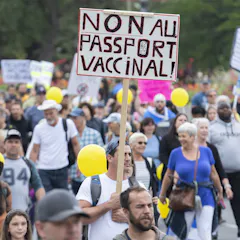
People who oppose vaccination won’t be swayed by statistics. To convince them, it is necessary to share real-life experiences and stories with which they will identify.

In Fiji, 95% of adults have received one jab and 80% are fully vaccinated. In PNG, however, less than 1% of the population is fully vaccinated – and the country is giving away its vaccines.

The COVID-19 pandemic is a stressful time for all, and even more so for people experiencing trauma-related stress. How can public health emergency responses avoid further trauma for vulnerable people?

Trust is needed to curb vaccine hesitancy. Governments need to explain vaccines and other public health measures, while also speaking to the broader purpose of caring for the community we belong to.

When it came to managing the spread of COVID-19, Canada fared better than the United States and the United Kingdom, but worse than other welfare states like New Zealand and Japan.
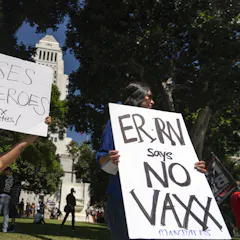
While the vast majority of health workers are prepared to accept COVID vaccinations, we need to make sure the concerns of the minority are heard and don’t compromise safety.

Talking about your own experience can help normalise vaccination.

The decision not to get the COVID-19 vaccine comes from a complex set of psychological factors.
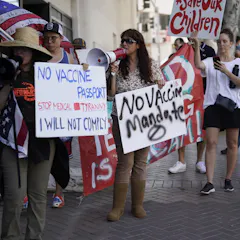
While surveys have shown a large share of unvaccinated workers threatening to quit over a mandate, the reality is few actually do.

People tend to stick with their stated beliefs. But here’s how external forces like vaccine mandates can push people to do something they don’t want to do – and provide some face-saving cover.

Vaccine hesitancy has been a subject of intense study in the field of scientific communication. Anti-vaxxers’ recent radicalization needs to be looked at.

There are a variety of reasons why people do or don’t want to be vaccinated. Depending on how they frame their messaging around vaccination, doctors can often be the deciding factor.

Ivermectin is the most recent example of a medication touted as a miracle drug for COVID-19 without solid medical evidence supporting its use.
Top contributors
-

Associate Professor of Health Law, Policy and Management, Boston University
-
Professor, School of Population Health, UNSW
-
Professor of Paediatrics and vaccinologist, Royal Childrens Hospital, University of Melbourne and Murdoch Childrens Research Institute (MCRI); Associate Dean International, University of Melbourne, Murdoch Children's Research Institute
-
Research Fellow, Vaccine Uptake Group, Murdoch Children's Research Institute
-
Professor, School of Public Health, University of Sydney
-
Professor, School of Social Sciences, The University of Western Australia
-
Extraordinary Professor, Global Health, Stellenbosch University; South African Medical Research Council
-
Endowed Professor of Health Policy and Associate Dean, George Washington University
-
Assistant Professor of Communication and Political Science, The Ohio State University
-
Senior Scientist, Cochrane South Africa, South African Medical Research Council (SAMRC) and Honorary researcher, Division of Social & Behavioural Sciences, School of Public Health, UCT, South African Medical Research Council
-
Professor of Neurology, Medicine (Infectious Diseases), and Epidemiology, University of Colorado Anschutz
-
Executive Director, African Population and Health Research Center
-
Senior Lecturer, School of Communication, Journalism and Marketing, Te Kunenga ki Pūrehuroa – Massey University
-
Assistant Professor of Health Policy and Managment, School of Public Health, Texas A&M University
-
Postdoctoral Research Associate in Public Interest Communications, University of Florida