
A new series delves into the big questions surrounding the nature of our universe.
Articles on Universe
Displaying 41 - 60 of 185 articles
Research casts doubt on theories predicting that light black holes formed immediately after the Big Bang.
The groundbreaking discovery of a temperate Earth-size planet just 40 light-years away may hold the key to understanding stellar habitability.
One hundred years ago, one star changed our view of the universe, proving that the Andromeda “nebula” was a galaxy like our Milky Way.
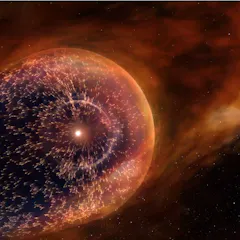
An interstellar probe could help scientists answer fundamental questions about how the Sun influences Earth, space and other planets in the solar system.

MeerKAT has made remarkable contributions to South African and international science.
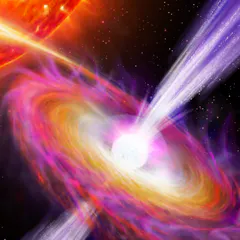
Powerful jets are launched from the most massive objects in our universe, but we don’t fully understand how. This measurement gets us a step closer to solving the mystery.
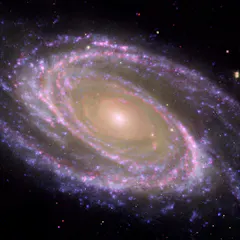
The nature of dark energy remains one of the biggest puzzles in cosmology.

People have been looking up at the stars for thousands of years. Here’s where to start if you want to learn more about the night sky – from spotting easy-to-find constellations to using the best apps.
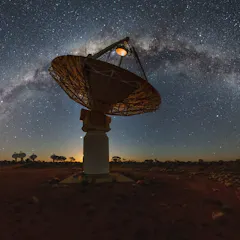
Do all big black holes in very massive galaxies emit radio waves? We used the latest radio telescopes to find out.
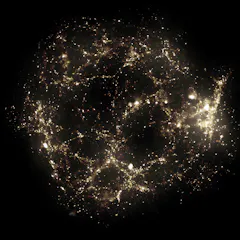
If we lived in a cosmic area with below average density, it would explain recent contradictory measurements of the universe’s expansion.
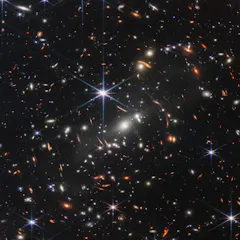
The universe is expanding faster than physicists would expect. To figure out what processes underlie this fast expansion rate, some researchers are first trying to rule out what processes can’t.

In September 2023, a NASA mission successfully brought samples of an asteroid down to Earth in a sealed capsule. Analysis of these samples may reveal information about the origins of the universe.
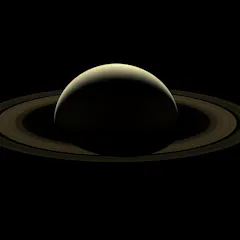
Viral headlines would have you think Saturn’s rings will vanish in just 18 months. Here’s what that really means and why you don’t need to worry.
The universe appears to be fine-tuned for life to evolve.
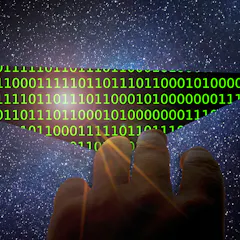
If the average amount of information conveyed by an event is always decreasing, it could mean we live in a computer program.
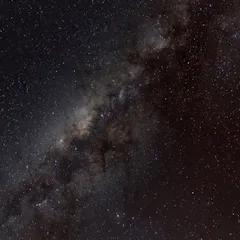
An astronomer explains why space looks so dark despite containing 200 billion trillion stars.
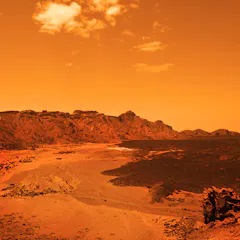
Planetary analogues are sites on Earth that are so extreme that they replicate those of celestial bodies in our solar system.

An astronomer and ‘black hole historian’ explains how the parts of the universe black holes grow in might influence how quickly they become bright, supermassive objects.
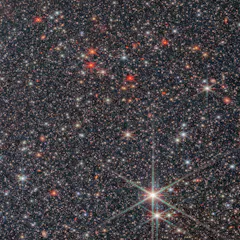
A new hypothesis suggests that the universe may be twice as old as we had believed. Observations from the James Webb Space Telescope provide new information on the rate of the universe’s expansion.
Top contributors
-

Professor of Astrophysics, University of Sydney
-
Associate Professor in Astronomy, Monash University
-
Associate Dean of Innovation and Engagement, Swinburne University of Technology
-
ARC Laureate Fellow & Distinguished Professor, Centre for Astrophysics & Supercomputing, Swinburne University of Technology
-
Emeritus Professor of Cosmology and Astrophysics, Institute of Astronomy, University of Cambridge
-
Senior Curator (Astronomy), Museums Victoria Research Institute; The University of Melbourne
-
Senior Lecturer in Physics, Western Sydney University
-
Professor, The University of Queensland
-
Pro Vice-Chancellor Flagship Initiatives, Swinburne University of Technology
-
Reader in Astrophysics, UCL
-
Professor (Astrophysics), University of Southern Queensland
-
Cosmologist, University of Tasmania
-
Professor, Macquarie University
-
John Curtin Distinguished Professor (Radio Astronomy), Curtin University
-
Professor of Astronomy & Astrophysics, University of California, Santa Cruz