

The early universe was kind of like a big game of musical chairs – scientists are figuring out how many particles were able to find ‘seats’ to understand the cosmos.
Articles on Big Bang
Displaying 1 - 20 of 80 articles
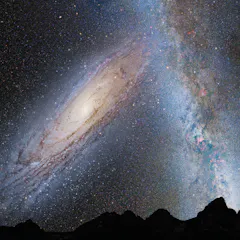
The Milky Way contains a fossil record of galaxies it has absorbed.
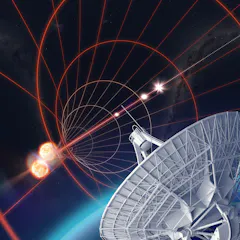
Astronomers have revisited data from a dramatic collision of neutron stars to help resolve the infamous ‘Hubble tension’.

Listen to the The Conversation’s Curious Kids podcast to hear astronomer Michael Lam on what theories scientists have for what came before the Big Bang.
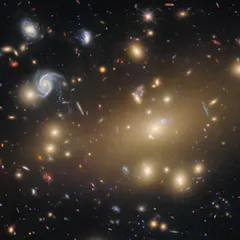
Two ways of measuring how fast the universe is expanding disagree, a puzzle known as the Hubble tension. Tiny magnetic fields from the Big Bang may offer a solution.

Will the universe keep existing forever? An astrophysicist explains how scientists aren’t entirely sure, but they can make predictions.
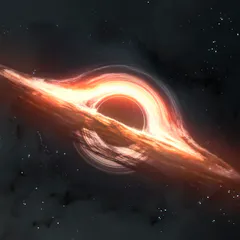
New theory makes testable predictions.
The universe’s expansion is accelerating, not decelerating. Our understanding of how the universe works may need an update.

A project to map galaxies across the universe may have spied cracks in the foundation of our understanding of the cosmos.
Can we really understand what happened at the beginning of the universe?
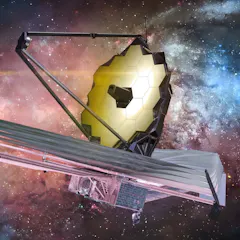
Some of the earliest galaxies found with JWST are also the brightest. That’s a problem for our ideas about the universe.

The Hubble tension has been described as a “crisis” for cosmology. Can it be resolved?
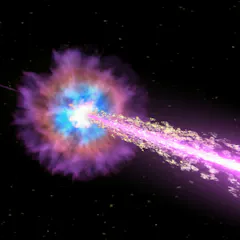
Analysis of two major cosmic blasts deepens the mystery of where the universe’s ‘heavy’ elements come from.
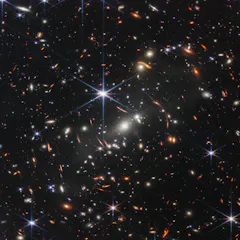
Now out in space for more than two years, the James Webb Space Telescope is a stunningly sophisticated instrument.
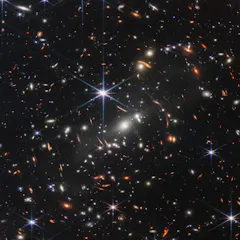
The universe is expanding faster than physicists would expect. To figure out what processes underlie this fast expansion rate, some researchers are first trying to rule out what processes can’t.
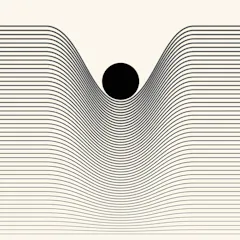
Einstein’s theory of general relativity suggests that our universe originated in a Big Bang. But black holes, and their gravitational forces, challenge the limits of Einstein’s work.

A book-length thought experiment uses math to investigate some of life’s big questions.

The universe used to be filled with a hydrogen fog, before early stars and galaxies burned through the haze. Astronomers are studying galaxies that tell them about this period in the early universe.
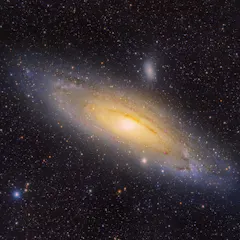
The way particles interacted while the universe was forming seconds after the Big Bang could explain why the universe exists the way it does – a physicist explains matter-antimatter asymmetry.
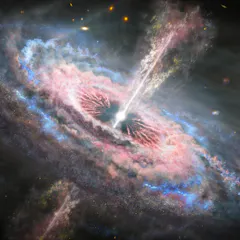
Bright, flickering galaxies called quasars were thought to pose a problem for our understanding of the cosmos – but new research shows Einstein was right yet again.
Top contributors
-

Professor of Astrophysics, University of Sydney
-
Pro Vice-Chancellor Flagship Initiatives, Swinburne University of Technology
-
Professor of Astrophysics and Royal Society University Research Fellow, University of Hertfordshire
-
Associate Professor in Astronomy, Monash University
-
Cosmologist, University of Tasmania
-
Research Scientist, SETI Institute
-
University Distinguished Professor of Astronomy, University of Arizona
-
Reader in Astrophysics, UCL
-
Emeritus Professor of Cosmology and Astrophysics, Institute of Astronomy, University of Cambridge
-
John Curtin Distinguished Professor (Radio Astronomy), Curtin University
-
Professor, The University of Queensland
-
PhD Candidate, University of Southern Queensland
-
Research Professor and Director of the International Institute for Accelerator Applications, University of Huddersfield
-
Senior Lecturer in Particle Physics Informatics, Brunel University of London
-
ARC Laureate Fellow & Distinguished Professor, Centre for Astrophysics & Supercomputing, Swinburne University of Technology