
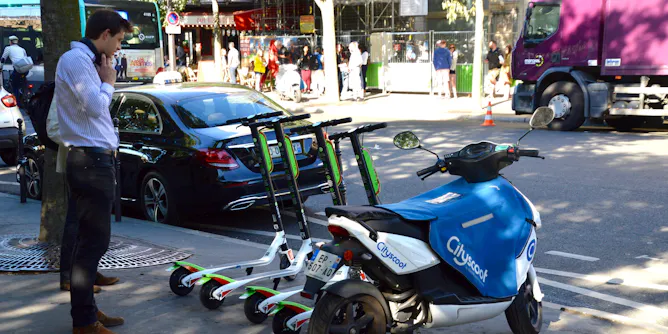
Shared electric scooters appeal as a way to cover that awkward distance between public transport stops and your destination. But first e-scooter operators must solve the littering and dumping problem.
Articles on Transport policy
Displaying 81 - 100 of 134 articles
Transport policies in European cities are on a collision course with the tech industry’s ambitions for self-driving cars.

We spend on average about an hour a day travelling. Given this is unlikely to change, how can we make this time more productive and enjoyable?
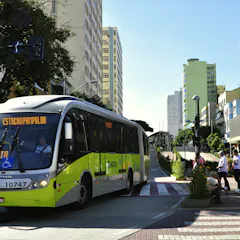
Trains and trams get most attention, but ‘tweaking’ bus transit can transform cities. Buses can be more cost-effective and deliver better service, especially for small to mid-sized cities.

In the 1970s, both Kyoto and Melbourne made fateful decisions about their transport networks. Melbourne today enjoys the benefits of trams, while Kyoto lives with the consequences of losing them.
Good public access for Melbourne Airport and others like it depends on not fixating on one solution, like a single rail line, but instead developing multiple options integrated with the city’s needs.
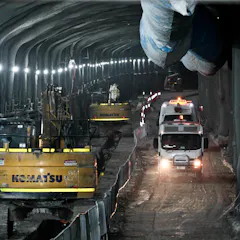
Analysis of the business cases for three of the biggest projects deemed “high priority” by Infrastructure Australia raises questions about the process.
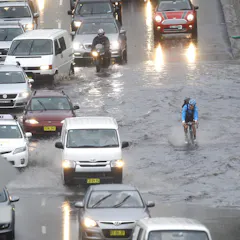
The relationship between weather and our travel choices is complicated. We can’t change the weather, but, with many other factors in play, good policy and design can reduce its impacts.
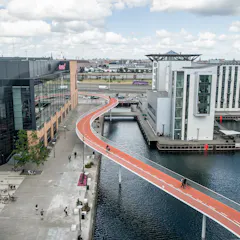
New analysis reveals just how little is spent on cycling and walking projects around Australia. No state’s spending on cycling is more than 1.5% of its road funding.
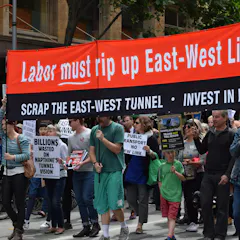
Transport infrastructure has such an impact on what kind of city we become that more democratic planning is long overdue. But public consultation is typically limited and focused on design issues.

The population growth is in the west, but most of the jobs are still in the city centre. Three major development proposals could help reshape Melbourne in ways that help overcome this costly mismatch.
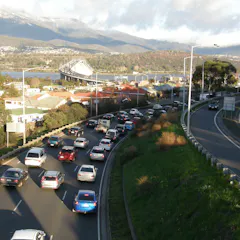
Hobart is a smaller city with big city problems that have become an election issue. Recent growth is creating traffic congestion that affects productivity, residents’ health and liveability.

Self-driving, shared, electric vehicles and increasing urban density represent four disruptions that will transform city life. But a transport utopia isn’t a guaranteed outcome of their interactions.

One potential benefit of WestConnex, which remains untouched, is that it could relieve Sydney’s city centre from cars and make it more pedestrian-friendly.
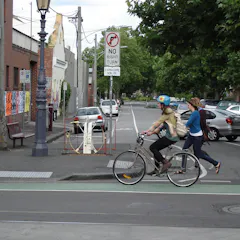
A comparison of Australian cities reveals cyclists and walkers are still very much a minority of commuters, despite the economic, health and environmental costs. Action on three fronts is needed.
The real challenge is finding appropriate ways to invest in public transport that will not only take pressure off the system but also support improved travel on all modes, including cars.
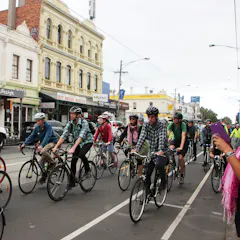
If the strategies we put in place to make cycling safer were taken up in earnest the result would often be chaos.

Australian cities generally don’t allow pet dogs on public transport. Instead, owners need their own vehicle to travel with their dogs, and it’s a surprisingly important factor in our car dependency.

Australians can see the impact of dockless bike sharing on the streets of their cities. The huge store of data collected about user journeys is less visible, but just as important.
The government claims figures showing the south gets more than the north are misleading.
Top contributors
-

Transport and Cities Program Director, Grattan Institute
-
Honorary Professor of Planning, The University of Queensland
-
Associate Professor in Urban Planning, The University of Queensland
-
Associate Professor of Urban Planning, The University of Melbourne
-
Senior Lecturer in Urbanism, University of Sydney
-
Professor of Human Geography, The University of Queensland
-
Professor and Director, Institute of Transport and Logistics Studies, University of Sydney
-
Professor of Transport Technology and Sustainability, Swinburne University of Technology
-
Professor of Sustainability, Curtin University
-
Professor of Urban Policy and Director, Urban Futures Enabling Impact Platform, RMIT University
-
Associate, Grattan Institute
-
Honorary Principal Fellow, University of Wollongong
-
Adjunct Professor, School of Engineering and Built Environment, Griffith University
-
Senior Research Fellow, School of Global, Urban and Social Studies, RMIT University
-
Postdoctoral Research Associate, Faculty of Architecture, Building and Planning, University of Sydney