
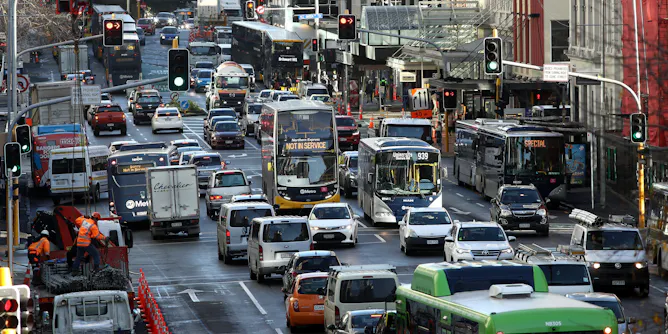
Auckland has settled on how congestion charging could work. But overseas experience shows the alternatives to driving are just as important.
Articles on Traffic congestion
Displaying 1 - 20 of 73 articles
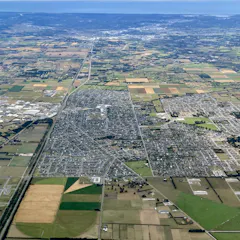
Rolleston near Christchurch is rapidly expanding, with more fast-tracked development coming. It’s a far cry from the ‘town of the future’ planned in the 1970s.
Mathematics is helping us move away from reacting to congestion, towards preventing it.
What if Canada could see the impact of wildfires, floods and traffic congestion before they happen?
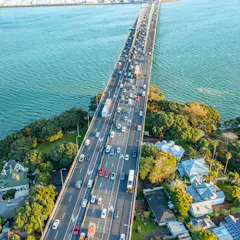
By charging all road users, the shift away from a petrol tax could help fund safer roads and lower pollution. NZ should embrace the opportunity to be innovative.
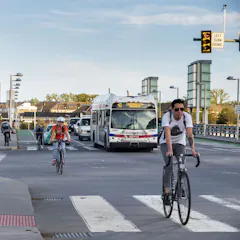
Philadelphia implemented new policies this year to better protect pedestrians and cyclists, but the city has a long way to go to reach its Vision Zero commitment of zero traffic deaths by 2030.

The term stroad is portmanteau of street and road. Stroads try to be both a thoroughfare for vehicles, and a place for people. Typically they fail at both, and the result is unpleasant for everyone.
Mass adoption of e-bikes in Australia requires better infrastructure, new government regulation and price incentives. But you can still enjoy the benefits now.

Support for road-user charging strengthens when people are assured that revenue goes into reducing traffic congestion, maintaining transport infrastructure, improving public transport.
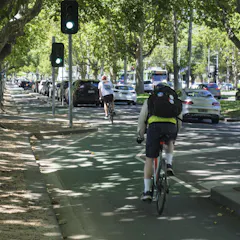
Early in the pandemic, when there was much less traffic on the roads, people took to their bikes. But since then, fewer people are cycling, with rates now lower than in 2011.
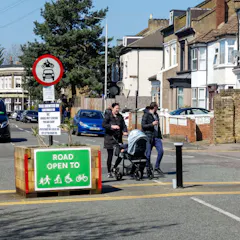
LTNs were introduced to UK cities to create a more pleasant environment for pedestrians and cyclists - but they’ve become controversial.
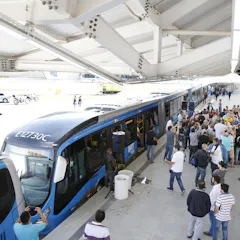
Bus rapid transit is more than a way to get thousands of people to the game. Used in cities globally as an alternative to light rail, it can be a cost-effective way to transform cities for the better.
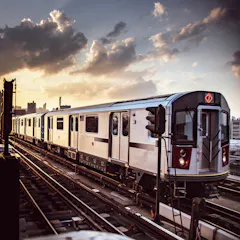
Public buses, subways and trains are relatively safe, fast and cheap. But competition from rideshares and concerns over COVID-19 will soon see some local agencies short of funds.
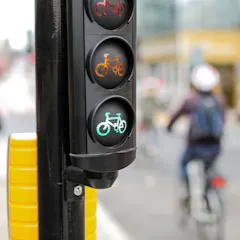
London was rated 2021’s most congested city.
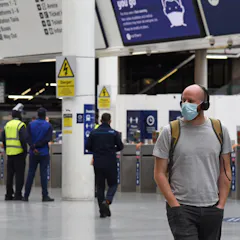
Until train use recovers, a new approach to rail funding is needed.

Apps are telling us how to get around our cities faster. But if each person acts only in their own interest, society at large gets stuck in traffic.

Cyclists in Melbourne are less likely than those in Dublin or Seville to ride in the rain. Understanding why is crucial.
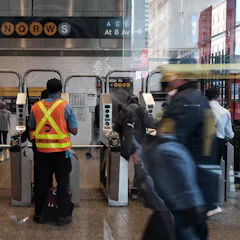
Transit agencies could use the money to buy new subway cars, buses and maintain rails. The funding is designed to build on last year’s emergency aid, which kept transit operating through the pandemic.
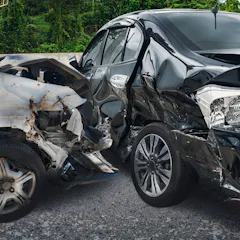
The inability to curb road accidents in Ghana is tied to colonial and neocolonial legacies.
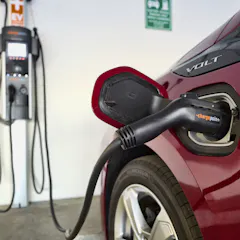
The benefits of road-user charging are now well established. And including electric vehicles doesn’t have to be a deterrent to their uptake, as New Zealand and other nations have shown.
Top contributors
-

Transport and Cities Program Director, Grattan Institute
-
Professor of Transport Technology and Sustainability, Swinburne University of Technology
-
Transport Fellow, Grattan Institute
-
Associate Professor in Infrastructure Management, University of Sydney
-
Associate Professor in Urban Planning, The University of Queensland
-
Professor of Human Geography, University of Canterbury
-
Honorary Senior Fellow in Transport Planning, The University of Melbourne
-
Professor of Sustainability, Curtin University
-
Professor of Human Geography and Planning, University of Tasmania
-
Research Fellow, University of Sydney
-
Associate professor in Economics, The University of Melbourne
-
Research Director, University of Technology Sydney
-
Assistant Professor, National Yang Ming Chiao Tung University, Taiwan, Griffith University
-
Research assistant, The University of Melbourne
-
Research Principal, Institute for Sustainable Futures, University of Technology Sydney