
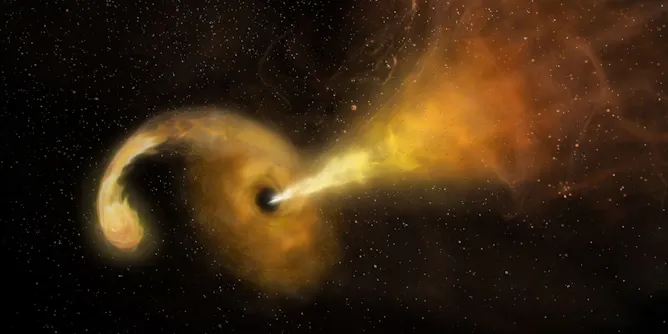
A team of astronomers captured the moment when a wayward star was pulled into the mouth of a supermassive black hole.
Articles on Supernovas
Displaying 41 - 50 of 50 articles
If we survive for another 7.59 billion years, our planet will spiral into the outer layers of the dying sun and melt away forever.
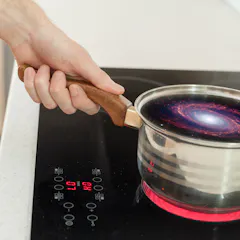
From supernovae explosions to the expansion of the universe and why the sky is blue: you can learn a lot about the universe in the kitchen.

Stargazing seems such a quiet, calm activity. But whether our eyes can see or not, those stars out there are in constant flux. Time-domain astronomy studies how cosmic objects change with time.
Extragalactic astrophysicists want to know how and why galaxies stop forming stars, change their shape and fade away. With help from citizen scientists, they’re figuring it out.
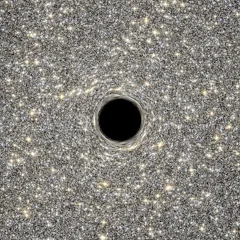
CC BY-ND45.4 MB (download)
Tanya Hill speaks with Meg Urry about distant galaxies and the supermassive black holes that lurk in their centres.
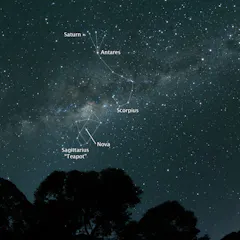
A new light in the southern night sky is thought to be an exploding star. It comes as astronomers reveal an ancient nova explosion is now thought to have been two stars colliding.
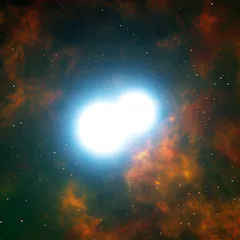
Two white dwarfs found orbiting each other at the centre of a planetary nebula are now known to have enough mass that they will eventually trigger a special kind of supernova, according to research published…
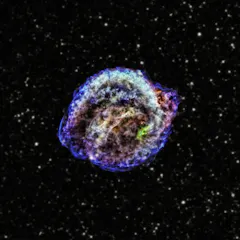
Our understanding of heavy element production in supernovae, exploding stars way beyond our solar system, may need to change following some discoveries we have made looking not to the skies, but deep under…
Research of a supernova in our galaxy will increase the precision of which we can measure distances outside of our own galaxy…
Top contributors
-

Senior Curator (Astronomy), Museums Victoria Research Institute; The University of Melbourne
-
Lecturer in Astronomy, Nottingham Trent University
-
Professor of Astrophysics, University of Manchester
-
Honorary Lecturer, Nuclear Physics, Australian National University
-
CSIRO
-
PhD Candidate, University of Hertfordshire
-
Senior Research Scientist, UCL
-
Research scientist, CSIRO
-
Professor of Astronomy, Macquarie University
-
Dean of Science, University of California, Santa Cruz
-
Graduate student of Astronomy, California Institute of Technology
-
Postdoctoral Researcher in Astronomy, Stockholm University
-
Research scientist & Head of Science Operations and Support, e-MERLIN/VLBI National Radio Astronomy Facility, Jodrell Bank Centre for Astrophysics, University of Manchester
-
Astrophysicist/Cosmologist, Australian National University
-
Associate Professor, Department of Earth Sciences, Carleton University