
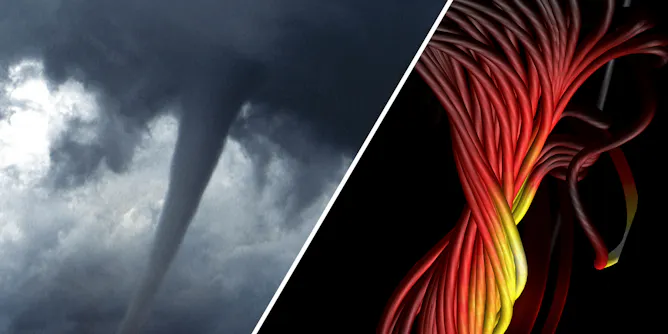
Unprecedented simulations show the formation of space tornadoes capable of causing strong geomagnetic storms around Earth, calling for earlier and more accurate warnings.
Articles on Sun
Displaying 21 - 40 of 200 articles
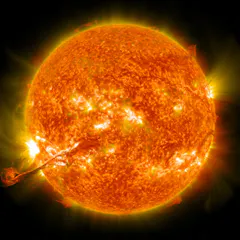
Space weather isn’t referring to rain clouds that float through the galaxy. Instead, it’s caused by massive explosions of particles that shoot out from the Sun.
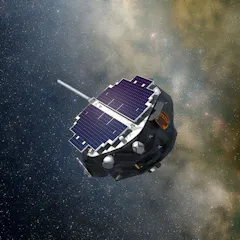
Studying the Sun helps researchers understand how space weather can affect technology back on Earth.

Would you guess that the Earth is spinning at 1,000 mph around its axis and at the same time hurtling through space on its orbit around the Sun at 67,000 mph? Here’s why you don’t feel all that motion.
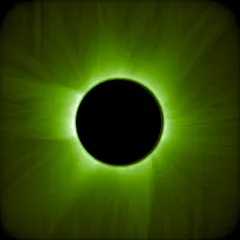
This solar eclipse was created by 2 satellites flying in formation, allowing astronomers to photograph the Sun’s corona.
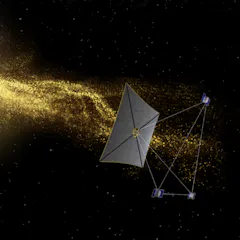
As more satellites are launched into orbit, space agencies are looking at how to predict space weather events that could harm them.

An astrophysicist who spent time doing research at the South Pole gets to the bottom of how things feel at the ends of the Earth.
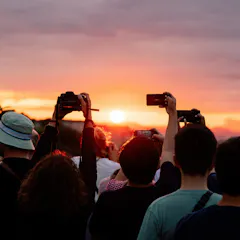
At certain times of year, sunsets seem to hit differently. It’s not just your imagination – it’s science.

A big freckle or a sunspot? A flat mole or a dark freckle? Here’s how to tell the difference between the three – and when to get a spot checked for skin cancer.
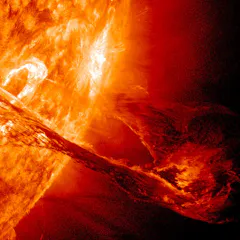
While geomagnetic storms can lead to gorgeous aurora displays, they can also damage satellites and GPS.
Humans evolved late in Earth history. While this timing inspired the conclusion that humanlike life is a cosmic improbability, a new study pushes back.
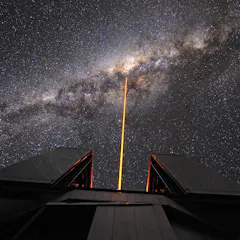
The discovery helps explain a long-running cosmic mystery about why some stars hurtle through space much faster than others.

The sun’s magnetic activity causes auroras, and the relationship between solar flares and auroras reveals an 11-year cycle; we’re experiencing a particularly busy one right now.
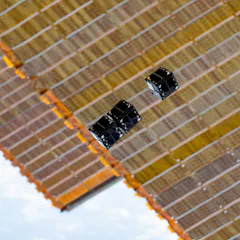
The Sun’s activity is what gives us beautiful auroras – but it also has dramatic negative effects on satellites that go around Earth in a low orbit.
Many peoples throughout history used the warmth of the Sun to heal. Others used lamps or light split into different colours, which we still use today.
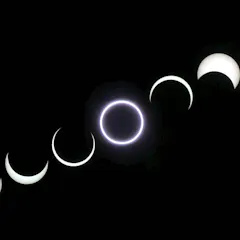
Argentina and Chile will see the ‘ring’, but other regions will see a partial eclipse.
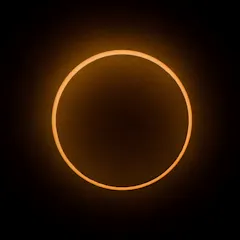
Parts of South America, the Pacific and Antarctica are under the path of an annular eclipse.
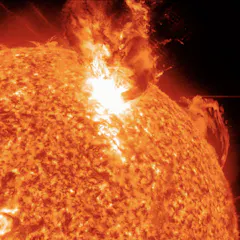
Extreme solar storms could play havoc with technological infrastructure.
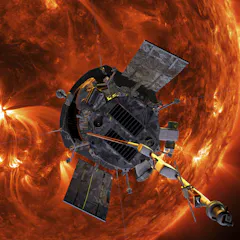
For years, researchers have wondered what energy source allows the solar wind − a projection of charged particles from the Sun − to rush by at hundreds of miles a second.
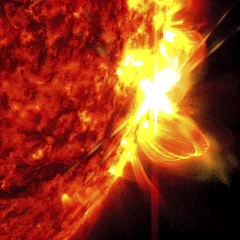
The Sun will be at its most explosive right around the time NASA plans to put people back on the Moon.
Top contributors
-

Senior Curator (Astronomy), Museums Victoria Research Institute; The University of Melbourne
-
Senior Lecturer in Physics, Nottingham Trent University
-
Associate Professor, RMIT University
-
Director of the Abrams Planetarium, Michigan State University
-
Teaching Professor of Astronomy & Astrophysics, Penn State
-
Reader in Physical Sciences, Aberystwyth University
-
Postdoctoral research associate, University of Oxford
-
Professor of Astronomy, Mathematics, and Physics, Athabasca University
-
Researcher in Astrophysics, Smithsonian Institution
-
Professor (Astrophysics), University of Southern Queensland
-
Professor of Physics and Astronomy, USC Dornsife College of Letters, Arts and Sciences
-
Professor (Physics), University of Southern Queensland
-
University Distinguished Professor of Astronomy, University of Arizona
-
Professor of Physics, UCL
-
Chief Specialist Scientist (Public Health), South African Medical Research Council