
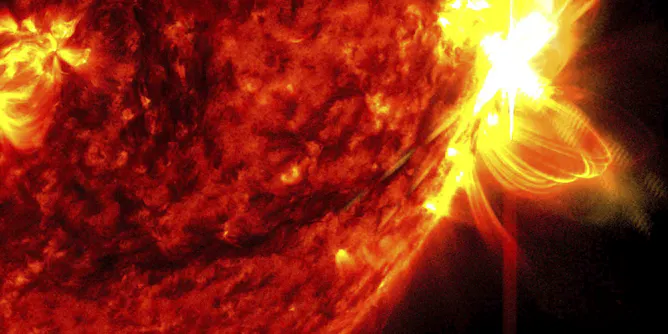
A massive solar flare could seriously disrupt life on Earth – but new NASA missions and others in development will help monitor the Sun.
Articles on Solar flare
Displaying 1 - 20 of 41 articles
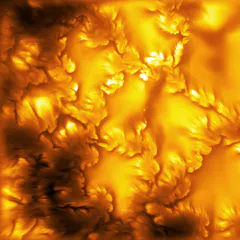
The closer you zoom in, the more fascinating it is.
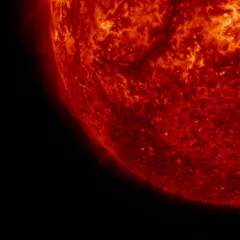
The Sun is a complex physical body. It generates incredible amounts of heat and a strong, often tangled, magnetic field.
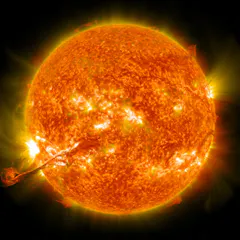
Space weather isn’t referring to rain clouds that float through the galaxy. Instead, it’s caused by massive explosions of particles that shoot out from the Sun.
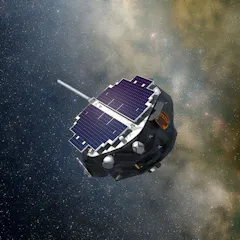
Studying the Sun helps researchers understand how space weather can affect technology back on Earth.
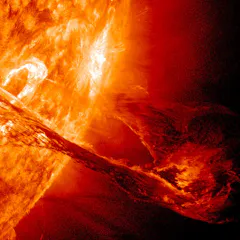
While geomagnetic storms can lead to gorgeous aurora displays, they can also damage satellites and GPS.
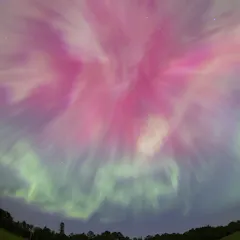
Geomagnetic storms occur fairly often. Minor ones happen multiple times per year.

Every few thousand years, the Sun unleashes a burst of high-energy particles that can have serious consequences for life on Earth.
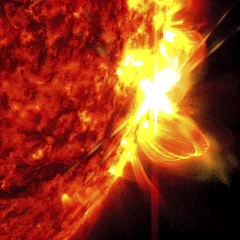
The Sun will be at its most explosive right around the time NASA plans to put people back on the Moon.
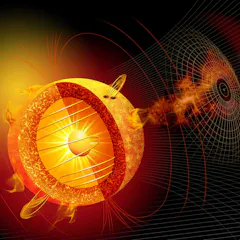
Solar storms can play havoc with electrical grids, satellites and railway lines.
Measuring the ages of planets and stars is tricky. An observational astrophysicist describes the subtle clues that provide good estimates for how old different space objects are.
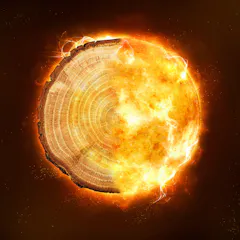
Half a dozen times in the past 10,000 years, enigmatic ‘Miyake events’ have showered Earth with cosmic rays.
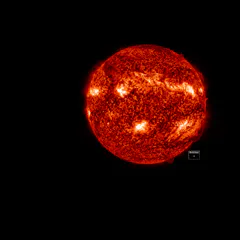
NASA, NOAA and SpaceWeather say a coronal mass ejection will reach Earth this week. It has the potential to knock out communications in some parts of the world.

Every few centuries the Sun blasts the Earth with a huge amount of high-energy particles. If it were to happen today, it would wreak havoc on technology.
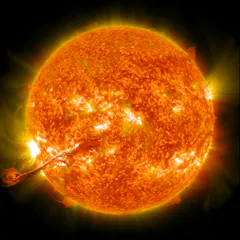
Space weather can affect satellites in a number of different ways, from frying electronics to increasing drag in the atmosphere.

It has only been in the past century that weather prediction on Earth has advanced enough to work two weeks in advance. Predicting space weather, however, is only reliable an hour in advance.

Astronomers just measured the largest flare ever from Proxima Centauri, humanity’s closest neighboring star. These flares could be bad news for life trying to develop on a planet orbiting the star.
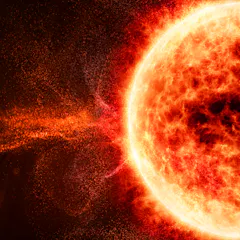
Satellites, space stations and astronauts, aviation, GPS, power grids and more can be affected.
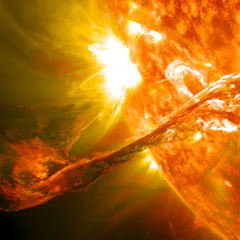
Has the Sun entered a stage of old age?
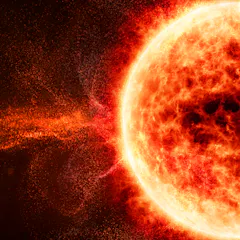
The sun’s phenomena, like flares, can cause solar particles to enter the Earth’s atmosphere, with material effects.
Top contributors
-

Associate Professor, RMIT University
-
Researcher in Astrophysics, Smithsonian Institution
-
Astrophysicist, Smithsonian Astrophysical Observatory, Smithsonian Institution
-
Assistant Research Scientist in Climate and Space Sciences and Engineering, University of Michigan
-
Research Scientist, Laboratory for Atmospheric and Space Physics, University of Colorado Boulder
-
Researcher in Astrophysics, Smithsonian Institution
-
Associate Professor of Space Systems, West Virginia University
-
Professor of Solar Physics, Monash University
-
Research professor, University of Colorado Boulder
-
John Curtin Distinguished Professor (Radio Astronomy), Curtin University
-
Senior Curator (Astronomy), Museums Victoria Research Institute; The University of Melbourne
-
Senior Lecturer (Astronomy), University of Southern Queensland
-
Professor, Department of Computer Science, University of Surrey
-
Research Officer, RMIT University
-
UKRI Future Leader Fellow & Associate Professor, Northumbria University, Newcastle