
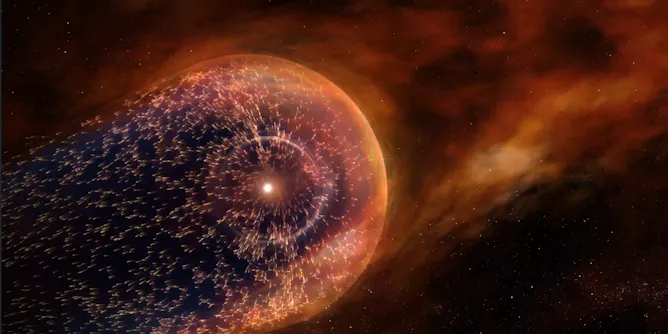
An interstellar probe could help scientists answer fundamental questions about how the Sun influences Earth, space and other planets in the solar system.
Articles on Sun
Displaying 41 - 60 of 200 articles
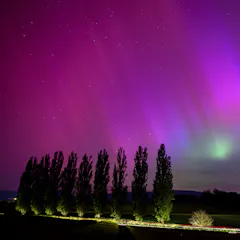
Here’s what’s going on to cause more widespread northern and southern lights.
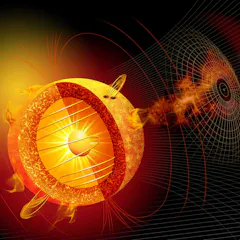
Solar storms can play havoc with electrical grids, satellites and railway lines.
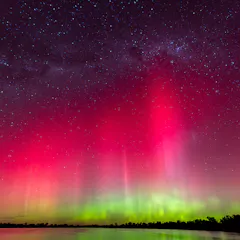
Australians were in for a Mother’s Day treat as auroras swept the skies. But there was little warning, and the spectacle didn’t repeat.
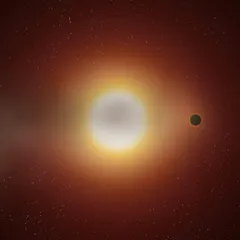
Research on one exoplanet that’s rapidly losing its atmosphere is hinting to scientists why exoplanets tend to look a certain way.
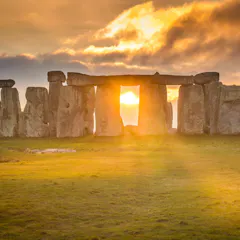
The monument’s ancient connection to the skies may run even deeper than we realised.

Where specialized algorithms fail to classify star-borne pulses, human volunteers with just a little training can step in.
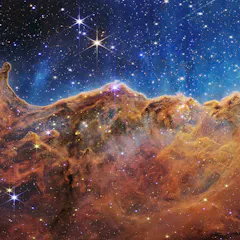
Analysis of fragments of the first solids that emerged out of the birth of the sun date our supernova as being 4.6 billion years old.
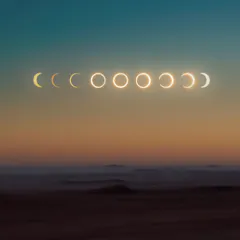
Eclipses have long fascinated and intrigued people, and anticipation of the total solar eclipse on April 8 is no exception. The beauty, history, mythology and science of eclipses justify the hype.
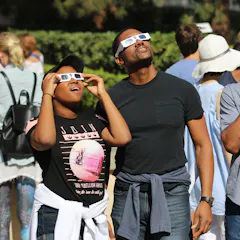
A total solar eclipse is a beautiful phenomenon worth seeing, but worth seeing safely.
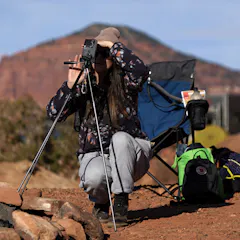
Your phone can’t take a perfectly clear picture of a solar eclipse like a professional camera can, but there are lots of other creative directions you can take to capture the rare moment.

Some ancient texts record what were likely dying stars, faintly visible from Earth. If close enough, these events can disturb telescopes and even damage the ozone layer.
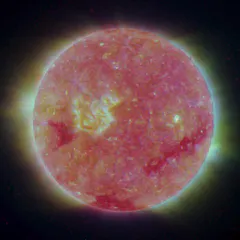
The solar corona can be seen during the solar eclipse on April 8. Astronomers are still trying to figure out the mysteries of the corona, including why it’s so hot.
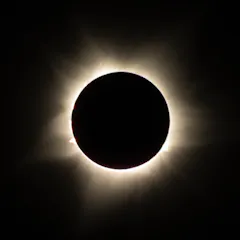
The eclipse will allow scientists to get rare measurements of the Sun’s atmosphere.
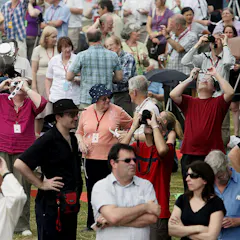
Apart from technical aspects, a successful photograph of the eclipse serves as a lasting reminder of the sense of wonder and the feeling of being part of something larger than ourselves.
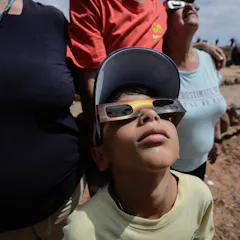
If you have young kids, the solar eclipse on April 8, 2024, represents a rare opportunity to teach them about science.

Eclipses are rare, fantastic celestial events. Here’s how educators can help visually impaired students enjoy eclipses alongside their sighted peers.
Eclipses have inspired myths, predictions and scientific discoveries. The total solar eclipse occurring on April 8 provides a once-in-a-lifetime opportunity to engage with science and the cosmos.
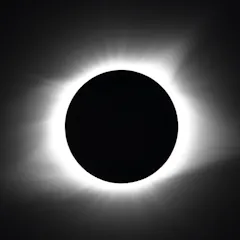
Many people will see a dazzling eclipse this April, but these events are possible only because of the sizes and precise distances between Earth, the Moon and the Sun.
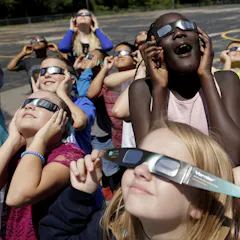
Now’s the time to get your hands on a pair of eclipse glasses in preparation for April’s display of celestial wonder.
Top contributors
-

Senior Curator (Astronomy), Museums Victoria Research Institute; The University of Melbourne
-
Senior Lecturer in Physics, Nottingham Trent University
-
Associate Professor, RMIT University
-
Director of the Abrams Planetarium, Michigan State University
-
Teaching Professor of Astronomy & Astrophysics, Penn State
-
Reader in Physical Sciences, Aberystwyth University
-
Postdoctoral research associate, University of Oxford
-
Professor of Astronomy, Mathematics, and Physics, Athabasca University
-
Researcher in Astrophysics, Smithsonian Institution
-
Professor (Astrophysics), University of Southern Queensland
-
Professor of Physics and Astronomy, USC Dornsife College of Letters, Arts and Sciences
-
Professor (Physics), University of Southern Queensland
-
University Distinguished Professor of Astronomy, University of Arizona
-
Professor of Physics, UCL
-
Chief Specialist Scientist (Public Health), South African Medical Research Council