
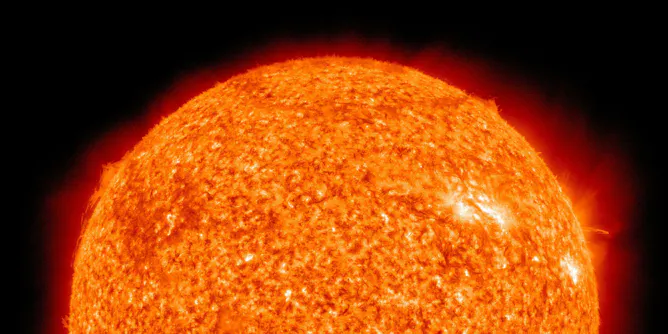
Yes, the Sun absolutely spins. In fact, everything in the universe spins. Some things spin faster than the Sun, some are slower and some things spin ‘backwards’.
Articles on Solar system
Displaying 161 - 180 of 290 articles

The new era of space exploration is characterized by an emphasis on diversity and international cooperation. But there’s a lot of work to do before there’s gender equality in STEM fields and at NASA.
When you look at the squiggly lines on Joy Division’s famous album cover, you’re seeing a record of lightning in outer space.
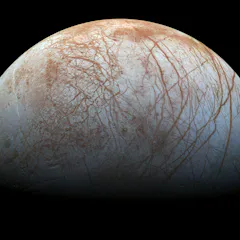
Whether anything could live in Europa’s subsurface ocean depends on what kind of salt it contains. Now scientists have found out.

The dwarf planet Pluto is heading away from the Sun and that’s having a devastating impact on its atmosphere.
Exoplanet discovery can help us work out how the Earth will end its days.

There’s a mysterious lack of small bodies beyond Neptune, but a ‘snowman-shaped’ object may help explain why.
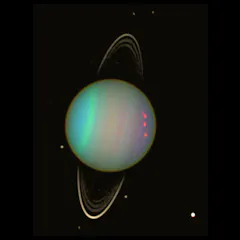
A body at least twice as massive as the Earth smashing into Uranus could have made it lopsided, shows research.
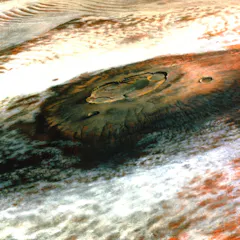
Naming features on other worlds is a trickier issue than you might think.
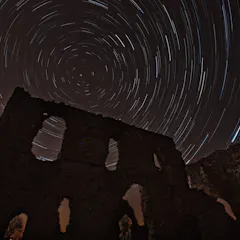
When you look up at the vastness of space you can see hundreds, thousands and even millions of years into the past.
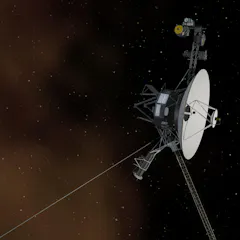
Voyager 2 launched in 1977 and visited all four gas giants in our Solar System. It’s now almost 18 billion kilometres from Earth and has finally joined its twin in interstellar space.
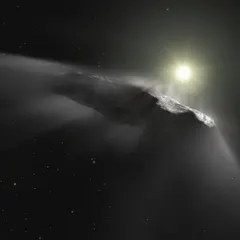
We will never see ‘Oumuamua again, and we may never know exactly what it is. But with the right kind of media coverage it could inspire some kids to take up a career in science.

Whether you call it Planet X or Planet Nine, talk of another planet lurking in our Solar system won’t go away. So what does the discovery of a new object – nicknamed “The Goblin” – add to the debate?
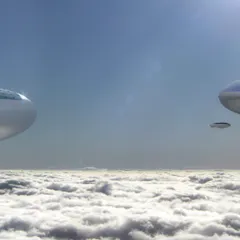
The upper atmosphere of Venus is the most Earth-like extra-terrestrial location in the solar system. It could even host life.
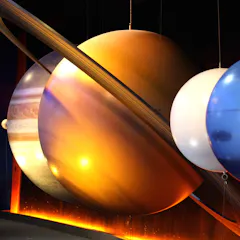
The five planets visible to the naked eye since ancient times are putting on a dazzling display this month, in a night-sky dance along with the Moon.
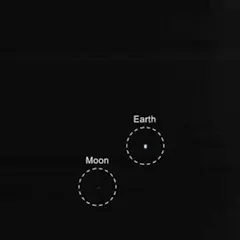
Space mining has the potential to provide a greater supply of resources either for being exploited locally for construction or being sent back to earth.
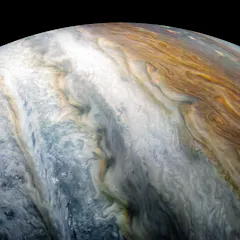
Jupiter’s bands are one of its most striking features – and can be seen from Earth – but they only go so deep within the giant planet. Now scientists think they know why.
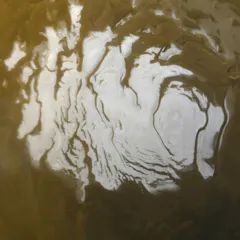
Researchers have found evidence of a large lake of salty water, buried 1.5 kilometres beneath the southern polar ice cap on Mars. So what does that mean for life on the red planet?
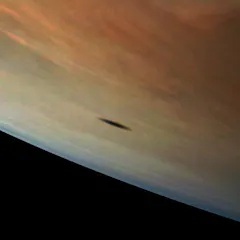
Jupiter now has at least 79 moons, the most for any known planet. But where did these newly discovered moons come from?
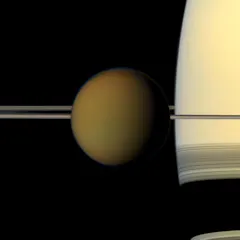
Titan is more than a billion kilometres from our Sun but occasionally it’s shadow can be seen here on Earth, with the right technology. That’s what scientists gathered in Western Australia to observe.
Top contributors
-

Professor (Astrophysics), University of Southern Queensland
-
Professor of Planetary Geosciences, The Open University
-
Senior Curator (Astronomy), Museums Victoria Research Institute; The University of Melbourne
-
Associate Professor in Archaeology and Space Studies, Flinders University
-
Professor of Planetary and Space Sciences, The Open University
-
Associate Professor in Astronomy, Monash University
-
Program Manager / Adjunct Research Fellow, Swinburne University of Technology
-
Postdoctoral Researcher in Radio Astronomy, University of Sydney
-
Postdoctoral research associate, University of Oxford
-
Scientist, Max Planck Institute for Solar System Research
-
Senior Instrument Scientist, Australian Nuclear Science and Technology Organisation
-
Lecturer, School of Science, Computing and Engineering Technologies, Swinburne University of Technology
-
Associate Dean of Innovation and Engagement, Swinburne University of Technology
-
PhD Candidate, University of Southern Queensland
-
Research Associate, Curtin University