
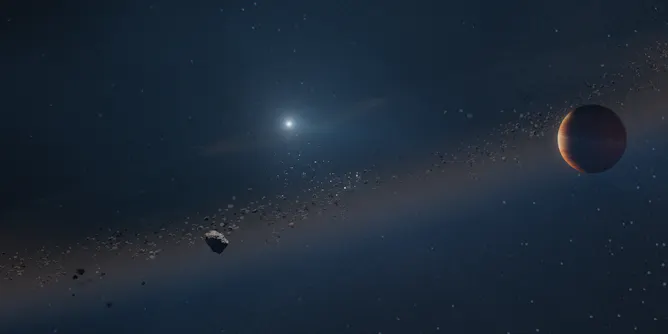
In 5 billion years the Sun will collapse. A new discovery suggest some planets may still survive afterwards.
Articles on Solar system
Displaying 121 - 140 of 290 articles

What did Mercury look like as BepiColombo swung by?
Gravity, mass and centrifugal force all contribute to the final shape of a planet.
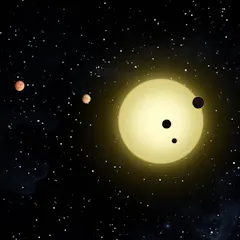
By studying the chemical makeup of binary stars, astronomers found many planetary systems are far less peaceful than ours.

From the tallest cliff in the solar system to its largest impact basin, geological processes on other worlds are very similar to those on our own planet.
Mars, Venus and the crescent Moon will all come together in the sky just after sunset on Tuesday.
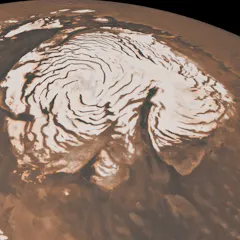
New results show why and how water is disappearing from Mars atmosphere.
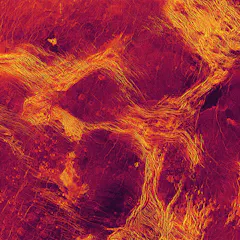
Researchers used decades-old radar data and found that some low-lying areas of Venus’ crust are moving and jostling. This evidence is some of the strongest yet of tectonic activity on Venus.
Astronomers know a lot about what’s in outer space – and think it’s possible it never ends.
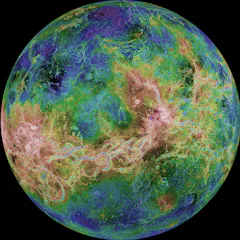
Two new NASA missions – VERITAS and DAVINCI+ – are headed to Venus. The missions will use radar and a probe to learn about Earth’s hard-to-study and potentially prophetic neighbor.
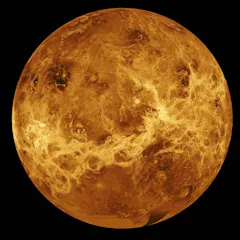
Nasa’s sending its first missions to Earth’s twin since 1990.
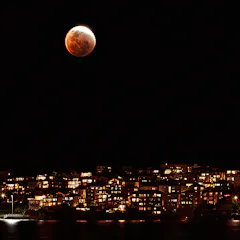
This Wednesday night, everywhere in Australia will have a box seat for a spectacular total eclipse of the Moon.
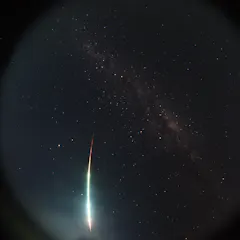
You might think lots of meteorites ultimately come from comets. Turns out, you’d be wrong, according to a new study that tracked meteors hurtling through the sky to find out where they came from.

A minuscule particle of asteroid dust has helped reveal how celestial rocks like Earth might have sprouted life.
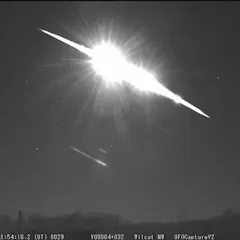
It looks like a broken barbeque brickette, but the newfound meteorite is a capsule of the Solar System’s history that could reveal the secrets of the origin of life.
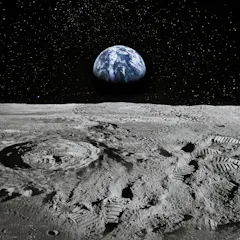
Send us your questions – and join us live to hear about the solar system.
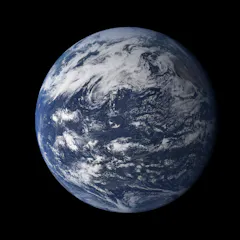
A recent study shows that the Earth’s water could come directly from the oxygen and hydrogen present in the rocks that formed it, and not from a late supply by asteroids.
It’s all to do with the light from the Sun and a blanket of air wrapped around Earth called the ‘atmosphere’.

From the birth of Jesus Christ to Newton’s discovery of gravity, great conjunctions of Jupiter and Saturn have many notable connections in human history.
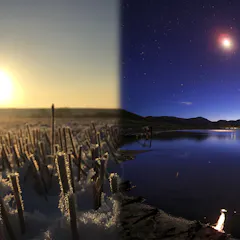
The 2020 winter solstice is also when Saturn and Jupiter appear closest to each other for 60 years, Here’s what you need to know about both the events.
Top contributors
-

Professor (Astrophysics), University of Southern Queensland
-
Professor of Planetary Geosciences, The Open University
-
Senior Curator (Astronomy), Museums Victoria Research Institute; The University of Melbourne
-
Associate Professor in Archaeology and Space Studies, Flinders University
-
Professor of Planetary and Space Sciences, The Open University
-
Associate Professor in Astronomy, Monash University
-
Program Manager / Adjunct Research Fellow, Swinburne University of Technology
-
Postdoctoral Researcher in Radio Astronomy, University of Sydney
-
Postdoctoral research associate, University of Oxford
-
Scientist, Max Planck Institute for Solar System Research
-
Senior Instrument Scientist, Australian Nuclear Science and Technology Organisation
-
Lecturer, School of Science, Computing and Engineering Technologies, Swinburne University of Technology
-
Associate Dean of Innovation and Engagement, Swinburne University of Technology
-
PhD Candidate, University of Southern Queensland
-
Research Associate, Curtin University