
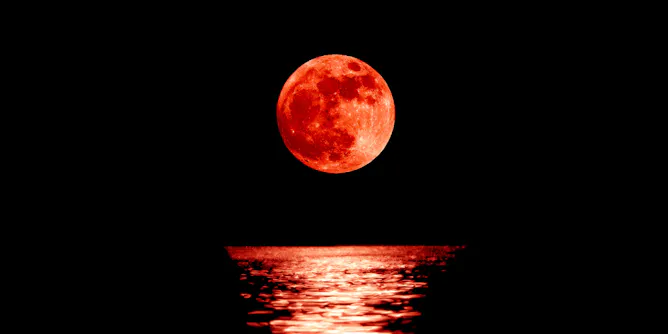
A rare super blood moon visible from parts of the Earth this month will delight those people lucky enough to see it. But why has this marvel of the solar system got some people so worried?
Articles on Solar system
Displaying 241 - 260 of 290 articles
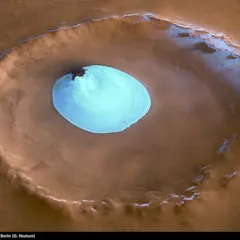
Ice is everywhere in the solar system and there may even be liquid water beneath the surface of a number of planets. But could we ever get to it?
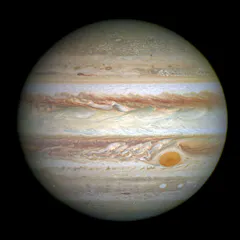
How a bunch of pebbles could have created Jupiter, Saturn, Neptune and Uranus.
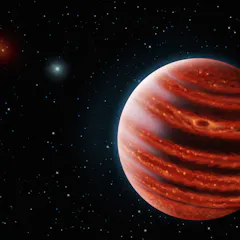
Studying the young, Jupiter-sized planet 51 Eridani b opens a window into our solar system’s past.
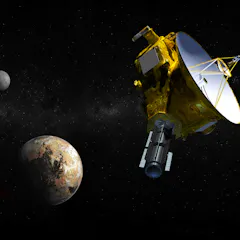
In the long lead-up to our ultimate flyby of Pluto, space science has reconfigured our notions of what it means to be a solar system, a planet, a world.
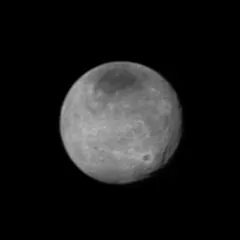
What can the data from New Horizons tell us about the dwarf planet’s five moons?
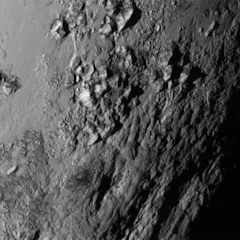
Lack of impact craters intrigues space experts who say it suggests the dwarf planet may be geologically active.
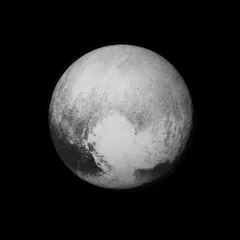
Now the flypast of Pluto is over the space probe New Horizons will begin sending the data back to Earth. It will take many months but what will it reveal about the dwarf planet?

Exactly half a century ago the US Mariner 4 made the first flyby of Mars. But why are we still doing flybys today?

NASA’s New Horizons spacecraft is nearly two decades old. Is that a problem?

The New Horizons spacecraft is only hours away from its closest approach to Pluto. It’s hoped the brief encounter will help answer many questions about the oddball member of our solar system.
Some atomic ratio detective work on our solar system neighbors tells us a lot about their watery pasts. That Venus and Mars are mostly dry now could be a cautionary tale for us on the Blue Planet.
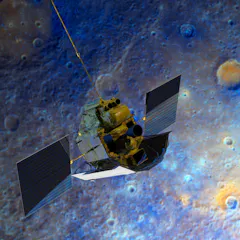
It was the first probe to find water on Mercury, the planet closest to the sun. Its mission nearly over, MESSENGER is about to crash into the planet it’s been observing.

Who gets to name the craters and features on our planets was once an ad hoc affair. But now the public can have a say with just days left to vote.
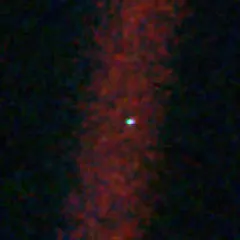
From a big blue marble to a tiny dot in space – reflections on our images of Earth.
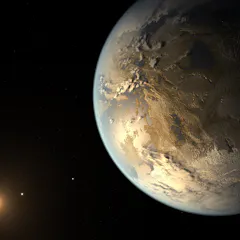
One to three planets in habitable zones around stars in our galaxy could sustain life.
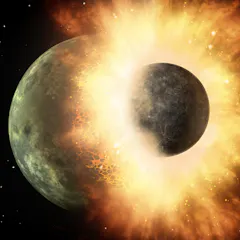
New experiments show that the asteroids that slammed into Earth and the moon more than 4 billion years ago were vaporised into a mist of iron. The findings, published in Nature Geoscience, suggest that…
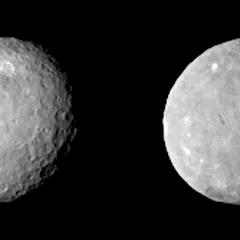
With increasing knowledge and familiarity, we’ll no longer be able to identify meaningful criteria to keep these good planets down.

It’s the satellite you probably didn’t know that Earth has. If we could land on it, it could be pretty useful
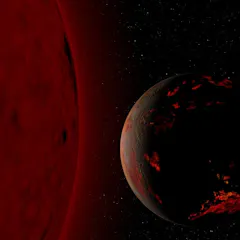
In a few billion years, the sun will become a red giant so large that it will engulf our planet. But the Earth will become uninhabitable much sooner than that. After about a billion years the sun will…
Top contributors
-

Professor (Astrophysics), University of Southern Queensland
-
Professor of Planetary Geosciences, The Open University
-
Senior Curator (Astronomy), Museums Victoria Research Institute; The University of Melbourne
-
Associate Professor in Archaeology and Space Studies, Flinders University
-
Professor of Planetary and Space Sciences, The Open University
-
Associate Professor in Astronomy, Monash University
-
Program Manager / Adjunct Research Fellow, Swinburne University of Technology
-
Postdoctoral Researcher in Radio Astronomy, University of Sydney
-
Postdoctoral research associate, University of Oxford
-
Scientist, Max Planck Institute for Solar System Research
-
Senior Instrument Scientist, Australian Nuclear Science and Technology Organisation
-
Lecturer, School of Science, Computing and Engineering Technologies, Swinburne University of Technology
-
Associate Dean of Innovation and Engagement, Swinburne University of Technology
-
PhD Candidate, University of Southern Queensland
-
Research Associate, Curtin University