
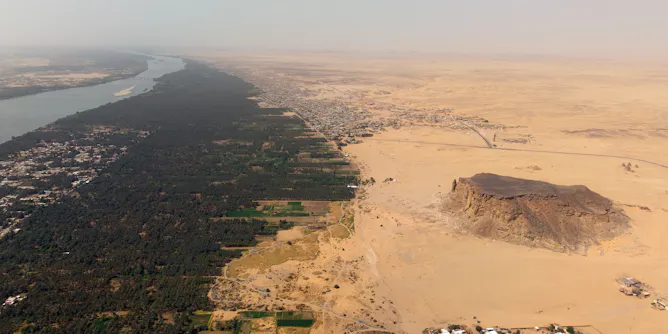
The ancient Kush city of Jebel Barkal rose up in the Nile River Valley starting around 2000 BCE. New research dug deep to learn more about what this landscape was like over the past 4,000 years.
Articles on Sediment cores
Displaying all articles
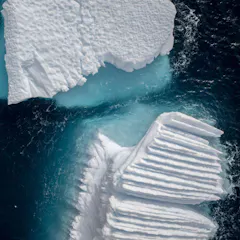
Sediments in a lagoon near Darwin hold traces of changes to monsoonal rains over 150,000 years. Here’s what it means as Earth’s polar ice melts.

Palaeontologist don’t just dig up dinosaur bones – they study the whole history of life on Earth, and uncover clues about its future too.
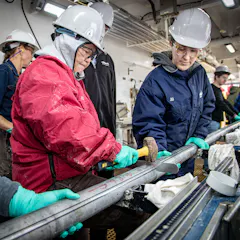
A newly discovered half-million-year-old layer of volcanic sediment beneath the Aegean Sea rewrites what scientists know about this area’s volcanic history – and potential future hazards.
Long before thermometers, nature left its own temperature records. A climate scientist explains how ongoing global warming compares with ancient temperatures.
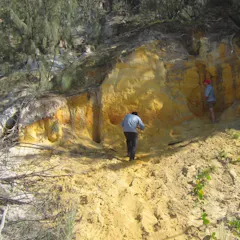
Until now, a limitation of records of past fires is that these have come from sediments laid down in lakes and bogs. Records for dryland regions have been lacking, but dune deposits can fill the gap.

A new environmental record for a prehistoric site in Kenya helped researchers figure out how external conditions influenced which of our ancient ancestors lived there, with what way of life.
The last time global carbon dioxide levels were around 400ppm was four million years ago. On average, the world was 3°C warmer, but in high northern latitudes, it was up to 14°C warmer than today.
Evidence shows Native Americans in New England lived lightly on the land for thousands of years. It wasn’t until Europeans arrived that the landscape experienced major human impacts.

Why did Earth’s climate rapidly cool 12,800 years ago? Evidence is mounting that a comet or asteroid collision is to blame, with new support coming from the bottom of a South Carolina lake.
Top contributors
-

Adjunct Professor, University of Queensland, and Professor and Head of School of Earth and Environment, University of Canterbury
-
Dean of the Harpur College of Arts and Sciences and Professor of Anthropology, Binghamton University, State University of New York
-
Associate Professor of Petrology and Planetary Geoscience, University of Tennessee
-
Director, Harvard Forest, Harvard University
-
Professor of Environmental Science, Emerson College
-
Postdoctoral Researcher, Idaho State University, Desert Research Institute
-
Director of the Human Origins Program, Smithsonian Institution
-
Professor of Earth and Environmental Sciences, Northern Arizona University
-
Lecturer in Environmental Geoscience, The University of Melbourne
-
Matthew Flinders Professor of Global Ecology and Node Leader in the ARC Centre of Excellence for Indigenous and Environmental Histories and Futures, Flinders University
-
Senior Research Fellow, ARC Centre of Excellence for Indigenous and Environmental Histories and Futures, and College of Science and Engineering, James Cook University
-
Michael Bird is a Friend of The Conversation.
JCU Distinguished Professor, ARC Centre of Excellence for Indigenous and Environmental Histories and Futures, James Cook University
-
Research Professor and Director of the Southeastern Paleoamerican Survey (SEPAS) at the South Carolina Institute for Archaeology and Anthropology, University of South Carolina
-
Research Scientist in Archaeology, University of Michigan