

While curriculum reform is relatively easy to announce, changing what happens in classrooms is much harder.
Articles on Secondary education
Displaying 1 - 20 of 193 articles

The numbers that show Indigenous students ‘behind’ their non-Indigenous peers are accurate. But they only tell part of the story.

Reading anxiety involves excessive worries and apprehensions about reading activities.
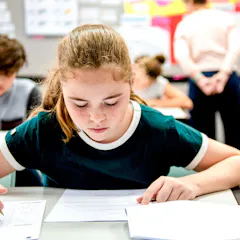
Are education systems succeeding in transforming individual abilities into collective opportunities? This is what rankings ought to be measuring rather than reducing education to a few figures.

Results from the latest international test of 15-year-olds has prompted headlines suggesting serious problems with Australia’s academic results.

A new study looks at how students’ capacity to handle adversity relates to their ability to manage changes at school.

Some might argue kids can just learn ethics from their parents. But new research shows formal ethics education can make a difference.

Some private schools have introduced behaviour contracts for parents. Meanwhile, some states let principals ban abusive parents from public school grounds.

A new study suggests ‘effective teaching’ in Year 9 may play an important role in supporting students to stay on and finish Year 12.

The current debate risks turning into a zero-sum choice between screens and pen and paper.

If this new development – designed to show if a text is AI-generated – sounds too good to be true, that’s because it is.

This gap was already a problem before the latest data. But the most recent results show how things are getting worse.

There is no comprehensive national data on how much time an Australian child spends on a device at school. The rules are just as patchy.

National NAPLAN results are released today, putting the spotlight on students’ numeracy and literacy skills.

This is the latest escalation in a dispute with the state government that has been running since mid-2025.

For some families, NAPLAN results will confirm what they already know. For others, they may contain surprises or raise concerns.

High school students can skip exams and do an ‘enabling program’ in years 11 and 12. This can qualify them for certain undergraduate degrees.

The research tells us there is no ‘magic screen time number’ to guarantee quality learning. It depends how the technology is used and for what.

When it comes to life after Year 12, the media and schools tend to focus on ATARs and university study.

Assessments are often treated as culturally neutral when they are not.
Top contributors
-

Associate Professor in Educational Leadership, Australian Catholic University
-
Scientia Professor and Professor of Educational Psychology, UNSW
-
Associate Professor of Education, Charles Sturt University
-
Postdoctoral Research Fellow, Centre for Inclusive Education, Queensland University of Technology
-
Senior Lecturer in Health and Physical Education, University of Tasmania
-
Professor and Director of the Centre for Inclusive Education, Queensland University of Technology
-
Lecturer in Mathematics Education, University of Sydney
-
Research Scientist, African Population and Health Research Center
-
Professor of Educational Psychology, University of Wollongong
-
Senior Research DECRA Fellow, Institute for Learning Sciences and Teacher Education, Australian Catholic University
-
Senior Lecturer in Education, Edith Cowan University
-
Lecturer (Curriculum & Pedagogy – Educational Psychology & Wellbeing)., University of Southern Queensland
-
Associate Professor of Education Policy, Australian Catholic University
-
Senior Lecturer in Education, University of New England
-
Associate Professor in Education, Deakin University