

South Africa’s White Paper doesn’t outline how science, innovation and technology can improve ordinary people’s lives.
Articles on Science policy
Displaying 41 - 60 of 85 articles
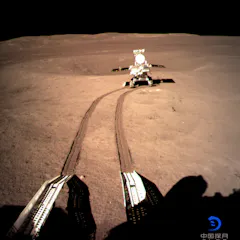
A pragmatic approach rather than active concealment is to blame for China’s lack of research transparency.

Plato suggested we leave complex things to experts and Aristotle suggested we leave them to the people. That tension has carried through to modern debates about where expertise belongs.
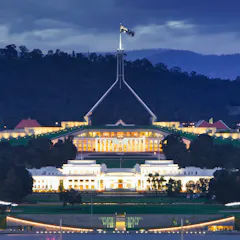
Starting February 14, the Science Meets Parliament event brings clear benefits - but there’s a case to be made for an ongoing effort in “Science Listens, Engages, and Collaborates with the Public.”
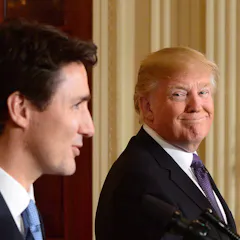
Canada must take the lead as a global champion of science as America under President Donald Trump presses its assault on fact and knowledge.

Most Australians value science. But we do have some hesitations about the pace of scientific advances, and we’re not sure if scientists are prestigious or not.
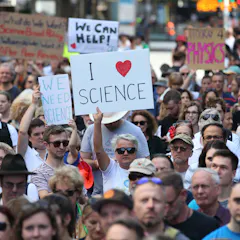
It’s not a new phenomenon that scientists who challenge the orthodoxy or policy positions suffer career ramifications.
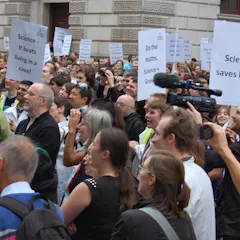
A march for science has become a divisive topic among scientists.

Some Australians feel they are missing out on the benefits of scientific and technological progress.
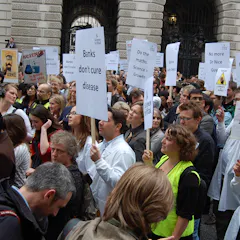
From mistrust in experts to fake news, it has never been more important for scientists to talk directly to the public.

R&D support is not the only way public policy can help create new industries.

The federal government released its National Science Statement today, reinforcing its commitment to science and innovation. But does it do enough?

Today is the start of Science Meets Parliament, which helps our nation’s leaders embrace the latest scientific evidence.

March for Science rallies will take place in cities around Australia on Saturday 22 April. A volunteer organiser explains why he and others are participating.

There is no guarantee that the UK can or will continue to be part of the €80 billion EU research funding programme Horizon2020.
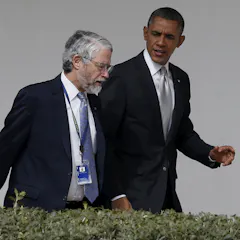
Innovation is a huge part of economic growth – and the White House needs to be well-informed on science and tech issues when setting goals and budgets. Here’s how presidents get up to speed.

The scientific community enjoys one of the highest levels of trust among American institutions. But engaging in the political arena during a contentious election season comes with dangers.
What’s in store for key policy areas, from health to education to infrastructure to asylum seekers, under a returned Coalition government?

When the GM crop debate is confined to the human risks, it limits who can participate in the decision making and privileges scientists.
Australian researchers engage in collaborative programs with both the UK and the rest of Europe. So what does Brexit mean for those collaborations?
Top contributors
-

Secretary for Science Policy at the Australian Academy of Science, and Senior Deputy Vice-Chancellor, UNSW
-
Professor of Public Affairs, The Ohio State University
-
Fellow in Science, Technology, and Innovation Policy, Baker Institute for Public Policy, Rice University
-
Professorial fellow, Flinders University; Australian National University
-
Professor of Experimental Physics Emerita, University of Cambridge
-
Distinguished Professor, Australian National University
-
Chair, The Conversation Media Group
-
Laureate Professor Emeritus, The Peter Doherty Institute for Infection and Immunity
-
Emeritus professor, Australian National University
-
Professor and Deputy Vice-Chancellor (Research), University of Sydney
-
Professor of Environmental Engineering, North Carolina State University
-
Research manager, Centre for Systems Genomics, The University of Melbourne, The University of Melbourne
-
President of the Australian Academy of Science, Laureate Professor Emeritus, The University of Melbourne
-
Honorary associate professor of economy and society, Macquarie University
-
Astrophysicist and Assistant Professor in Science Education, Trinity College Dublin