
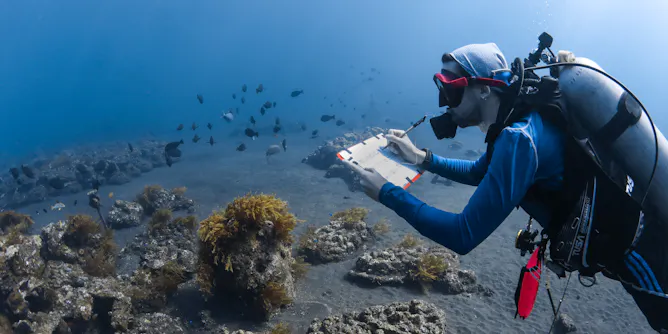
Most restoration programmes focus their efforts on increasing coral growth, but rarely ask whether the reef is actually functioning as a living ecosystem.
Articles on Reef restoration
Displaying all articles
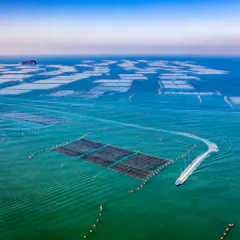
Farming seaweed, changing ocean chemistry, breeding corals and restoring mangroves could help fight climate change – if assessed and managed responsibly.
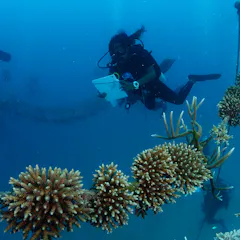
New research examined coral restoration projects worldwide to calculate what it would actually cost to bring back what’s already been lost.

Creating 3D computer models of entire reefs – sometimes known as digital twins – can help researchers monitor these precious ecosystems faster and more accurately than ever before.

Around the world, coral reefs are suffering. But scientists in high-income nations are developing new ways to build coral resilience. We have a duty to share our skills and build capacity elsewhere.

A clever approach to restoring Australia’s native oyster and mussel reefs in Queensland’s Moreton Bay is catching on, giving community groups a way to get involved in their local patch.
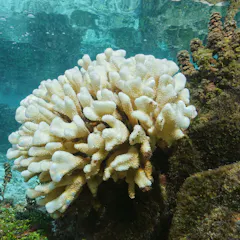
For decades, conservationists have tried to repopulate dead reefs with corals reared elsewhere.
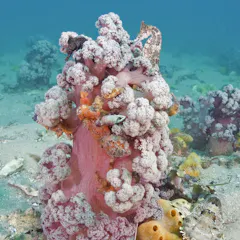
After a chance discovery in the lab, this team used IVF to make hundreds of coral babies for restoration projects in New South Wales. So far the IVF babies are doing well in the wild.
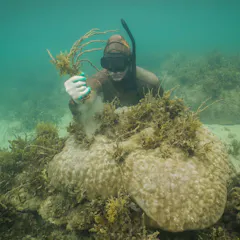
Many researchers are exploring high-tech ways to help reefs survive the climate crisis. But low-tech solutions like manually pulling out seaweed have a place too.

This knowledge is particularly important if we want to help reefs recover devastating events such as mass bleaching and cyclones.
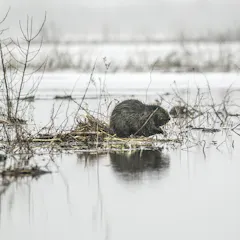
Restoring entire ecosystems is a difficult and expensive process. Thankfully, certain species, called ecosystem engineers, can make restoration easier. Gaining social and political support is critical too.

By playing the sounds of healthy reefs, we can draw oysters back to the barrens where their reefs once stood.
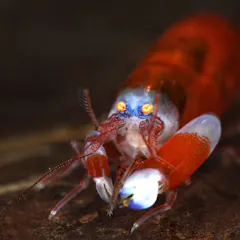
Playing the sounds of the sea can attract lost baby oysters to join the restoration of oyster reefs.

Sexual reproduction helps keep coral colonies diverse and resilient. Now, scientists are doing it in a lab to restock flagging reefs.

Hundreds of organizations are working around the world to restore damaged coral reefs. New research shows that rapid ocean warming threatens these efforts.
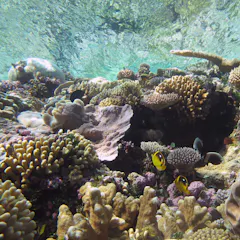
A new study found shallow water corals with high temperature tolerance in their DNA. Could they make reefs more resilient to climate change?

Coral reefs get a lot of attention, but the world has lost almost all of its vital oyster reefs in the last few centuries.

Federal Labor has pledged to withdraw the A$443 million given to the Great Barrier Reef Foundation. But the foundation’s decisions are led by science, and free of undue influence, its chief scientist says.
Top contributors
-

Postdoctoral researcher, marine ecology, Adelaide University
-
PhD Candidate, Adelaide University
-
Professor, Sustainable Marine Futures, Environment Institute, Adelaide University
-
Adjunct Research Associate, Faculty of Fisheries and Marine Sciences, IPB University
-
Professor of Community & Landscape Resilience, University of Idaho
-
Professor, National Marine Science Centre, Southern Cross University
-
Professor of Coral Biology, University of Essex
-
Senior Research Fellow, School of Life and Environmental Sciences, University of Sydney
-
Lead - Pilot Deployments Program (AIMS); Professor (Queensland University of Technology; Adjunct), Queensland University of Technology
-
PhD Candidate, Southern Cross University
-
Adjunct Senior Lecturer, University of Newcastle
-
Postdoctoral research fellow, Nova Southeastern University
-
Associate Professor in Water Science, University of Birmingham
-
Senior Research Officer, James Cook University
-
Professor of Marine Biology, James Cook University