
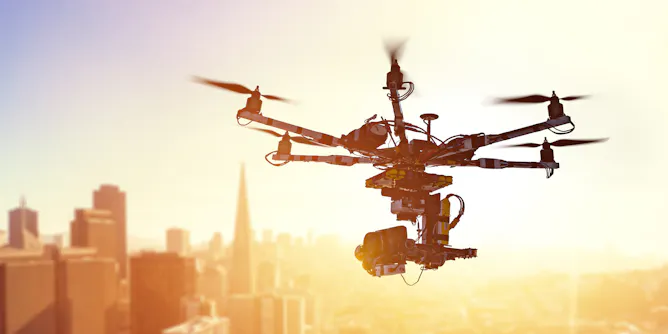
Plans for a drone superhighway could change our skies.
Articles on Privacy
Displaying 141 - 160 of 624 articles

Cyberattacks demanding ransoms for the release of information are on the rise. To determine if they should pay, businesses need to think about how they would react in such a scenario.

Proctoring software is a symptom of a bigger problem: universities see themselves as businesses and students as customers.

In the development of ever smarter homes, Amazon could soon have access to the maps of our houses created and stored by Roomba vacuums.

As material objects, diaries give scholars an intimate look into their subjects’ lives, including handwriting and mementos. What if diaries in the future are nothing but insubstantial digital ghosts?

Strip-searches are rarely a matter of public debate in the UK. Raw data – and the impact known from research in other jurisdictions – suggests though that they should be.

It’s increasingly difficult to move about – both in the physical world and online – without being tracked.

Digital twins could be used in the future to predict and influence our behaviour, but this raises concerns about who owns our data and how we can access and control it.
Australians – and Australian governments – need to get more savvy about data privacy

“Hackathons” can imply breaching security and privacy. To more accurately reflect their creative and constructive intent, they can be referred to instead as “datathons” or “code fests.”

Children’s voices and actions are recorded by virtual assistants, but what is being done with all the collected information?

My research shows how urban design can make it harder for women in some countries to make sustainable choices.

It would take huge numbers of people submitting bad data to affect the algorithms behind period tracking apps, but even then it would be more harmful than helpful.

Cookie notifications remind people that they are being tracked, which affects how people behave online.

Women taking precautions to conceal their identities while seeking reproductive advice is akin to spies using tradecraft to avoid enemy agents.

Private companies and public authorities are beginning to implement facial recognition technology, even without rules to govern what they can do.

How we get the balance right between using social media to hold people to account versus the risk of invading people’s privacy depends on the context, of course, and is ultimately about power.

The Tim Hortons consumer app was found to have collected detailed user information, including location data. As a privacy violation, this challenges perception of Tim Hortons as a trusted brand.

The Supreme Court has found protections for people’s privacy in several constitutional amendments – and used it as a basis for some pretty fundamental protections.

The EU’s proposed regulations don’t align with existing technology. They’re likely to fail – or to break the internet as we know it.
Top contributors
-

Associate Professor, School of Law, University of Canberra
-
Associate Professor, Faculty of Law & Justice; Lead, UNSW Public Interest Law & Tech Initiative, UNSW
-
Professorial Fellow, University of Canberra
-
Emeritus Professor in Law and Criminal Justice, Adelaide University
-
Professor of Cyber Security Practice, Edith Cowan University
-
Professor specialising in Internet law, Bond University
-
Dean of Global Business, The Fletcher School, Tufts University
-
Director of UWA Centre for Software Practice, The University of Western Australia
-
Associate Professor in Telecommunications Engineering, Swinburne University of Technology
-
Research Director of the Security and Surveillance Research group; Professor, The University of Queensland
-
Professor (adjunct) and Senior Fellow, Institute for Health Policy, Management and Evaluation, Dalla Lana School of Public Health, University of Toronto
-
Research engineer, Advanced Surveillance Project, CSIRO
-
Senior Lecturer, The University of Melbourne
-
Senior Researcher and Project Manager, Advanced Surveillance Project, CSIRO
-
Former data protection and surveillance stream lead, Allens Hub for Technology, Law and Innovation, UNSW Law Faculty, UNSW