
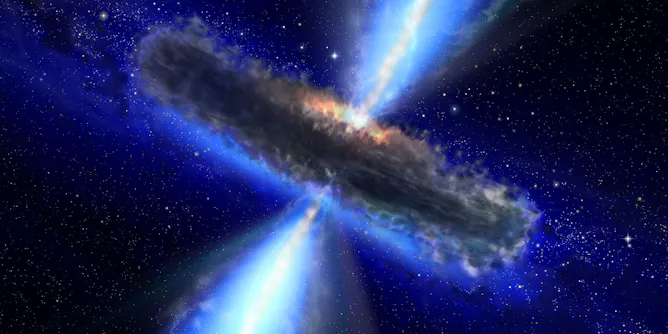
A detector buried under more than a mile of ice in Antarctica has detected a high-energy subatomic neutrino and traced it to its origin, a blazar – a gargantuan black hole more than a billion times more massive than the sun.
Articles on Neutrinos
Displaying 21 - 40 of 51 articles
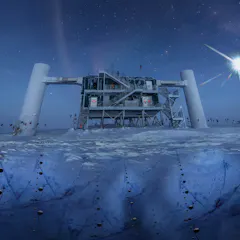
A giant detector at the South Pole has observed a neutrino from a black hole in a distant galaxy for the first time.
A particle physicist explains just what this keystone theory includes. After 50 years, it’s the best we’ve got to answer what everything in the universe is made of and how it all holds together.
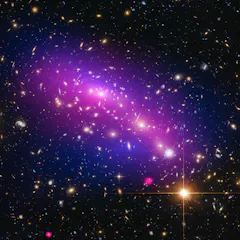
A new study challenges the established view of what dark matter is.
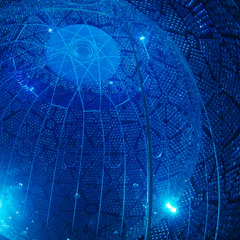
Deep underground, scientists research subatomic particles from space in a bid to understand the building blocks of our universe.
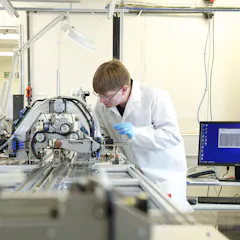
Deep beneath the Alpine ski slopes, patient scientists are waiting to observe a rare radioactive decay that would make us rewrite the Standard Model of Particle Physics.
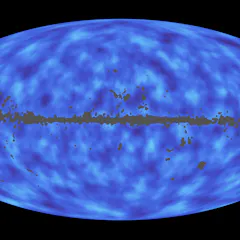
Cosmologists are heading back to their chalkboards as the experiments designed to figure out what this unknown 84 percent of our universe actually is come up empty.
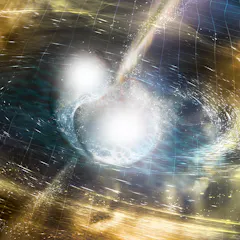
The discovery of tiny ripples in space from the violent collision of dense stars could help solve many mysteries – including where the gold in our jewellery comes from.

Razor-sharp, unconventional and fun on the dance floor. A colleague paints a colourful portrait of one of this year’s Nobel Laureates in physics.

The Deep Underground Neutrino Experiment (DUNE) could help unravel the mysteries of antimatter and complete scientists’ next model of the universe.
A new detector could work out what’s causing a heat flow from the Earth’s interior. It may even solve the mystery of what powers the Earth’s magnetic field.
The universe is expanding faster than expected, but we don’t know what’s driving it. Here are a few of the possible explanations, from dark energy to a modification of general relativity.
A burst of neutrinos detected deep under the Antarctic ice may have originated from a distant quasar on the edge of the visible universe.

Antimatter is at the heart of one of the biggest conundrums in physics. Here’s why.
When looking for evidence of some of the universe’s mysterious high energy particles, why not enlist the help of our nearest neighbour: the moon.
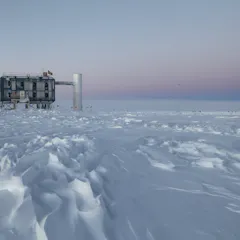
A cubic kilometer of clear, stable ice could help physicists answer big questions about cosmic rays and neutrinos. Hardy scientists collect data via a unique telescope at the frozen bottom of the world.

The Nobel Prize-winning research on neutrinos is expected to push the boundaries of science and technology.

The tiniest of particles could have huge potential to solve the greatest mysteries of the universe - including why there is more matter than antimatter.

On the journey to discovery with the ‘gifted mentor’ Takaaki Kajita, one of this year’s Nobel Prize winners, from some one who studied with him.
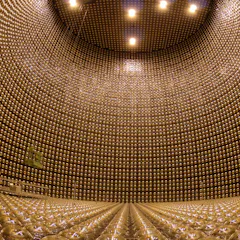
They’re beyond tiny and super mysterious. Neutrinos are an elemental particle that might just help us understand the structure and evolution of the universe.
Top contributors
-

Professor of Physics and Professor of Astronomy and Astrophysics, Penn State
-
Professor of Physics and Astronomy, Michigan State University
-
Post Doctoral Research Associate, Centre for the Subatomic Structure of Matter, Adelaide University
-
CSIRO Fellow, CSIRO
-
Reader (Physics and Astronomy), University of Sussex
-
Glenn Starkman is a Friend of The Conversation.
Distinguished University Professor of Physics, Case Western Reserve University
-
Postgraduate Research Student in High Energy Astrophysics, Adelaide University
-
Research scientist at SNOLAB, Adjunct faculty at Laurentian University, Laurentian University
-
Assistant Professor of Physics, McGill University
-
Professor of Physics, University of the Witwatersrand
-
Associate Professor, University of Alberta
-
Professor of Physics, Head of Department, Lancaster University
-
Executive Director, Wisconsin IceCube Particle Astrophysics Center, University of Wisconsin-Madison
-
Post-doctoral research fellow, London Research Institute
-
Professor of Astronomy, Auckland University of Technology