
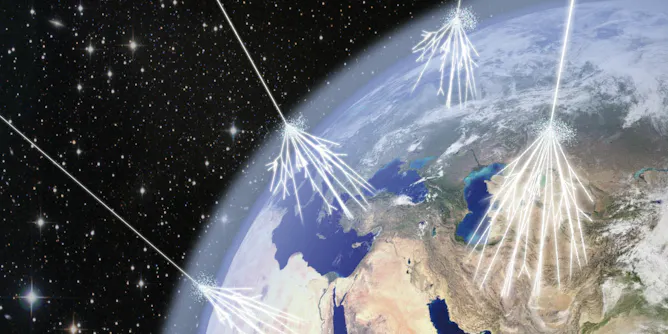
Scientists recreated cosmic rays in a massive underground particle collider.
Articles on Cosmic rays
Displaying 1 - 20 of 22 articles
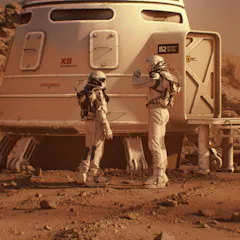
High-energy particles streaming through space can damage DNA and increase cancer risk, but antioxidants, tardigrades and hibernation could help astronauts make the journey safely.
Global cooling associated with the impact of supernova remnants may have affected plants and animals, including species related to humans.

You would have to flip 75 heads in a row on a fair coin to have the same probability of a single neutrino interacting with a particle of matter.
While space is mostly empty, it does have some matter and particles spread throughout it.
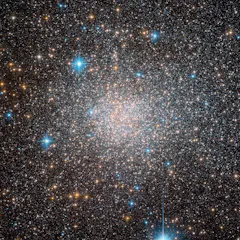
Space magnetism scrambles the paths of the universe’s most wayward particles – and scientists are finally discovering exactly how much.
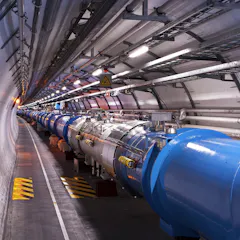
The LHC is back in business for the year, but getting it ready to collect data isn’t always a straightforward process. You can’t just unplug it and plug it in again.

Some ancient texts record what were likely dying stars, faintly visible from Earth. If close enough, these events can disturb telescopes and even damage the ozone layer.

The Peregrine and Nova-C landers are due to carry out valuable science at two diverse lunar locations.
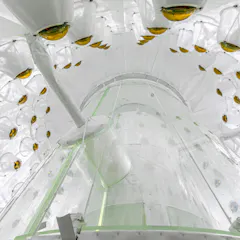
To detect dark matter, you need to build an ultra-sensitive detector and put it somewhere ultra-quiet. For one physics collaboration, that place is almost a mile under Lead, S.D.
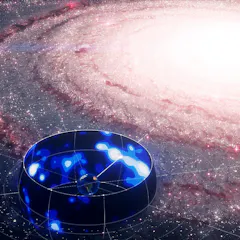
Neutrinos are some of nature’s most elusive particles, but new research has used them to create an image of our own galaxy.
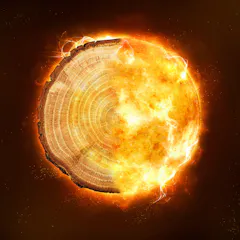
Half a dozen times in the past 10,000 years, enigmatic ‘Miyake events’ have showered Earth with cosmic rays.
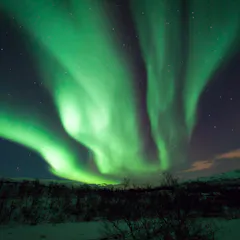
Every few centuries the Sun blasts the Earth with a huge amount of high-energy particles. If it were to happen today, it would wreak havoc on technology.
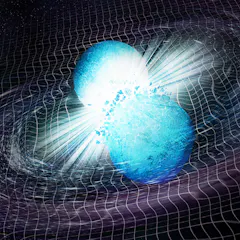
Astronomers are now able to detect a host of signals streaming through the universe. This newfound ability is like gaining new senses and it’s opening the door to understanding the cosmos.
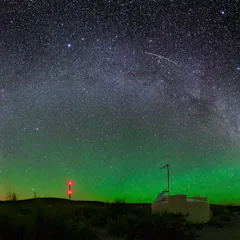
Scientists say they now know that high energy cosmic ray particles that bombard Earth are coming from outside our galaxy. But the actual source still remains a mystery.

The true radiation risk from commercial flying has nothing to do with security scans. A radiation expert explains how much cancer risk the most frequent of flyers take on when they take to the skies.
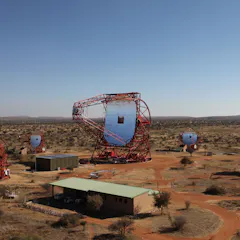
A new study suggests that mysterious high energy cosmic rays might originate from the supermassive black hole at the centre of our galaxy.
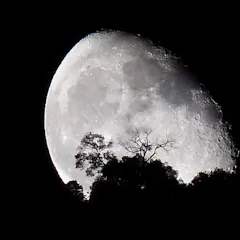
When looking for evidence of some of the universe’s mysterious high energy particles, why not enlist the help of our nearest neighbour: the moon.
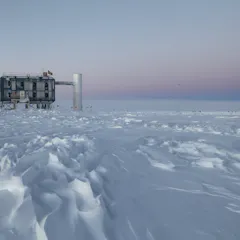
A cubic kilometer of clear, stable ice could help physicists answer big questions about cosmic rays and neutrinos. Hardy scientists collect data via a unique telescope at the frozen bottom of the world.

Astronauts living on the ISS get to experience the wonders of the universe’s natural phenomena like no one else.
Top contributors
-

Professor of Astrophysics, University of Sydney
-
Assistant Professor of Physics, McGill University
-
Professor of Physics and Astronomy, Michigan State University
-
Professor of Physics, Adelaide University
-
Lecturer in Mathematics, University of Dundee
-
Timothy J. Jorgensen is a Friend of The Conversation.
Director of the Health Physics and Radiation Protection Graduate Program and Professor of Radiation Medicine, Georgetown University
-
Associate Professor, University of Alberta
-
Professor in High Energy Astrophyics, Adelaide University
-
Post Doctoral Research Fellow, School of Biological Sciences, University of East Anglia
-
Postdoctoral Fellow in High Energy Astro-particle physics
-
CSIRO Fellow, CSIRO
-
Senior Lecturer in Physics, Nottingham Trent University
-
University Distinguished Professor of Astronomy, University of Arizona
-
Particle Physicist working at CERN on the ATLAS experiment, Research Associate, University of Pittsburgh
-
Assistant Clinical Professor of Electrical Engineering, Mississippi State University