
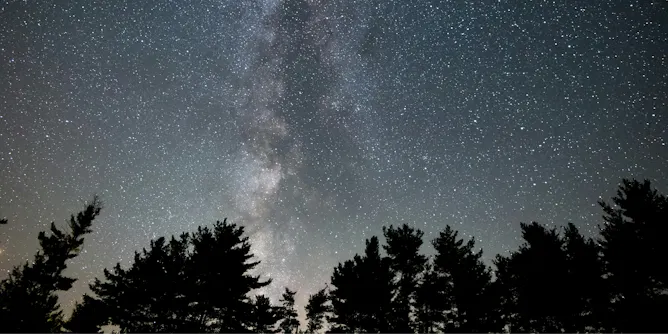
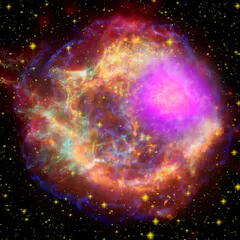
Ghost particles from ancient stellar explosions could be detected for the first time this year.
Articles on Neutrinos
Displaying 1 - 20 of 48 articles

The electron is the tiniest particle. Then there are neutrinos, which are as small but may weigh more.

In the search for elusive particles called neutrinos, researchers are stringing thousands of detectors in the depths of the Mediterranean.

You would have to flip 75 heads in a row on a fair coin to have the same probability of a single neutrino interacting with a particle of matter.

Tau neutrinos are notoriously difficult to spot in detectors like IceCube. But researchers have managed to isolate 7 candidates.
The way particles interacted while the universe was forming seconds after the Big Bang could explain why the universe exists the way it does – a physicist explains matter-antimatter asymmetry.

An observatory called IceCube was used to produce a view of our galaxy in particles rather than light.

New data from the IceCube collaboration shows neutrino emissions from within our Milky Way galaxy – but figuring out where exactly these ghost particles come from is harder than it seems.
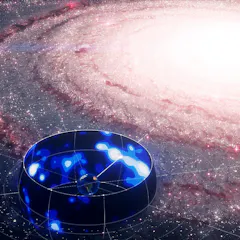
Neutrinos are some of nature’s most elusive particles, but new research has used them to create an image of our own galaxy.
The IceCube telescope near the South Pole has received a first glimpse into the core of the galaxy NGC 1068.
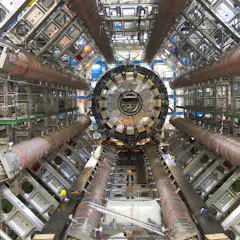
Physicists know a lot about the most fundamental properties of the universe, but they certainly don’t know everything. 2021 was a big year for physics – what was learned and what’s coming next?
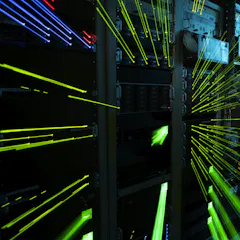
A new result from the MicroBooNE neutrino experiment has dashed hopes for a neat resolution to several puzzles for physicists.

The study of neutrinos produced within the Earth’s interior provides a better understanding of the radioactivity of our planet.
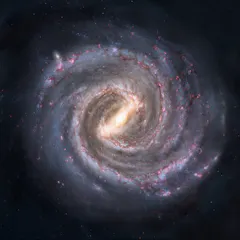
A new method suggests we should aim to detect dark matter haloes by tracing galactic gas.
When scientists created the Higgs particle with protons, they needed the 10km-wide Large Hadron Collider. A muon machine could achieve it with a diameter of just 200 metres.
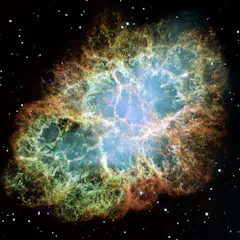
If we want an improved theory of particle physics, understanding neutrino masses is key.
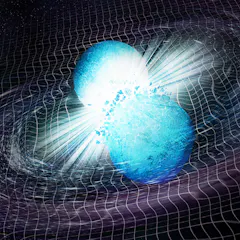
Astronomers are now able to detect a host of signals streaming through the universe. This newfound ability is like gaining new senses and it’s opening the door to understanding the cosmos.
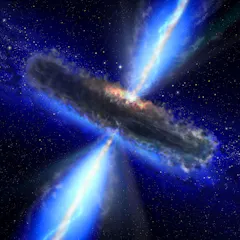
A detector buried under more than a mile of ice in Antarctica has detected a high-energy subatomic neutrino and traced it to its origin, a blazar – a gargantuan black hole more than a billion times more massive than the sun.
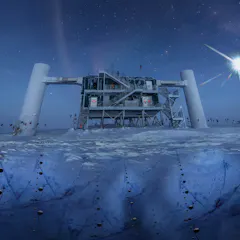
A giant detector at the South Pole has observed a neutrino from a black hole in a distant galaxy for the first time.
A particle physicist explains just what this keystone theory includes. After 50 years, it’s the best we’ve got to answer what everything in the universe is made of and how it all holds together.
Top contributors
-

Post Doctoral Research Associate, Centre for the Subatomic Structure of Matter, Adelaide University
-
Professor of Physics and Professor of Astronomy and Astrophysics, Penn State
-
CSIRO Fellow, CSIRO
-
Reader (Physics and Astronomy), University of Sussex
-
Assistant Professor of Physics, McGill University
-
Professor of Physics, Head of Department, Lancaster University
-
Associate Professor of Astronomy and Astrophysics, Penn State
-
Associate Professor, University of Alberta
-
Professor of Particle Physics, University of Manchester
-
Professor of Physics, University of the Witwatersrand
-
Professor of Astronomy, Auckland University of Technology
-
Postgraduate Research Student in High Energy Astrophysics, Adelaide University
-
Glenn Starkman is a Friend of The Conversation.
Distinguished University Professor of Physics, Case Western Reserve University
-
Executive Director, Wisconsin IceCube Particle Astrophysics Center, University of Wisconsin-Madison
-
Research scientist at SNOLAB, Adjunct faculty at Laurentian University, Laurentian University