
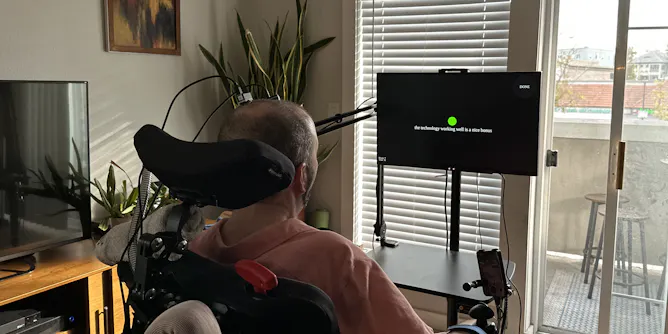
Listening in on neural activity is a promising way of restoring the ability to communicate for people whose bodies no longer can. Artificial neural networks are the key middleman in the process.
Articles on Machine learning
Displaying 61 - 80 of 367 articles

A study of more than 1,000 IVF patients showed a deep learning software system was almost as good as human experts at choosing viable embryos.
Generative AI needs tons of data to learn. It also generates new data. So, what happens when AI starts training on AI-made content?
There are hopes AI may be the silver bullet we need to save the environment – but it comes with downsides.

As they improve, we’ll likely trust AI models with more and more responsibility. But if their autonomous decisions end up causing harm, our current legal frameworks may not be up to scratch.
The government is calling for AI tutors. But before their introduction, we need to consider where these tutors are getting their information – and who that information belongs to.
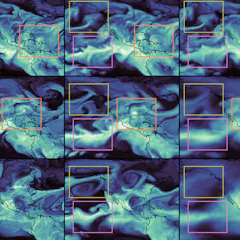
By combining traditional weather modelling with machine learning, a new model promises to make high-quality forecasts much cheaper to produce.

AI is finding applications across sport, from talent spotting and training to gymnastics judging and injury rehab.

The machine learning model can work in the absence of video data, identifying prey capture events from new acceleration and depth data.

Trees are better at designing habitat than we are. Can we use machine learning to get some tips?

Coral reefs share genetic material across wide areas, with help from ocean currents. This ability is especially important during episodes like the mass bleaching currently occurring.

Police efforts to sort through online child sexual exploitation material are being hampered by the rise in AI-generated imagery. Here’s how they’re working to combat the problem.

Satellite data shows the amount of food the residents of the tiny Pacific island have grown over time, pointing to a small but stable population.
AI has learned the ins and outs of proteins. Gene editing gives scientists control of life’s molecular machinery. Together they could lead to a revolution in biotechnology.
AIs that can see and hear have captured the public imagination. A machine learning expert explains why the sense of smell has lagged behind – and why that could change.

A data privacy expert explains how machine learning algorithms draw inferences and how that leads to privacy concerns.

Scientists are discovering viral genetic sequences in the wild faster than they can analyze them. A kind of ChatGPT for proteins can help make sense of all that data.

Just as human biases show up in machine learning systems, so, too, do people’s vagaries and vicissitudes.

Human staff accumulate data as ‘expertise’ instead of giving it to their employers. For profit-chasing retailers, that’s a problem AI can eliminate.
‘Uncanny’ AI music generators blur the line between creators and consumers. Will they turn music from high art to an everyday language? Listen to these AI-generated tracks and judge for yourself.
Top contributors
-

Senior Research Fellow in AI Accountability, Queensland University of Technology
-
Professor of Statistics and Professor of EECS, University of Michigan
-
Professor of Information Systems, Michigan State University
-
Professor in Robotics, Queensland University of Technology
-
Professor of Chemistry, Connecticut College
-
Professor of Artificial Intelligence, University of Bath
-
Research Assistant Professor of Industrial & Systems Engineering, University of Southern California
-
Professor of AI and Behavioral Data Science, University of Technology Sydney
-
Head of the Marketing Innovation and Distribution Program at EMLV, Pôle Léonard de Vinci
-
Professor of Computer Science, Queen Mary University of London
-
Professor of Marketing and Consumer Behaviour, Queensland University of Technology
-
Assistant Professor of Integrative Biology & Computer Science and Engineering, Michigan State University
-
Associate Professor of Law and Analytics, Georgia State University
-
Adjunct Senior Lecturer, Applied Ethics and CyberSecurity, Griffith University
-
Professor of AI, Research Group Leader, UNSW