
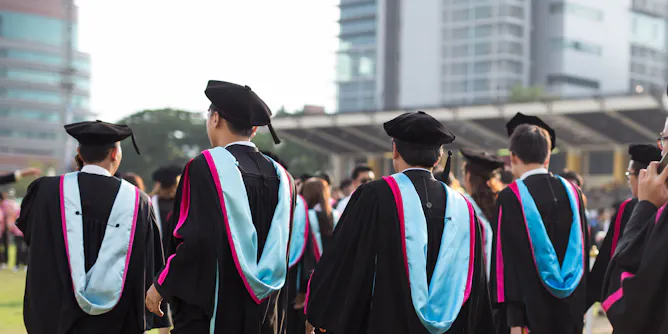
One option could be to cut per-student funding and instead raise the student contribution from an average of about 40% to 50%, by raising HECS caps.
Articles on Higher education policy
Displaying 61 - 80 of 219 articles

Demand for research grants has far exceeded supply, with success rates for grant applications falling to record lows.

Not only does higher education build the economy’s skills and knowledge, but that it pays for itself and much else many times over.

Mentoring support and campus visits are a couple of ways of familiarising students with university.

Liberal higher education policy is obscure; perhaps deliberately so. But the conclusion is clear. Unless students are required to pay significantly more, universities will face major cuts.

A new report offers recommendations for how to best reform the education system in India.
Pyne talked more about changing taxes and incentives to stimulate growth and industry, whereas Carr had clear plans for government investment.

The huge growth in student numbers is restricting the government’s capacity to increase levels of public funding per student and for research.

The main failure of university expansion is the unwillingness to fund it. Costs are certainly escalating, but priorities are always political as well as financial.
Labor’s policy essentially creates a new layer of tertiary education that would involve universities and TAFE Institutes working together to deliver associate degrees and advanced diplomas.
For-profit colleges and universities have been in a lot of trouble. But the case of Trump University is different. To start with, it cannot even be called a for-profit university.
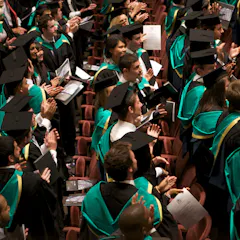
Universities deemed excellent at teaching will be allowed to raise their fees in line with inflation.

Over the next ten years, 40% of jobs are predicted to disappear. Universities will be essential to helping people reskill, upskill and reinvent their jobs.

The onus is now on students, universities and the wider public to make clear where they stand on the options laid out in the discussion paper.

While the government finally ruled out full fee deregulation in its 2016 budget, it is still contemplating uncapping fees for some degree courses. Here’s what else is being discussed.
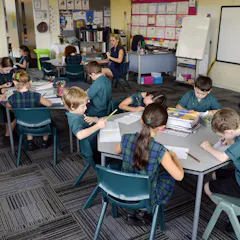
While schools receive an extra $1.2 billion in funding for 2018-20, reforms for higher education are delayed by a further year.

The government wants to make the university admissions process more transparent as a way to provide greater choice. But this fails to recognise how the system currently works.

Increasing the amount that students pay towards their degree is likely to be on the cards of higher education in this year’s election.

Competition can be a force for positive change. But in its current form, it’s setting universities back rather than moving them forward.

Young people are pressured into university and many end up in unsuitable courses. We need to recognise these realities and be clear about the purpose of higher education so it doesn’t lose its value.
Top contributors
-

Professor of Higher Education Policy, Monash University
-
Associate Professor, Melbourne Centre for the Study of Higher Education, The University of Melbourne
-
Adjunct Professor, Department of Leadership, Higher and Adult Education, OISE, University of Toronto
-
Honorary Senior Fellow, Melbourne School of Psychological Sciences, The University of Melbourne
-
Senior Research Fellow, Curtin University
-
Honorary Professorial Fellow, Melbourne CSHE, The University of Melbourne
-
Associate Professor & Academic Director, Widening Participation, La Trobe University
-
Professorial Fellow, University of Canberra
-
Adjunct Associate Professor in History, University of New England
-
Executive Director, IRU, La Trobe University
-
Fellow, Higher Education Program, Grattan Institute
-
Mitchell Professorial Fellow, Victoria University
-
Vice-Chancellor, Western Sydney University
-
Honorary Senior Fellow, The University of Melbourne
-
Vice Chancellor, Victoria University