
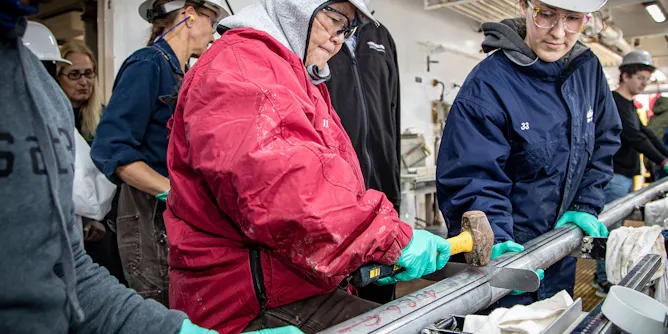
A newly discovered half-million-year-old layer of volcanic sediment beneath the Aegean Sea rewrites what scientists know about this area’s volcanic history – and potential future hazards.
Articles on Geology
Displaying 101 - 120 of 453 articles
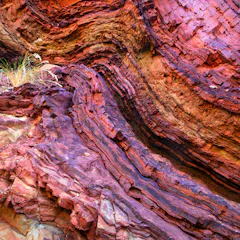
How did Australia end up with so much iron ore? What we discovered in Western Australia redefines how we think about iron deposits – and provides clues on how we might find more.
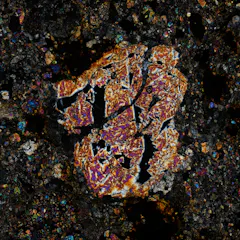
Vast amounts of space rocks litter our Solar System, and sometimes land on Earth’s surface. There are many things we can learn from them.

These rare rocks come in a few different types, which can tell geologists about Mars’ volcanic past and hint at its potential habitability.

Kids love digging and may not realize the dangers a hole in the sand can pose.
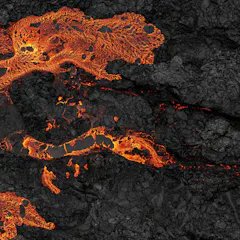
Life depends on Earth’s ancient continental crust – but there are only a few places where remnants of it can still be seen today.
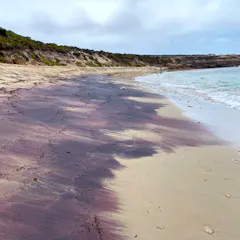
The hunt for the origin of garnet crystals found on South Australian beaches took researchers thousands of kilometres and half a billion years back in time to a hidden Antarctic mountain range.
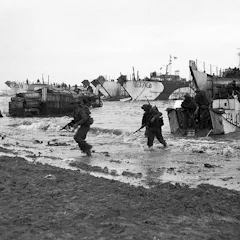
Scientists with expertise in mud and peat were a key part of planning the Normandy landings in 1944.
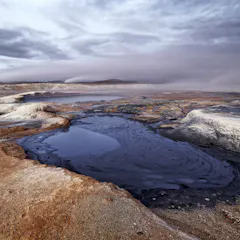
The very early Earth may not have been as inhospitable as scientists thought, with life perhaps starting more than 4 billion years ago.
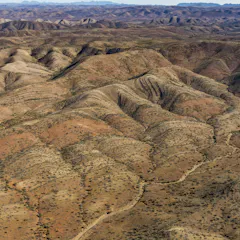
By detailing the landscape at the time of first humans’ migration into Australia, we can better understand how people travelled and where they settled.
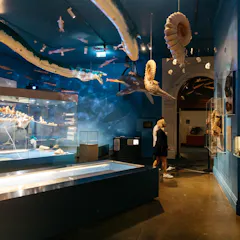
Experts say the ‘reimagining’ of the South Australian Museum will destroy its crucial contributions to science.
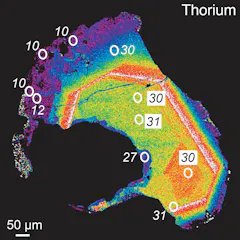
Measuring the concentration of radioactive elements in a single, sand-size crystal reveals the growth of the Himalayan mountain range over time.
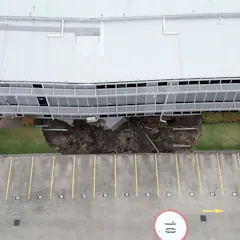
When the soil ‘ceiling’ collapses, you end up with a hole exposing a cavity previously hidden underground.
Scientists Jan Zalasiewica and Erle Ellis on the recent decision to reject a proposal for a new geological epoch, the Anthropocene. Listen to The Conversation Weekly podcast.
The idea cannot be stopped, even if geologists have voted not to recognise a new epoch.

Deep-sea sediments show how the changing orbits of Earth and Mars are linked to past global warming and the speeding up of deep-ocean eddies.
Geologists recently voted down a proposal to formally recognise the Anthropocene.

Cratons are pieces of ancient continents that formed billions of years ago.

While NASA rovers on the surface of Mars look for hints of life, researchers back on Earth are studying ‘echoes of life’ from ancient basins – hoping that the two sites might be similar.
As space travel and lunar exploration becomes a near-future reality, we should consider the impact of human activities on the lunar environment.
Top contributors
-

Professor of Geochronology, Curtin University
-
Professor of Geology, Adelaide University
-
Professor of Palaeobiology, University of Leicester
-
ARC Future Fellow and Associate Professor in Igneous Petrology/Volcanology, The University of Queensland
-
Professor in Earth Sciences, Nanyang Technological University, Singapore, and Emeritus Professor of Mineral Physics, University of Cambridge
-
Professor of Earthquake Science, The University of Melbourne
-
Professor of Geophysics, University of Sydney
-
Associate Professor, Earth and Planetary Sciences, Curtin University
-
Professor of Planetary Geosciences, The Open University
-
Senior Curator of Geosciences, Museums Victoria Research Institute; Monash University
-
Professor in Earth & Climate Science, University of Southampton
-
Harold T. Stearns Professor of Earth Science, Wesleyan University
-
Adjunct professor, UNSW
-
Redmond Barry Distinguished Professor Emeritus, The University of Melbourne
-
Professor of Earth and Space Sciences, University of Washington