
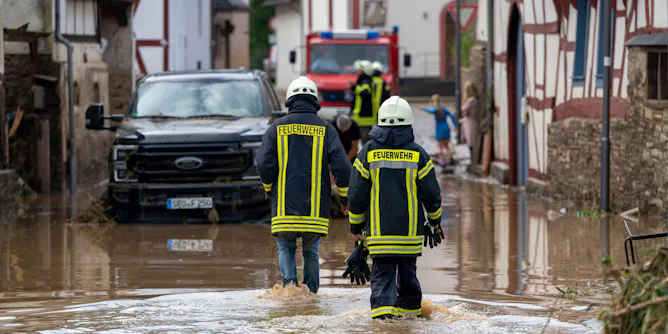
Catastrophic floods in north-western Europe have shown how badly early warning systems can fail.
Articles on Flood risk
Displaying 61 - 72 of 72 articles

Planting a hedge can boost biodiversity, tackle noise, air and soil pollution and help towards meeting carbon emissions targets.
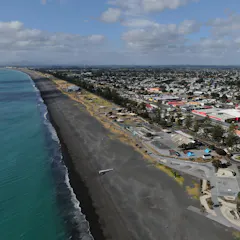
New Zealand is replacing its once groundbreaking environmental legislation with new laws, one of which focuses on climate change adaptation and will include a fund to enable managed retreat.
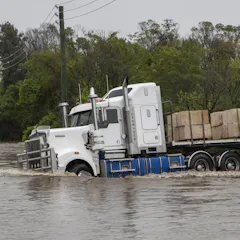
The expert advice is to never drive, walk, or ride through flood waters. Unfortunately, however, this is advice often not heeded. Research on psychology and floods reveals clues as to why.
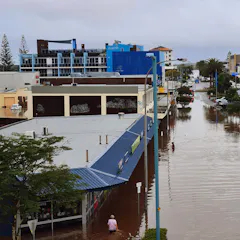
Unless you’ve lived through it, it’s hard to understand how stressful a catastrophic flood can be - both in the moment and long after the event. That’s especially true for vulnerable populations.
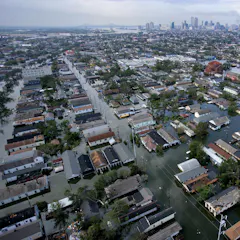
We can design parks, open space and public infrastructure to hold excess water when flood strikes. That means better control of where floodwater ends up, reducing the risk to lives and property.
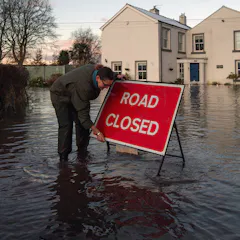
Clear messaging is crucial when dealing with multiple disasters.
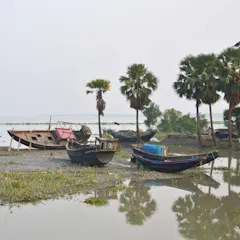
Rising sea levels are as likely to trap people as they are to force them to move.
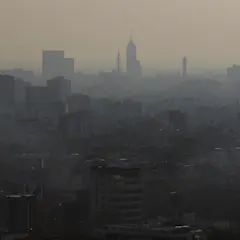
The Aztecs had a shining city on a lake, with canals, causeways and aqueducts – until the Spanish came. Mexico City is still suffering the consequences of their bad public health decisions.
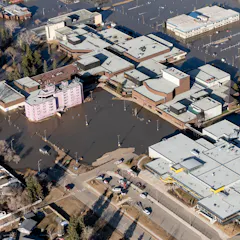
Blaming flooding on an act of God wrongly absolves government and developers of their liability for poor decisions that unfairly burden taxpayers.
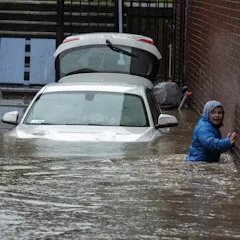
‘Leaky dams’ and tree planting are useful against smaller floods, but they won’t hold back the water after a major storm.
We asked some climate researchers what kept them hopeful in 2019.
Top contributors
-

Professor of Sociology, Rice University
-
Associate Professor, Macquarie University
-
Postdoctoral Research Fellow in Atmospheric Sciences, The University of Melbourne
-
Professor of Quantitative Methods in the Social Sciences, City University of New York
-
Senior Research Associate, Institute for Environment and Human Security (UNU-EHS), United Nations University
-
Professor of Anthropology, Rice University
-
Researcher, Queen's University, Ontario
-
Professor Emeritus of Climate and Space Sciences and Engineering, University of Michigan
-
Honorary Senior Research Fellow at the University of Sydney, Honorary Adjunct Research Fellow, Western Sydney University
-
Lecturer, Monash University
-
Regius Professor of Meteorology and Climate Science, University of Reading
-
Senior Spatial Research Analyst, Kinder Institute for Urban Research, Rice University
-
Assistant Professor of Civil, Construction and Environmental Engineering, Iowa State University
-
Associate Professor of Political Science, University of Waterloo
-
Research Officer in Environment and Planning, Te Kunenga ki Pūrehuroa – Massey University