

Ontario must seize the promise of Canada-wide early learning and child-care funding before it becomes another missed opportunity.
Articles on Early childhood education
Displaying 41 - 60 of 265 articles

They’re crying, but you have to leave and get to work. You spend the rest of the day feeling absolutely wretched. Sound familiar?

Planning a playdate can be stressful. Parents can end up worrying about where to go, what to do, whether the house is tidy enough, or that you might be judged about the food you offer.

New research shows how the beach provides many ways to teach young children about biology, chemistry and physics.
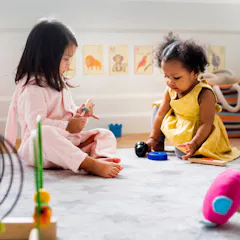
Canadian 24-hour movement guidelines for healthy development recommend naps for infants and children under two years, and nap options for ages three to four.

One candidate has gone after for-profit colleges. The other has tried to loosen restrictions. What else does the record show about what Donald Trump and Kamala Harris have done on education?
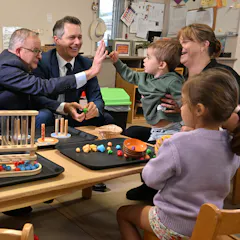
Big increases in government spending on child care have been recommended by the Productivity Commission, that would see families earning up to $80,000 fully subsidised under the Child Care Subsidy.
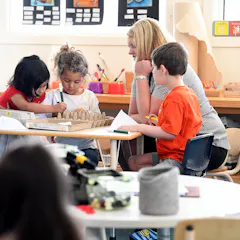
The families who rely on early childhood services will likely appreciate the skills and professionalism involved. But as a community, we do not value this work.
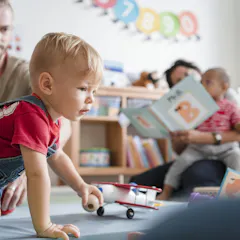
Research consistently shows access to early childhood education can effect literacy, schooling and life in general. Its relative absence in a budget supposedly focused on education is baffling.

A study pertaining to more than 1.4 million kindergarteners across Canada finds the occurrence of health disorders higher as the socio-economic status of a neighbourhood decreases.

The Early Childhood Education Report offers detailed profiles capturing how each province and territory are doing with implementing Canada-wide early learning and child care.
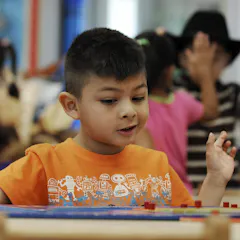
Kindergarteners’ literacy and active play are both grounded in the science of learning.

Governments need to co-operate to prioritize access to high-quality child care for low-income families, and sustain not-for-profit care centres with well-paid educators.
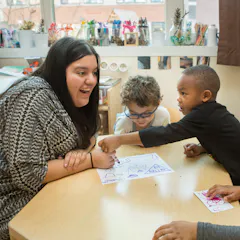
We need to ensure the best scientific research in play-based learning and early reading is leveraged, and teachers receive supports to meet children’s developmental and academic needs.

It makes good economic sense to lean on the neighbourhood public school in the push to expand early learning.

Findings of a study suggest using a ‘hundreds chart’ showing numbers one through 100, beginning with one in the top-left corner, fosters children’s counting by 10s.
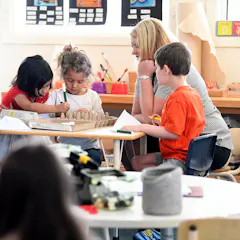
Early childhood educators are passionate but they are leaving the sector in droves.

Australia is set to embark on bold changes to early childhood education if a new report is anything to go by.

For vulnerable and marginalized groups, access to early learning and child care remains uncertain. Inclusive access must become a top priority to achieve affordable care for all families.

Access to schooling for four-year-olds is inconsistent across Canada. Families need to know children are immersed in high-quality early learning, and they shouldn’t be exhausted searching for it.
Top contributors
-

Fellow in Early Childhood Policy, Atkinson Centre, Ontario Institute for Studies in Education, University of Toronto
-
Professor of Applied Psychology and Human Development, University of Toronto
-
Adjunct Professor, Department of Applied Psychology and Human Development at Ontario Institute for the Study of Education (OISE) and Executive Director at the Atkinson Centre, University of Toronto
-
Associate Professor, Flinders University
-
Adjuct Faculty University of Guelph, Former Chair, Early Childhood Studies and Founder of The Love Model Inc.
-
Assistant Researcher, Perlman Lab, Ontario Institute for the Studies of Education, University of Toronto
-
Professor, Department of Pediatrics, University of British Columbia
-
Professor and Head of School, School of Early Childhood and Inclusive Education, Queensland University of Technology
-
Associate Head of Early Childhood Studies, University of Guelph-Humber
-
PhD Candidate, Doctor of Social Sciences, Royal Roads University
-
Professor, Werklund School of Education, University of Calgary
-
Professor, Canada Research Chair in Determinants of Child Development, Owerko Centre at the Alberta Children’s Hospital Research Institute, University of Calgary
-
Policy Fellow, Mitchell Institute, Victoria University
-
Professor, Queensland Brain Institute, The University of Queensland
-
Professor, Special Education, Memorial University of Newfoundland