

The wall in Western Sahara marks the practical frontline of a conflict most of the world has stopped watching.
Articles on Deserts
Displaying 1 - 20 of 52 articles
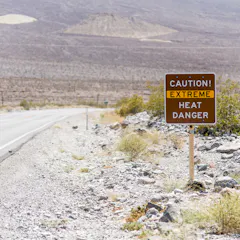
Death Valley set a record when the temperature reached 134 degrees Fahrenheit. Here’s why deserts can reach such scorching temperatures – and also very cold ones.
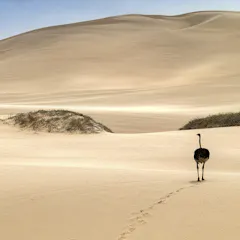
Scientists have extracted atoms from eggshells that are 15 million years old which reveal how plants responded to high levels of carbon dioxide.
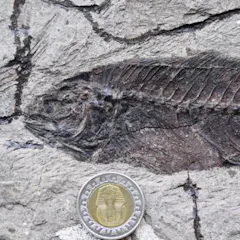
A team of researchers worked grueling, hot hours in the desert to understand the history of life in Earth’s oceans after a major extinction event.
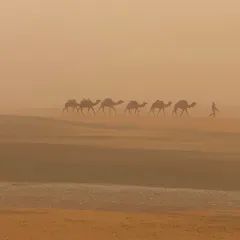
Rising temperatures and shifting winds are changing how dust travels from the Sahara to Europe.
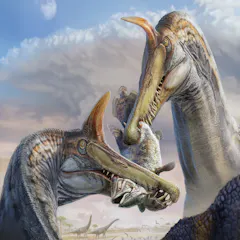
The hunt for a mythicized fossil hot spot took a team of researchers on a journey through the Sahara Desert.
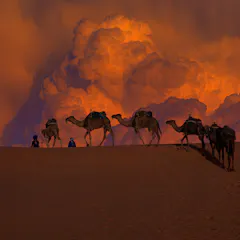
Why climate models struggle to simulate this special kind of desert thunderstorm.

The white-backed swallow survives the extreme temperatures of inland Australia by reducing its body temperature to save energy.
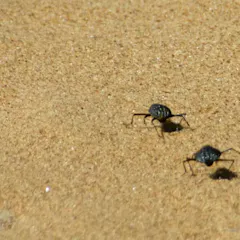
A Namibian desert beetle cools down by running in the sun.

Some in China are blaming Mongolia for the dust storms they are experiencing. But what are the real causes?

From water fleas to seed shrimp, Australia’s desert rock holes shelter unique animals found nowhere else. But as the climate warms, their homes are at risk.
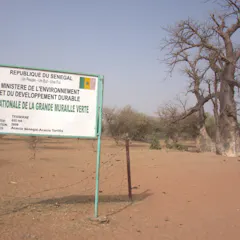
Africa’s Great Green Wall of 6,000km of trees was launched 18 years ago, promising to halt desertification. But in Senegal, it’s been very slow to progress.

There are elements of these ancient, distant George Lucas stories that might seem like science fiction but are, in fact, science reality.
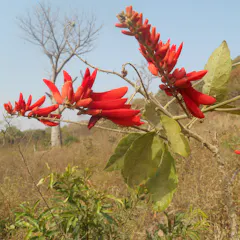
A new publication sheds light on the plants of Burkina Faso and Mali.
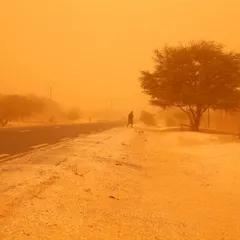
The Harmattan is linked to a range of conditions that affect the skin and mucous membranes of humans and animals.
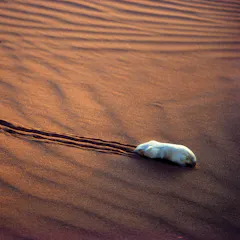
Scientists have traced the evolutionary heritage of marsupial moles and explained how they evolved unique adaptations that help them survive beneath the sand.

Cacti are more complex and mysterious than you might realise.
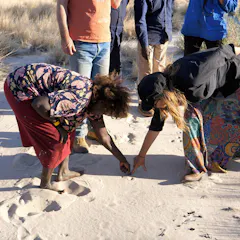
Footprints, droppings, diggings and other signs left behind by animals reveal a lot to a skilled observer. Indigenous knowledge feeds into one of Australia’s largest wildlife monitoring endeavours.
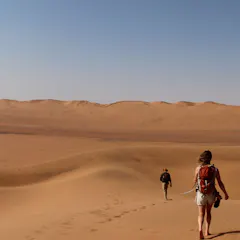
New research provides the foundation for larger, regional-scale analyses of early human adaptive strategies in the Namib Sand Sea, Namibia.
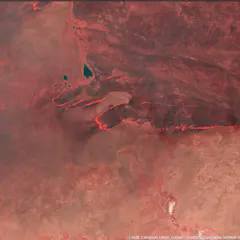
The 2023 megafires burnt more than 84 million hectares of desert and savannah in northern Australia. That’s larger than the whole of NSW, or more than three times size of the UK.
Top contributors
-

Senior research fellow, Charles Darwin University
-
Postdoctoral Fellow in Entomology, Adelaide University
-
Associate Professor Natural Resource Management, Namibia University of Science and Technology
-
Future Fellow in Ecology, Queensland University of Technology
-
Associate Professor and Director, Centre for Compassionate Conservation, University of Technology Sydney
-
Research Fellow, University of Canberra
-
Professor of Geography, University of Oxford
-
Senior Research Fellow, Molecular Ecology Lab, Flinders University
-
Emeritus Professor of Archaeological Science, University of Oxford
-
Board Chair, Global EverGreening Alliance & Distinguished Senior Fellow, World Agroforestry (ICRAF), Center for International Forestry Research – World Agroforestry (CIFOR-ICRAF)
-
Postdoctoral Fellow in Ecology, University of Alberta
-
Professor of Aeolian Geomorphology, King's College London
-
Senior Research Scholar, Max Planck Institute for the History of Science
-
Lecturer in China and Sustainable Development, King's College London
-
Lecturer in Biological Sciences, University of Wollongong