

In her Quarterly Essay, Anna Goldsworthy treats AI as a mirror rather than a monster. Is humanity wise enough to live with a technology that amplifies our weaknesses?
Articles on Artificial intelligence (AI)
Displaying 241 - 260 of 2835 articles

As AI becomes increasingly embedded in hiring, Canada needs to consider how opportunity is distributed once immigrants enter the labour market.

Students have always cheated in exams. But instead of handwritten notes, they might now use AI-enabled glasses.

AI can produce the language of care, but therapy depends on a trained human presence that listens, responds and remains accountable.

Using AI for cybersecurity without first investing in fundamentals is like deploying a robot guard dog to defend an unlocked door.

Understanding the coopetition mechanics behind Europe’s defence dilemma is vital and key for making much-needed headway.

Several scientific fields rely on visual evidence to illustrate their claims. Inaccurate AI-generated images put the credibility of science at risk.

The football technology being showcased at the 2026 World Cup often has its origins in university research.

Writing prompts to generate images combines two literary tasks at once: the realist description of concrete things and the modernist evocation of atmosphere.

AI is often described as if it lives in the cloud. The persistent controversies regarding the Wonder Valley project in Alberta illustrate how false that is.

Meta’s just-launched Business Agent could mark a major shift in how companies of all sizes deal with customers. But what are the trade-offs?

According to one study, 75% of respondents believe chatbots are conscious.
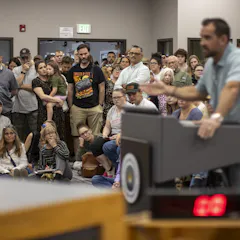
Local needs, political tensions and corporate power all get involved in the democratic processes by which Americans govern their communities.

Rest can feel uncomfortable when society treats effort as evidence of commitment.

The effects won’t be immediately visible. But many of these jobs are entry points for young graduates and early-career professionals: our future business leaders.

Sextortion is a form of online blackmail where a perpetrator coerces or tricks a victim into sending intimate images. New research shows it’s on the rise.

Canada is now investing billions to strengthen domestic AI capacity. But sovereignty is not simply about where the servers sit.

Adults need to guide kids’ interactions with AI, and teach the difference between talking to a machine and a human.

The risks of depending on US-based AI models are becoming clear.

We know not to leave lights on all day. We also know not to run an air conditioner with windows open. We need a similar mindset for AI.
Top contributors
-

Professor of AI, Research Group Leader, UNSW
-
Professorial Fellow, University of Canberra
-
Associate Professor of Visual Communication & Digital Media, RMIT University
-
Adjunct Senior Lecturer, Applied Ethics and CyberSecurity, Griffith University
-
Professor of Information Systems, Michigan State University
-
Adjunct Lecturer in Public Policy, Harvard Kennedy School; University of Toronto
-
Professor in Robotics, Queensland University of Technology
-
Professor of Philosophy and Director of Applied Ethics Center, UMass Boston
-
Senior Research Fellow in AI Accountability, Queensland University of Technology
-
Professor in Business Information Systems, University of Sydney
-
Director of Sydney Executive Plus, Business School, University of Sydney
-
PhD in machine ethics, University of Canterbury
-
Senior Lecturer, School of Engineering, Australian National University
-
Professor in Computational Intelligence, Australian Catholic University
-
Professor of Information Technology and Organisation, University of Sydney