
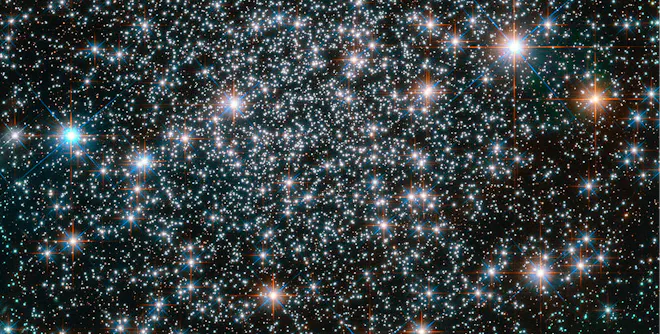
Stars begin their life inside very large, fluffy clouds of space dust and gas called nebulae.
Articles on Stars
Displaying 141 - 160 of 224 articles

Around the world and throughout history, we find remarkably similar constellations defined by disparate cultures, as well as strikingly similar narratives describing the relationships between them.
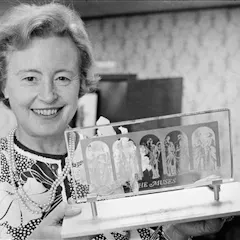
In an age when women were rarely allowed in observatories, Margaret Burbidge changed how we saw the stars.
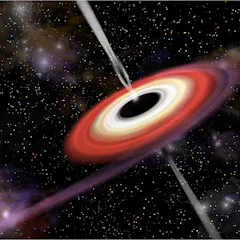
If you got too close to a black hole, it would suck you in and you’d never be able to escape, even if you were travelling at the speed of light.
This point of no return is called the event horizon.

Yes, the Sun absolutely spins. In fact, everything in the universe spins. Some things spin faster than the Sun, some are slower and some things spin ‘backwards’.
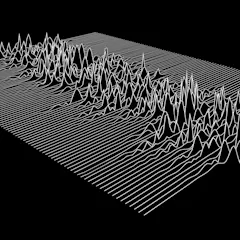
When you look at the squiggly lines on Joy Division’s famous album cover, you’re seeing a record of lightning in outer space.
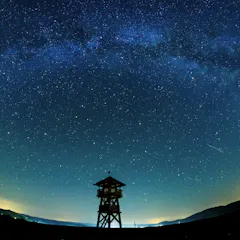
The diameter of the Milky Way is a billion billion kilometres.
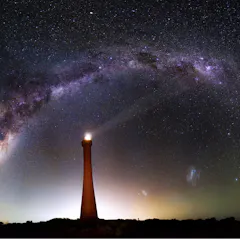
Science is full of surprises. While searching for planets orbiting nearby stars, researchers stumbled across the remains of a star that once outshone the Sun.
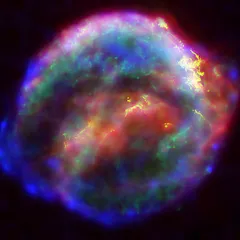
By studying old and dead stars, we can discover what will happen to our sun in the far, far future. And it won’t end with a big explosion.
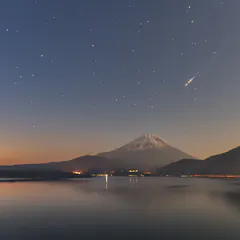
Shooting stars are not stars at all. They are tiny space adventurers who accidentally wander into our sky and get sucked toward us by Earth’s gravity. Here’s the story of a shooting star’s journey.
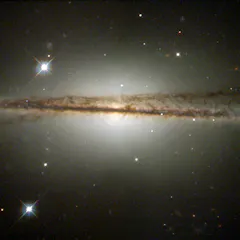
The Milky Way’s disc of stars becomes increasingly warped and twisted the further away they are from the galaxy’s centre.
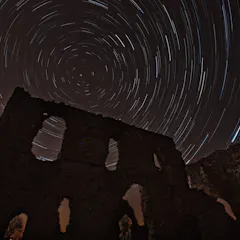
When you look up at the vastness of space you can see hundreds, thousands and even millions of years into the past.

Are there stars other than the Sun that might explode soon close to us? Yes, there are! As long as by ‘soon’ we mean within a million years.

There are lots of places where it’s much, much hotter than the Sun. And the amazing thing is that this heat also makes new atoms - tiny particles that have made their way long ago from stars to us.
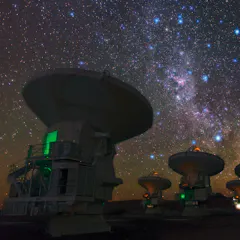
The ‘oldest known nova’ (a star explosion) in the sky was actually not a nova, astronomers show.

We are in the Milky Way. If you travelled on an extremely fast spaceship for more than two million years, you would reach our neighbour, the Andromeda galaxy. All other galaxies are even further away.
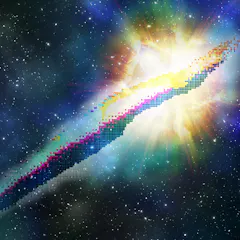
People long assumed all the elements we see now were created during the Big Bang. But on May 2, 1952, an astronomer reported spotting new elements coming from an old star and changed our origin story.
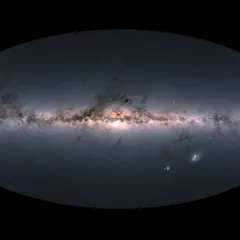
Detailed information about stars in our galaxy could help us discover new exoplanets.
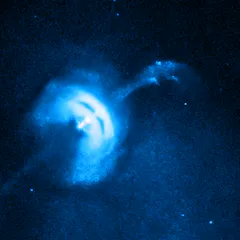
Pulsars are rapidly rotating neutron stars and some of them are know to have a “glitch”, and astronomers have captured one as it hapened.
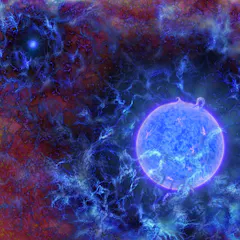
Signals from the first stars to form in the universe have been picked up by a table-sized detector in a west Australian desert. The find also hints at an early interaction with dark matter.
Top contributors
-

Professor (Astrophysics), University of Southern Queensland
-
University Distinguished Professor of Astronomy, University of Arizona
-
Associate Professor in Astronomy, Monash University
-
Senior Curator (Astronomy), Museums Victoria Research Institute; The University of Melbourne
-
Professor (Physics), University of Southern Queensland
-
Associate Dean of Innovation and Engagement, Swinburne University of Technology
-
Lecturer in Astronomy, Nottingham Trent University
-
ARC Laureate Fellow & Distinguished Professor, Centre for Astrophysics & Supercomputing, Swinburne University of Technology
-
Associate Professor, School of Physics, The University of Melbourne
-
Professor, Radio Astronomy, University of Sydney
-
CAASTRO Affiliate Postdoc, The University of Melbourne
-
Professor of Nuclear Physics, Michigan State University
-
Professor and Director of the Centre of Excellence for Data Science, AI and Modelling, University of Hull
-
Professor of Astrophysics and Royal Society University Research Fellow, University of Hertfordshire
-
Lecturer, University of Southern Queensland