
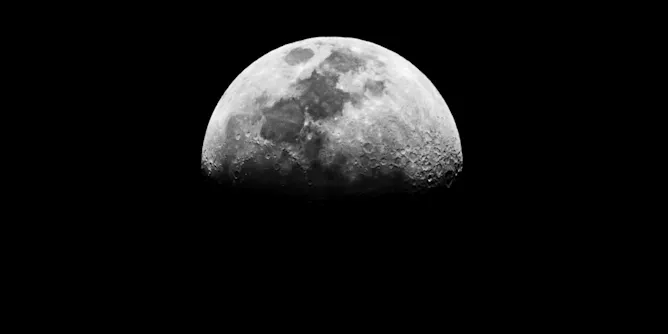
China’s Change'6 is going to explore the Moon’s far side and bring back precious lunar soil for scientists to study.
Articles on Space
Displaying 341 - 360 of 1098 articles

The Starliner launched June 5 after several delays, making it the first commercial crew craft that’s not SpaceX’s Dragon to lift off.
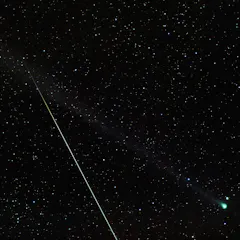
The Eta Aquariid meteor shower peaks each year in early May, but this year it should be particularly good, thanks to dark skies and extra activity.
Astrophysicist Jacco van Loon joins us on The Conversation’s Curious Kids podcast.
The Netflix series ‘3 Body Problem’ is based on Liu Cixin’s scifi novel that follows what happens to the alien residents of a planet that orbits two stars.

It’s not easy to collect rocks on a budget when the rocks are 140 million miles away.

The Perseverance rover has arrived at what’s thought to be an ancient shoreline on Mars.
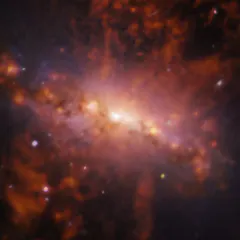
When astronomers focused on the galaxy NGC 4383, they didn’t expect the data to be so spectacular. This is the first detailed map of gas flowing from this galaxy as stars burst within.

If you look carefully at the night sky, you may spot this fuzzy visitor with the naked eye – but binoculars will help.
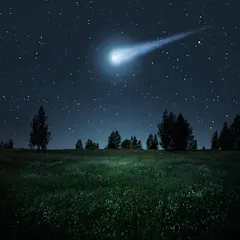
The amount of space junk will increase as we continue to launch objects into space, but there are ways to curb damage on the ground.

Saturn’s moon Enceladus has geysers shooting tiny grains of ice into space. These grains could hold traces of life − but researchers need the right tools to tell.
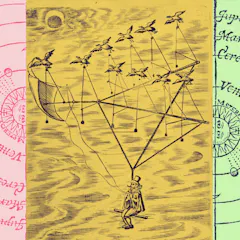
When scientists observed planets revolved around the Sun, they posited we were now like other planets. And if other planets were like Earth, then they most likely also had inhabitants.

Where specialized algorithms fail to classify star-borne pulses, human volunteers with just a little training can step in.
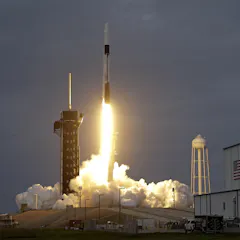
Space exploration is not a waste of resources, but a source of technological and medical advances, a tool for climate monitoring and a source of educational inspiration for youth.
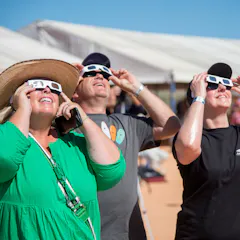
A type of eclipse is crucial for measuring what’s in the atmospheres of planets orbiting distant stars.
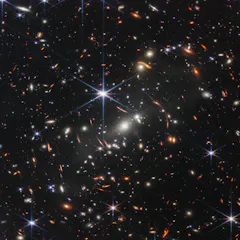
Now out in space for more than two years, the James Webb Space Telescope is a stunningly sophisticated instrument.

Astronomers caught the bizarre ‘awakening’ of an incredibly rare magnetic star.
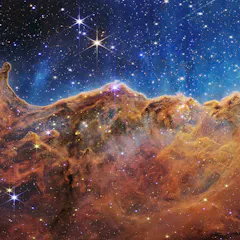
Analysis of fragments of the first solids that emerged out of the birth of the sun date our supernova as being 4.6 billion years old.
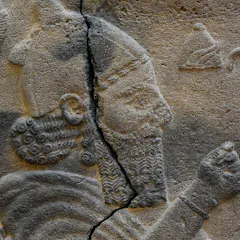
To protect their kings, ancient Mesopotamians discovered how to predict eclipses, which were associated with the deaths of rulers. This eventually led to the birth of astronomy.
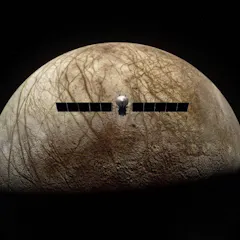
An instrument on the Europa Clipper mission might be able to detect biological cells from space.
Top contributors
-

University Distinguished Professor of Astronomy, University of Arizona
-
Professor of Strategy and Security Studies, Air University
-
Professor (Astrophysics), University of Southern Queensland
-
Professor of Planetary and Space Sciences, The Open University
-
Associate Professor in Archaeology and Space Studies, Flinders University
-
Associate Professor in Astronomy, Monash University
-
Reader in Astrophysics, Keele University
-
Emeritus Professor of International Law, Western Sydney University
-
Senior Lecturer in Physics, Nottingham Trent University
-
Associate Dean of Innovation and Engagement, Swinburne University of Technology
-
Professor of Air and Space Law, University of Mississippi
-
Associate Professor, Astronomy, University of Regina
-
Kevin Orrman-Rossiter is a Friend of The Conversation.
Sterrenkenner, History & Philosophy of Science, The University of Melbourne
-
Professor of Physics and Astronomy, USC Dornsife College of Letters, Arts and Sciences
-
Lecturer in Astronomy, Nottingham Trent University