
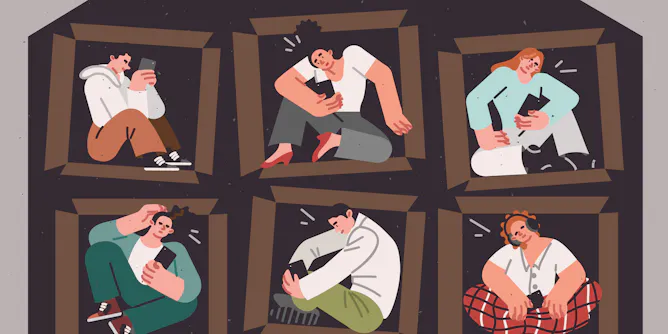
Students in this course learn about the biology and sociology of friendship, but also put their studies to the test by going to eat a meal with a peer, and tracking their experience.
Articles on Social isolation
Displaying 1 - 20 of 110 articles

Loneliness and isolation may shape a young person’s life chances.
Research suggests loneliness and depression can reinforce each other, while social isolation has a more limited effect.

Paid social clubs promise connection with new people, with a lot of the complicated legwork handled. But here’s why they’re unlikely to fix our loneliness epidemic.

Singing does something measurable to your body and brain, whether you are alone, harmonising in a choir, or singing with your friends at a karaoke bar.

Guidelines for social well-being can help health care providers identify when someone is socially isolated and provide goals and standards for policymakers.

It isn’t just social isolation that’s a risk factor for self harm.

Research shows that rural women in the US are more likely to be killed by their current or former male partners compared to their urban and suburban counterparts.

Creating inclusive communities means not just offering services to people with serious mental illness, but changing negative beliefs and behaviors toward them.

A new research review shows live music isn’t just entertainment — it’s a proven way to boost feelings of belonging and community.

Americans are spending more of their time alone. Contrary to national fears of a loneliness crisis, many of them find solitude essential for their well-being.

Even after the pandemic lockdowns were lifted, out-of-home activities and travel remained substantially depressed, far below 2019 levels.

Even OpenAI is worried about people developing intimate relationships with the new human-like version of its language model-cum-chatbot. But it should have known the risks.

One in four Australians report feeling lonely. As more people grapple with a cost-of-living crisis, a key driver of loneliness is financial hardship.

Overlooking the impacts of remote work on motivation may have unexpected consequences for Canadian public services and policies.

Social relationships are a key source of happiness but most people won’t reach out to an old friend.

Before we draw conclusions about the implications of social isolation, we should check our expectations of how, when and why neighbouring does or does not happen.

A recent study showed encouraging people with obesity to interact with others more can keep them alive for longer.

The need to connect is fundamental. But diminishing social ties and community support are contributing to the loneliness epidemic.

COVID was a ‘gendered pandemic’, with women carrying very different burdens to men. A three-year New Zealand research project aimed to overcome the urge to forget, and provide lessons for the future.
Top contributors
-

Associate Professor, Sydney School of Public Health, University of Sydney
-
Associate Professor of Medicine and Geriatrics, University of Virginia
-
Professor of Psychology, The University of Melbourne
-
Assistant Professor in Health Sciences, Simon Fraser University
-
Regents and Distinguished Professor of Environmental and Occupational Health, Texas A&M University
-
PhD Student, New York University
-
Senior Lecturer in Architectural HIstory and Theory, UNSW & Honorary Research Fellow, Australian Centre for Architectural History, Urban and Cultural Heritage (ACAHUCH), UNSW
-
Assistant Professor of Communication, University of Pennsylvania
-
Cornelia H. Dudley Professor of Psychology, Knox College
-
Senior teaching fellow, University of Surrey
-
Associate Professor, Associate Head of School (Research), co-leader of the research network HOME, Deakin University
-
Professor, Director Australian Urban Observatory, Centre for Urban Research, RMIT University
-
NSF Graduate Research Fellow, Penn State
-
Associate Professor in Physical Activity & Health, Durham University
-
Associate Professor of Philanthropic Studies, Indiana University