

Given the right conditions, certain types of cells are able to self-assemble into new lifeforms after the organism they were once part of has died.
Articles on Robots
Displaying 41 - 60 of 397 articles
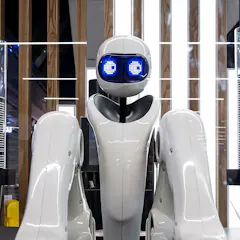
Sometimes, we lie to others to protect their feelings. Maybe robots should be allowed to do the same.
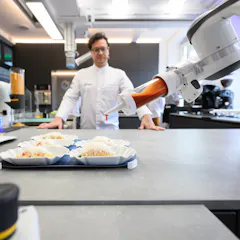
Can automated restaurants still be community and cultural spaces, or will they become feeding stations for humans? These and other questions loom, as AI and robot cooks reach the market.

Dogs and infants may not be able to tell us what they’re thinking, but we are developing the tools that will help us find out.
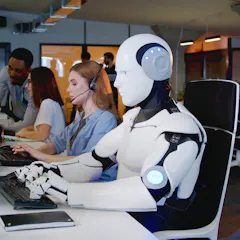
The technology behind ChatGPT could help put humanoid robots in homes and workplaces.
There are hopes AI may be the silver bullet we need to save the environment – but it comes with downsides.
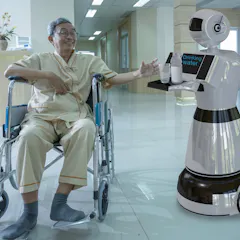
While some nurses have protested the use of robotics and AI in healthcare, new technologies could help care for aging populations offering efficiency alongside the compassion of human nurses

Farmers and soil scientists are starting to use clever tech to reliably measure changes in soil condition.

Disabled people are experts in using – and designing – assistive technologies. They have lessons to offer everyone about keeping control when help is offered.

Green algae carry drug-loaded nanoparticles directly to the lungs, reducing side effects in other organs and increasing treatment efficiency.

The prevailing human reaction to the idea of artificial intelligence has always been fear, revealed in the way film has portrayed our increasingly important relationship with AI over the years.

Stereotypes can creep in if ‘culturally sensitive’ robots are not designed with great care.
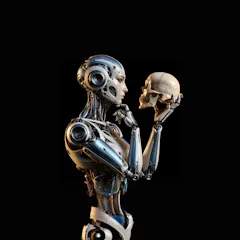
Australian literature is a rich and largely untapped source of information about how Australians think about AI.

Artificial Intelligence’s capacity to mimic and identify emotions is worlds away from the human one to feel.

The next generation of spacesuit needs to do more than simply protect an astronaut from the vacuum of space.
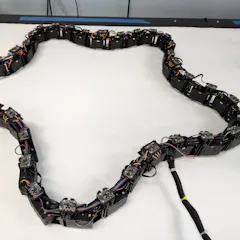
‘Loopy’ is a multicellular robot inspired by biology and designed to react to its environment without instructions on how to do so.

Robots often have a hard time navigating through debris, but robots designed based on worms and snakes could move around obstacles faster, thanks to an idea called mechanical intelligence.

Humanoid robots tend to be white or resemble white people. Here’s why this is a problem and what social scientists, designers and engineers can do about it.

Social robots can be useful tools to help students learn about programming, but here’s why they won’t be replacing classroom teachers anytime soon.
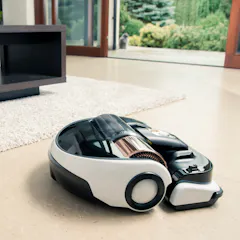
Robotics and AI look set to transform how we carry out domestic work, including caring for other people.
Top contributors
-

Professor in Robotics, Queensland University of Technology
-
Adjunct Senior Lecturer, Applied Ethics and CyberSecurity, Griffith University
-
Professor, Director of the Centre for Robotics, Queensland University of Technology
-
PhD in machine ethics, University of Canterbury
-
Senior Lecturer, Department of Engineering, Nottingham Trent University
-
Professor of AI, Research Group Leader, UNSW
-
Senior Research Fellow and Deputy Director, Centre for Biomedical Technologies, Queensland University of Technology
-
Reader in Autonomous Intelligent Robotics, University of Birmingham
-
Lecturer in Computer Science, Edinburgh Napier University
-
Lecturer in Digital Media and Cultures, The University of Queensland
-
James Martin Research Fellow, Future of Humanity Institute & Oxford Martin School, University of Oxford
-
Researcher in Artificial Intelligence Regulation, Australian National University
-
Associate professor, Australian Catholic University
-
Professor of Orthopaedic Research, Queensland University of Technology
-
Leverhulme Fellow and Lecturer, Faculty of Law, University of Cambridge