
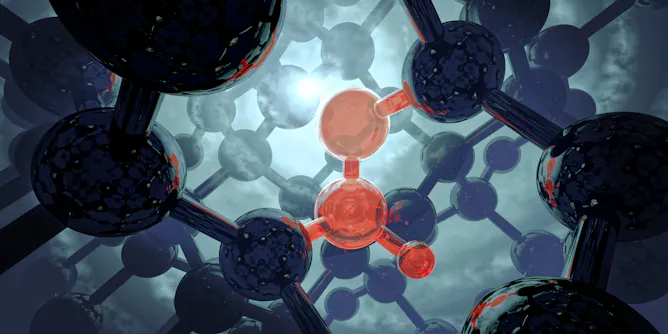
Canada is well positioned to gain far-reaching economic and social benefits from the rapidly developing quantum industry, but it must act now to secure its success.
Articles on Quantum physics
Displaying 21 - 40 of 78 articles

A cultural collaboration with deafblind people led to the development of a high-tech device to help navigate their world post-lockdown
Quantum entanglement is the stuff of sci-fi, advanced physics research and, increasingly, technology used by governments, banks and the military.
Regular matter makes up just one-sixth of all the matter in the universe. What would it mean to finally understand what makes up the rest?

Quantum leaders are curious, adaptable and tolerant of ambiguity and uncertainty.
The quantum nature of light can be harnessed for a variety of purposes.
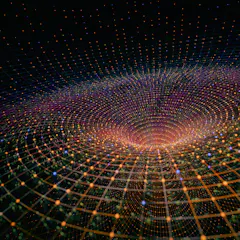
The universe has a finite age — 13.8 billion years to be exact. So if it had a beginning, why is it so difficult to say for sure whether it will have an end?

New experiments could help scientists settle the longstanding debate about whether consciousness is generated by quantum activity.

Einstein was awarded a Nobel prize for his explanation for how light can be described as being made up of individual particles of energy under certain conditions.

If God could break the laws of physics, why haven’t we seen any evidence of the laws ever being broken in the universe?
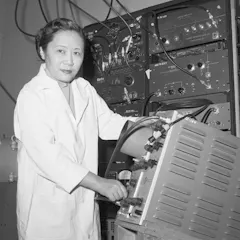
Chinese American physicist Wu worked on the Manhattan Project and performed groundbreaking experiments throughout her long career.
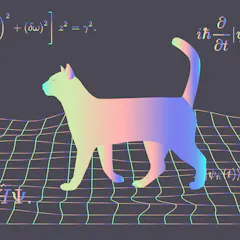
We identify an experimental method which could finally reveal whether objects much larger than atoms - such as humans or animals - can exist in several places at once.

New research shows how the next generation of ultra-secure communication could be possible with existing infrastructure.

Amid trying times, the collaboration between Western science and Eastern philosophy provides numerous health benefits and a path to understanding the natural world.

Generating energy usually means wasted heat. Semiconductors let the electrons flow with zero waste – but so far scientists only know how to get them to work at ultra-low temperatures.

Albert Einstein may have been the ultimate example of a visionary genius, but that did not stop him from twice losing his way due to beliefs that were perhaps not so scientific.
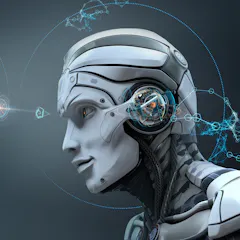
If it’s impossible to accurately predict the future then there may be limits to how smart artificial intelligence can become.

Google claims quantum supremacy – IBM says not so fast. One researcher explains why he doesn’t see quantum computers outpacing classical computers any time soon … and maybe not ever.

To protect the futures of today’s children and youth, schools and universities must go beyond Eurocentric approaches that dissect particulars yet miss the larger point.
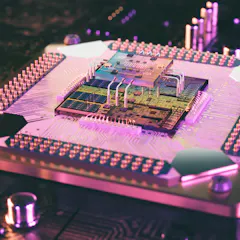
Manufacturing quantum computers would be a lot easier with existing technology than the exotic components currently used to build them.
Top contributors
-

Director, Centre for Quantum Dynamics, Griffith University
-
Professor of Quantum Physics and Quantum Technology, University of Sydney
-
Professor, Philosophy of Science, The University of Melbourne
-
Associate Professor, Griffith University
-
Professor of Electrical and Computer Engineering, Oklahoma State University
-
Professor in Physics, Griffith University
-
Professor of Strategy and Entrepreneurship, ESSCA School of Management
-
Professor of Quantum Technologies (Physics and Astronomy), University of Sussex
-
Professor of Electrical Engineering, Chemistry, and Physics and Astronomy, University of Southern California
-
Director, Maryland Cybersecurity Center; Professor of Computer Science, University of Maryland
-
Professor, The University of Queensland
-
Professor of Strategic Management and Behavioural Science, University of Manchester
-
PhD Candidate, University of KwaZulu-Natal
-
ARC Laureate Fellow, Swinburne University of Technology
-
Researcher on Quantum Technologies, ETH Zurich