
Particles’ properties at the quantum level could one day enable faster computing and better cybersecurity.
Articles on Quantum entanglement
Displaying 1 - 20 of 30 articles

Science fiction sometimes uses quantum concepts to make the impossible seem plausible. But real-world developments will likely have profound societal implications.
A ‘quantum telephone’ connecting atomic nuclei could make practical quantum computers easier to build and use.
Gravitational waves carry information about massive cosmic events and help scientists to ‘listen’ to space.
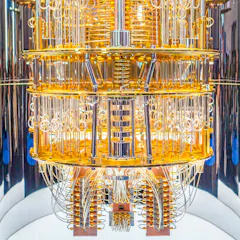
Quantum computing expert Daniel Lidar explains what problems scientists are still trying to overcome to make quantum computing useful.
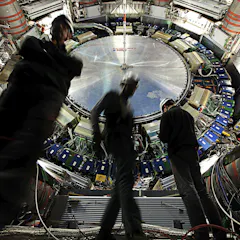
The ATLAS experiment has found quantum entanglement in yet another system: quarks at high energies.
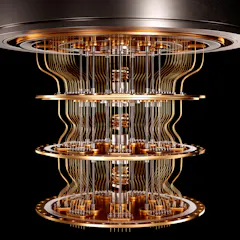
Quantum computing has huge promise from a technical perspective, but the practical benefits are less clear.
When it comes to physics experiments, quantum simulations aren’t quite the real thing – but in some cases they’re much closer than you’d expect.
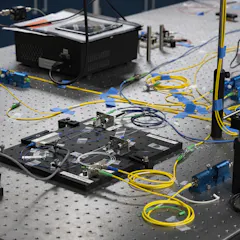
Quantum entanglement is the stuff of sci-fi, advanced physics research and, increasingly, technology used by governments, banks and the military.
A multitude of experiments have shown the mysterious phenomena of quantum mechanics to be how the universe functions. The scientists behind these experiments won the 2022 Nobel Prize in physics.
The quantum nature of light can be harnessed for a variety of purposes.
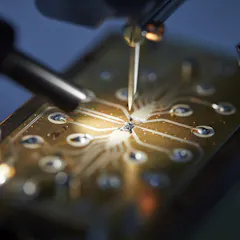
So far researchers have only been able to control a handful of qubits — the basic units of information in a quantum computer. A new approach could help them control millions at a time.
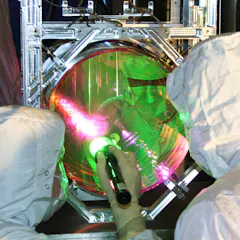
The world’s biggest gravitational wave observatory is now probing the limits of quantum mechanics.

Quantum microscopes reveal biological structures that would otherwise be impossible to see.
Entangled photons have been used for the first time to encode information in a hologram, which could lead to improved medical diagnosis and speed up the advance of quantum technologies.
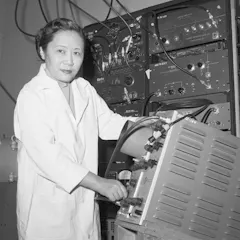
Chinese American physicist Wu worked on the Manhattan Project and performed groundbreaking experiments throughout her long career.

New research shows how the next generation of ultra-secure communication could be possible with existing infrastructure.

The Micius satellite has enabled messages with unbreakable encryption to be sent 1,200km.

Experiment produces thousands of entangled atoms, raising hopes that we can soon create real quantum computers.
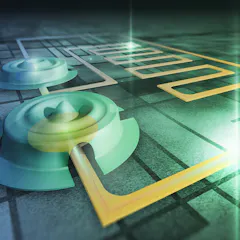
We usually think of quantum entanglement in the realm of atomic systems, but now it’s been scaled up to relatively massive objects. This opens the door to new kinds of technology.
Top contributors
-

Professor of Physics and Director of the Lancaster Quantum Technology Centre, Lancaster University
-
Director, Centre for Quantum Dynamics, Griffith University
-
Researcher in quantum physics, Monash University
-
Professor and Canada Research Chair in Quantum Materials Discovery, University of Winnipeg
-
Lecturer, School of Computer Science and Digital Technologies, Aston University
-
Assistant Professor, Eindhoven University of Technology
-
Professor in Physics, Griffith University
-
Lecturer in Physics, University of Bath
-
Lecturer in quantum physics, Monash University
-
Emeritus Professor, ARC Centre of Excellence for Gravitational Wave Discovery, OzGrav, The University of Western Australia
-
Director, Maryland Cybersecurity Center; Professor of Computer Science, University of Maryland
-
Senior Lecturer in Electrical Engineering, UNSW
-
Research Fellow in Quantum Communication, University of Bristol
-
Scientia Professor in Quantum Engineering, UNSW
-
Postdoctoral Researcher, University of Nottingham