
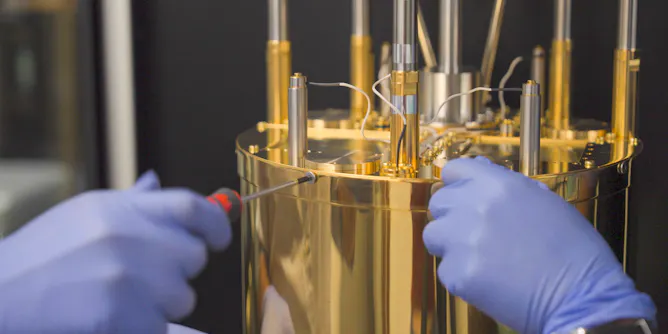
A new facility in Queensland will allow researchers from academia and industry to test new ideas on a real quantum processor.
Articles on Quantum physics
Displaying 1 - 20 of 78 articles
Particles’ properties at the quantum level could one day enable faster computing and better cybersecurity.

Quantum computers are still a work in progress but quantum sensors are already in use at hospitals, laboratories and by defense contractors.

A light particle can appear to leave a cloud of atoms before it enters – a new experiment, asking the atoms, confirms the light spends ‘negative time’ with them.

In quantum batteries, subunits take collective action to charge faster.

Physicists long believed time was a basic feature of the universe. But it may just emerge from cosmic information.
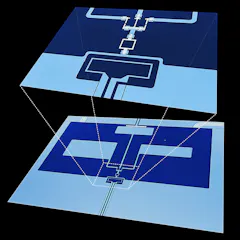
The discovery that superconducting circuits can behave like quantum particles was a revolutionary development in the field of quantum technologies.
Physicists have found a way to redistribute uncertainty in quantum measurements, paving the way for ultra-sensitive atom-scale sensors.
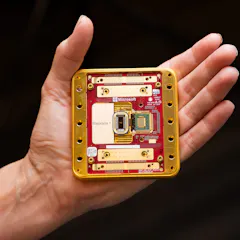
A new “topological” approach to quantum computing may address longstanding challenges with the technology.

Gravitational waves carry information about massive cosmic events and help scientists to ‘listen’ to space.

Scientists thought there was no way to verify the ‘quantumness’ of the enigmatic ‘spin’ just by watching it rotate – until now.

Quantum information theory is the field behind quantum computing, but experts in this field are also applying their way of thinking to some big questions in quantum physics.

Tech giants, major powers and top research universities are all in a race to build viable quantum systems. Why now?
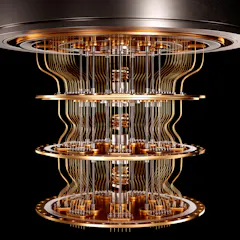
Quantum computing has huge promise from a technical perspective, but the practical benefits are less clear.

A new measurement of gravity at small scales hints at an alternative to billion-dollar experiments for the future of physics.
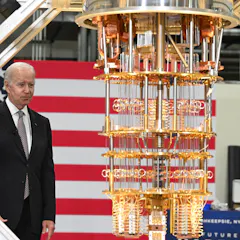
Several companies have made quantum computers, but these early models have yet to demonstrate quantum advantage: the ability to outstrip ordinary supercomputers.

Physicists uncovered a new experiment hidden in old data from the Large Hadron Collider. Using this innovative approach, the team has unlocked an entirely new way to study quantum physics.

Remember building model molecules with balls and sticks in chemistry class? You have J. Robert Oppenheimer to thank for that, as a quantum chemist explains.
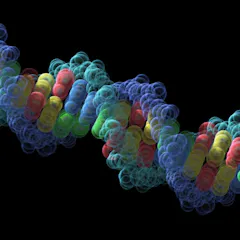
Studying the brief and tiny quantum effects that drive living systems could one day lead to new approaches to treatments and technologies.
Examining microscopic quantum objects is exceedingly tricky, because their properties are connected to each other. But there could be a new method to measure them as accurately as possible.
Top contributors
-

Director, Centre for Quantum Dynamics, Griffith University
-
Professor of Quantum Physics and Quantum Technology, University of Sydney
-
Professor, Philosophy of Science, The University of Melbourne
-
Associate Professor, Griffith University
-
Professor of Electrical and Computer Engineering, Oklahoma State University
-
Professor in Physics, Griffith University
-
Professor of Strategy and Entrepreneurship, ESSCA School of Management
-
Professor of Quantum Technologies (Physics and Astronomy), University of Sussex
-
Professor of Electrical Engineering, Chemistry, and Physics and Astronomy, University of Southern California
-
Director, Maryland Cybersecurity Center; Professor of Computer Science, University of Maryland
-
Professor, The University of Queensland
-
Professor of Strategic Management and Behavioural Science, University of Manchester
-
PhD Candidate, University of KwaZulu-Natal
-
ARC Laureate Fellow, Swinburne University of Technology
-
Researcher on Quantum Technologies, ETH Zurich