
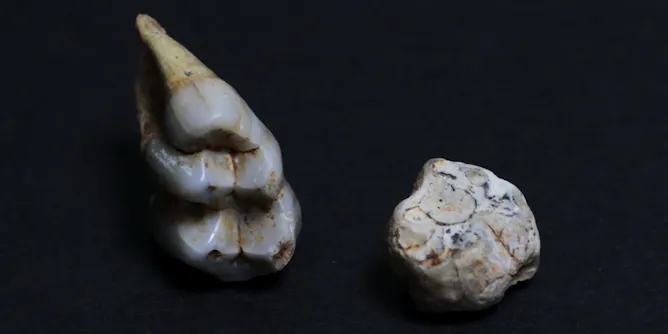
The rise and fall of monkeys in ancient Europe should remind us of our own species’ precarious relationship with changing climates.
Articles on Pleistocene
Displaying 21 - 27 of 27 articles

Given that we know humans moved across these landscapes, we wondered whether there might also be evidence of other forms of human activity on these surfaces of sand.
The Indian summer monsoon rainfall affects the lives of over a billion people. By looking at how prehistoric climate changes affected it, scientists can contribute to its future prediction.
A 20-year-old experiment is testing whether filling the Arctic tundra with animals could keep carbon trapped in the ground.
Fossils of a whale thought to be found only in southern waters have been discovered at two sites in the northern hemisphere.

A team of archaeologists strived to improve the reproducibility of their results, influencing their choices in the field, in the lab and during data analysis.
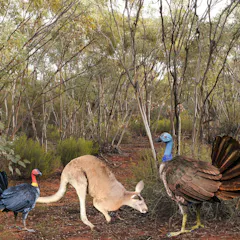
Large birds once lived across Australia, only to become extinct around the time that giant marsupials and other megafauna died out during the Pleistocene “ice ages”.
Top contributors
-

Research Associate, African Centre for Coastal Palaeoscience, Nelson Mandela University
-
Professor, Flinders University
-
Senior Lecturer, Geography and Environmental Sciences, Northumbria University, Newcastle
-
Curator of Vertebrates, Museum of New Zealand Te Papa Tongarewa
-
Professor of Climate Science, University of Bristol
-
Researcher, Flinders University
-
Research Centre of Archeometry, Badan Riset dan Inovasi Nasional (BRIN)
-
Senior Curator, Vertebrate Palaeontology, Museums Victoria Research Institute
-
Professor of Archaeology, Griffith University
-
Postdoctoral Researcher in Archaeogenetics, Max Planck Institute for Evolutionary Anthropology
-
Professor, University of Wollongong
-
Professor of Ocean Biogeochemistry and Palaeoclimate, The Open University
-
Professor of Bioorganic Chemistry and Paleobiotechnology, Friedrich-Schiller-Universität Jena
-
Lecturer in Physical Geography, Newcastle University
-
Associate Professor in Vertebrate Palaeontology, Flinders University