

More fossil tracks of vertebrates have come to light on the South African coast, adding to the picture of an ancient plain full of wildlife.
Articles on Fossil tracks
Displaying 1 - 20 of 30 articles
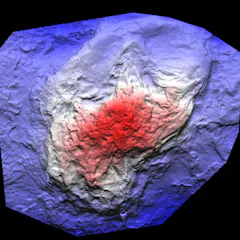
Dinosaur tracks from the Cretaceous period have been found in South Africa for only the second time.

Long ago, people identified fossils in their environment and explained them within their own cultural framework. This was early citizen science.

These tracksites appear to contain the first recorded Pliocene vertebrate tracks described from southern Africa.
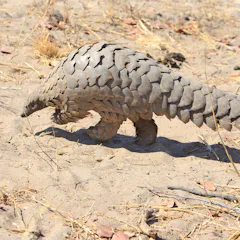
No fossilised pangolin tracks had been recorded anywhere in the world until a track was found in South Africa, dated to between 90,000 and 140,000 years ago.
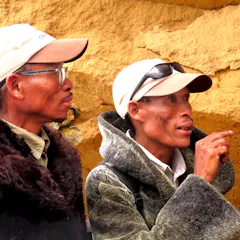
Animal trackers using traditional skills helped to find and identify fossil tracks on the coast of South Africa.
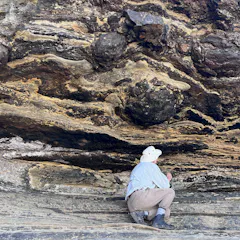
Dinosaur tracks were found in a rugged, remote coastal South African setting.
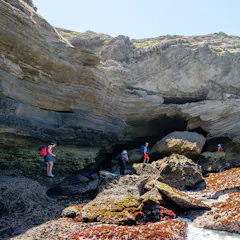
South Africa is home to some remarkable geoheritage.
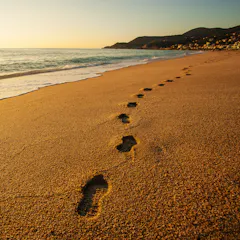
Tracks and traces from long ago are preserved in cemented dune surfaces.

At a global level it is rare to find fossilised hominin tracks.

The image underscores the depth of indigenous knowledge exemplified by San people.
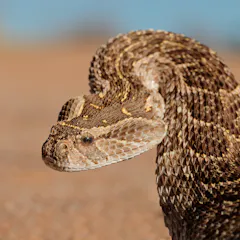
The trace was probably made between 93,000 and 83,000 years ago, almost certainly by a puff adder.

Trackway findings support the notion of southern Africa being one region where human cognitive and practical ability developed a very long time ago.
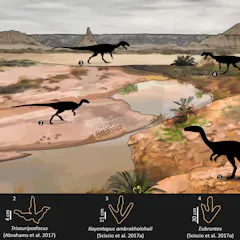
Fossilised tracks of a group of plant-eating dinosaurs have been found in Lesotho’s Roma Valley for the first time.

Ammoglyphs – ancient ‘sand art’ – are a relatively new find.

It hasn’t been clear how common the species was on the Cape south coast because its body fossils are predominantly from southern Africa’s west coast.

Studying fossil dung offers another avenue for scientists trying to recreate ancient landscapes.
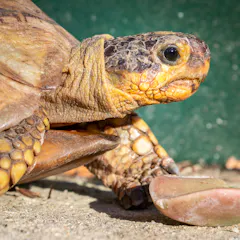
Track marks are a way to fill in the blanks that sometimes exist in the body fossil record.
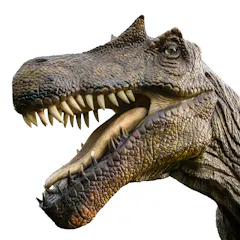
The African continent is a rich repository for dinosaur fossils, including teeth and track marks.
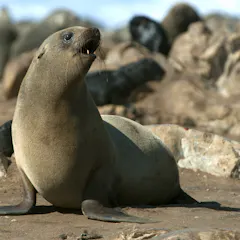
The fossilised seal traces date back about 75,000 years.
Top contributors
-

Research Associate, African Centre for Coastal Palaeoscience, Nelson Mandela University
-
Lecturer, University of Cape Town
-
Researcher and curator, Jurassica Museum
-
Specialist Scientist, Council for Geoscience
-
Honorary researcher, Evolutionary Studies Institute, University of the Witwatersrand
-
Clive Thompson is a Friend of The Conversation.
Research Associate, African Centre for Coastal Palaeoscience, Nelson Mandela University
-
Associate professor in Vertebrate Palaeontology, University of the Witwatersrand
-
Senior Research Assistant (Palaeontology), Queensland Museum
-
Principal Research Fellow Applied Palaeontology & Palaeotourism, CQUniversity Australia
-
Assistant Professor, University of the Witwatersrand
-
Palaeontologist, Earth Science Faculty, University of New England
-
Professor in Geological Sciences, University of Cape Town
-
Senior Lecturer, University of Leicester
-
Professor of Environmental and Geographical Sciences, Bournemouth University; University of Reading
-
Research Associate, African Centre for Coastal Palaeoscience, Nelson Mandela University