
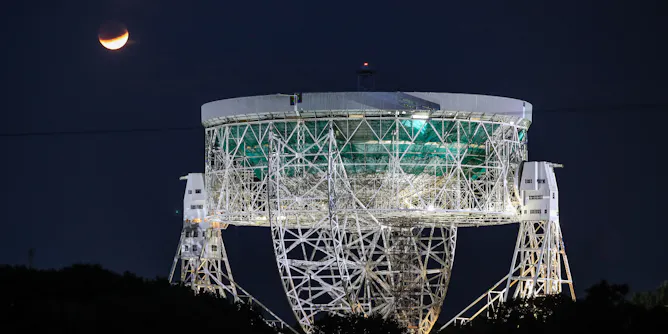
Radio telescopes are incredibly sensitive to phone network interference.
Articles on Moon
Displaying 241 - 260 of 418 articles
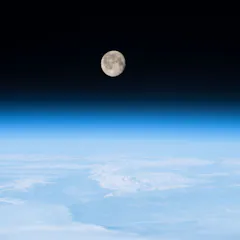
The Earth’s magnetic field was most likely weaker when life evolved on our planet than it is today.
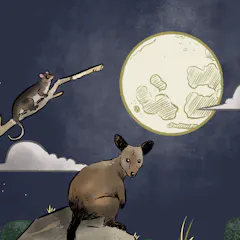
Three recent studies shed new light, as understanding how the behaviour of Australia’s wildlife changes at night can help scientists better protect them.
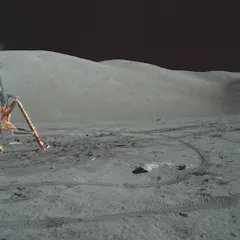
When it comes to managing the tussle for resources on the Moon, we might take lessons from New Zealand environmental law and TikTok ‘witches’.

Towns and cities create an orange glow on the horizon at night. It’s so widespread that it even disturbs sea creatures.
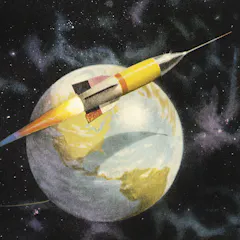
An update of 50-year-old regulations has kickstarted research into the next generation of rockets. Powered by nuclear fission, these new systems could be the key to faster, safer exploration of space.
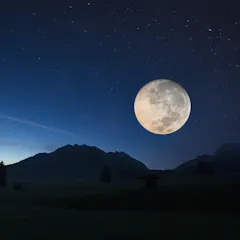
US and international law conflicts about who would be in charge if a private company established a Moon base or colonized Mars.
From the Moon’s size to the first calculator, the ancients made some jawdropping discoveries without modern technology.
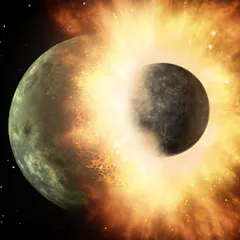
The Earth and the Moon were long thought to be virtually identical in composition. Now we know they are not.
Earth currently has a second moon - but it won’t stay long.
Sex technologies and ‘erobots’ could help address issues related to human desire, and physical and emotional needs of astronauts in space.

The Earth’s shadow does not cause the Moon’s phases.
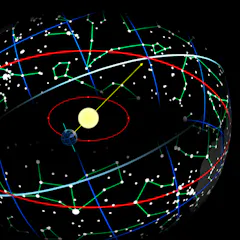
Astronomy and astrology do not agree on the dates of the zodiac constellations.
On December 26 a solar eclipse will be visible from northern Australia, southern Asia and parts of the Middle East.

Many people are still upset that Pluto was demoted from being a planet. But definitions of various celestial objects are fairly fluid. So whether it is an asteroid or moon or planet is up for debate.
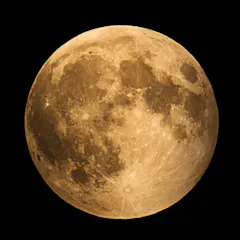
Young readers ask: How did our moon get its name?
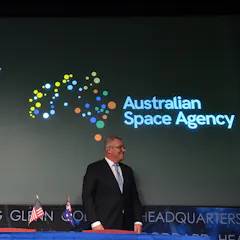
From solar sail-powered spacecraft, to laser communications, to asteroid detection systems, there is no shortage of Australian ideas and expertise to help NASA explore the Moon and Mars.
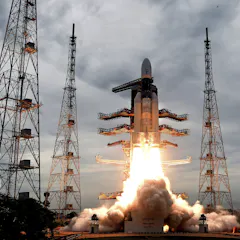
Are India and China engaged in a new space race? India’s increasingly ambitious space ventures, including its Chandrayaan-2 lunar mission, are evidence of the country’s interest in space exploration.
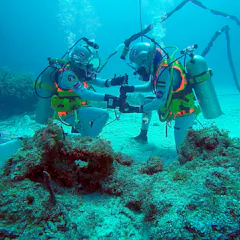
How is NASA preparing astronauts for high-stress living on the Moon? Turns out the answer is by living in undersea bases just off the coast of Florida in a lab known as Aquarius Reef Base.

Current plans for lunar exploration may end up destroying ancient, genetic samples from Earth that have ended up on the moon.
Top contributors
-

Senior Curator (Astronomy), Museums Victoria Research Institute; The University of Melbourne
-
Professor of Planetary Geosciences, The Open University
-
Associate Professor in Archaeology and Space Studies, Flinders University
-
Professor of Air and Space Law, University of Mississippi
-
Professor (Astrophysics), University of Southern Queensland
-
Senior Lecturer in Physics, Nottingham Trent University
-
Postdoctoral research associate, University of Oxford
-
Professor of Planetary and Space Sciences, The Open University
-
Professor in Earth and Planetary Science, Western University
-
Reader in Astrophysics, Keele University
-
Andrew Dempster is a Friend of The Conversation.
Director, Australian Centre for Space Engineering Research; Professor, School of Electrical Engineering and Telecommunications, UNSW
-
Associate Professor of International Affairs, Georgia Institute of Technology
-
Podcast host, The Conversation
-
Space Plasma Physicist, Imperial College London
-
Professor of Planetary Science and Exploration, The Open University
