
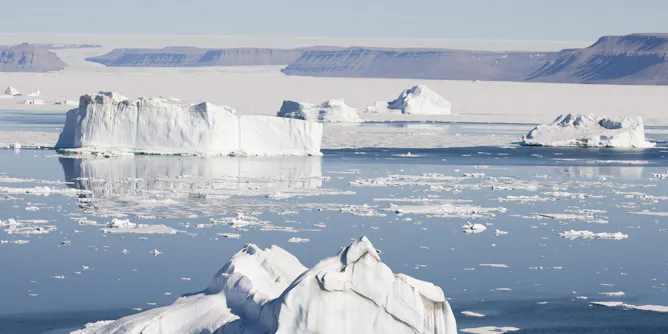
Climate change impacts are nonlinear and unevenly distributed. In the Arctic, rising temperatures affect glaciers’ ability to store water, leading to rising sea levels.
Articles on Meltwater
Displaying all articles
The Antarctic Slope Current shields Antarctica from warm waters. But new research shows meltwater is speeding up the current, which could make it more unstable.

Part of the system that pumps water, heat and nutrients around the globe is at risk. Climate change could slow the Antarctic Circumpolar Current down 20% by 2050.
Scientists now have a better understanding of the risks ahead and a new early warning signal to watch for.
Glaciologists are discovering new ways surface meltwater alters the internal structure of ice sheets, and raising an alarm that sea level rise could be much more abrupt than current models forecast.
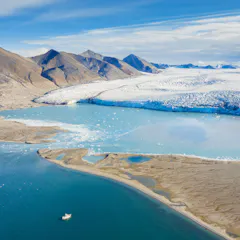
To fully understand the extent of climate-related dangers the Arctic – and our planet – is facing, we must focus on organisms too small to be seen with the naked eye.

Scientists have detected a 30% slowdown of the deep ocean currents that form in Antarctica, with profound consequences for Earth’s climate, sea level and marine life.
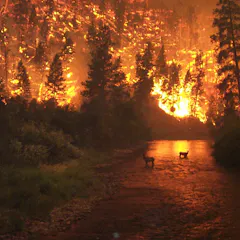
Fires here can affect meltwater timing and water quality, worsen erosion that triggers mudslides, and much more, as two scientists explain.
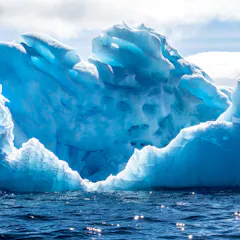
In a plot reminiscent of the 2004 movie The Day After Tomorrow?, Australian scientists are warning that the Southern Ocean’s deep “overturning” circulation is slowing and headed for collapse.
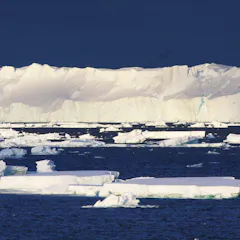
Antarctica’s ice shelves have helped insulate it from dangerous levels of ice loss. But this is changing.
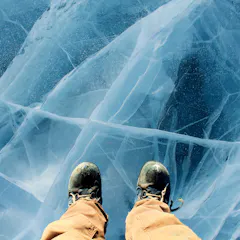
Melting lakes on ice shelves can widen cracks within them - new research shows how these lakes change across the world’s largest sheet.

Glaciers in North America, Europe and the Andes, in particular, have significantly less ice than people realized.
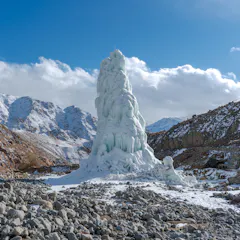
Constructed ice domes release water during dry periods when rain is blocked by high mountain ranges, stifling essential crop cultivation for rural communities.
Top contributors
-

Director of the ARC Centre of Excellence for Our Future Oceans and Scientia Professor in Oceanography, UNSW
-
CSIRO Fellow, CSIRO
-
Postdoctoral associate, Massachusetts Institute of Technology (MIT)
-
Research Associate in Climate Science, Massachusetts Institute of Technology (MIT)
-
Professor and Director of ACCESS-NRI, Australian National University
-
Postdoctoral Researcher in Climate Physics, Utrecht University
-
Professor of Geography and the Environment, School of Geosciences, University of Aberdeen
-
Scientist at NASA's Jet Propulsion Laboratory, California Institute of Technology
-
Associate Professor of Civil Engineering, Boise State University; United Nations University
-
Reader in Biology, Department of Life Sciences, Aberystwyth University
-
PhD Candidate in Cryospheric Remote Sensing, Durham University
-
Professor of Physics, Utrecht University
-
Senior Researcher in Antarctic Remote Sensing, University of Tasmania
-
University of Southampton
-
Senior Lecturer in Climate and Fluid Physics, Australian National University