

The bipartisan revolution against automated license plate readers suggests Americans have not entirely lost their rebellious spirit.
Articles on Law enforcement
Displaying 1 - 20 of 116 articles

Growing concerns about police use of AI could erode the public’s perception of trust in the legal system.
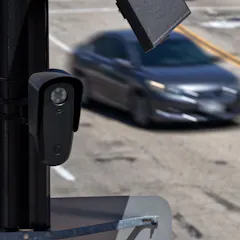
License plate readers are widely used in the US. A new product marketed to police departments promises to add the ability to sense phones and other devices in passing cars.
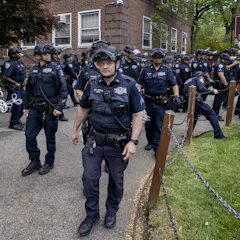
A persistent government strategy to sow fear through punitive measures has corroded freedom and democracy.

Danger arises when law enforcement believes that AI models are retrieving certainties rather than generating likelihoods.
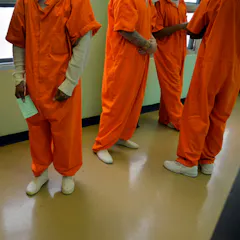
A new policy at Allegheny County Jail allows incarcerated people to earn money for their work. The goal is to improve conditions for everyone involved.

The US may be experiencing democratic backsliding. Around the world, nonviolent civil movements exist to support democracy and protect fellow citizens.

Black children who go missing are often labeled as runaways, which excludes them from the Amber Alert system.

Canada urgently needs stronger privacy laws, ones that deal explicitly with facial recognition.
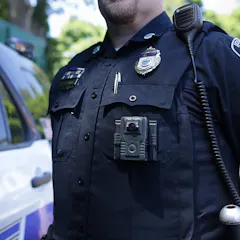
For body cameras to function as transparency tools, wrongdoing would have to be consistently penalized, highlighting the consequences of noncompliance.

Police have charged a man with throwing a homemade bomb into a protest crowd. It’s the alleged result of an increasingly complicated style of terrorism.
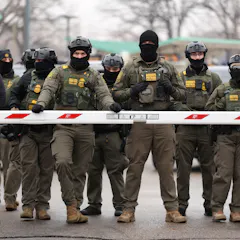
A policing scholar and former FBI special agent lays out the established principles of policing and constitutional law that govern how federal immigration enforcement efforts should be carried out.
A US district judge is weighing whether the surge of ICE agents in the state violates the US Constitution or falls within the executive’s power to enforce federal law.

Police departments have changed their policies regarding use of force over the years to protect life, but ICE and other federal agencies have lagged in this regard.

Founder Stewart Rhodes says he will relaunch the group, serving as an important outlet for thousands of members who have felt lost since his imprisonment, a scholar writes.

Florida’s new unified human trafficking database allows criminologists to determine the scope of the problem and find patterns of exploitation.
Child sex traffickers are typically white, wealthy men who often insulate themselves from detection and charges, according to a sexual exploitation scholar.

Longtime mob reporter George Anastasia explains how intensive electronic eavesdropping revealed dialogue that surpassed Hollywood scripts.

AI-generated police reports promise to save cops time, but they also raise a host of legal and technical concerns.

A surrender plan aims to send a message to Dezi Freeman that he has options open to him to bring things to a peaceful end.
Top contributors
-

Associate Professor in Criminal Justice and Criminology, Bond University
-
Professor of the Practice of Law, University of Southern California
-
Professor of Sociology and Criminology, Villanova University
-
Ph.D. Candidate in Geography and Assistant Director at the Center for Refugee Studies, Indiana University
-
Postdoctoral Researcher of Law and Public Administration, University of Virginia
-
Professor Emeritus of Criminal Justice, University of Alabama at Birmingham
-
Founders Professor of Criminology and Criminal Justice, University of Missouri-St. Louis
-
Associate Professor in Criminology, Deakin University
-
Professor of Sociology, Lancaster University
-
Assistant Professor, Sociology, Memorial University of Newfoundland
-
Associate Professor of Journalism, The University of Texas at Austin
-
Postdoctoral Fellow, Cyber Security Project, Belfer Center for Science and International Affairs, Harvard University
-
Professor of Law, Suffolk University
-
Professor of International Security, University of Bradford
-
Senior Lecturer in human-centred computing & human-computer interaction, Western Sydney University