

What should ordinary citizens be doing?
Articles on Policing
Displaying 1 - 20 of 375 articles

Rural and regional areas bear a disproportionate burden of domestic violence. Distance, police staffing and station hours aren’t the only barriers to seeking help.

AI could speed up some police work, but trusting it with evidence raises difficult questions about accuracy, accountability and justice.

The issue is not whether cities should use technology for public safety, but how those technologies are chosen, evaluated and governed.

Most people credit policing or the lack of it, but the real story tracks three trends that rose and fell together.
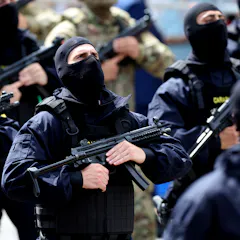
Africa’s ‘coup belt’ has seen rising anti-Western sentiment.

One woman said her husband and his friends told her that, in Australia, police strip-search women who complain about domestic violence.

The government says proposed move-on orders will tackle disorder. Critics argue they risk punishing homelessness while doing little to address its causes.
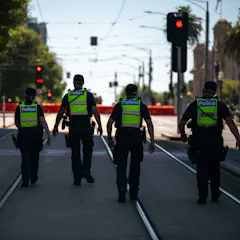
New research has found why so many Australians no longer trust police. There are solutions, though.

Danger arises when law enforcement believes that AI models are retrieving certainties rather than generating likelihoods.
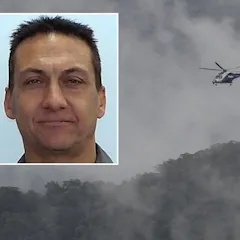
A fugitive going off the grid is one of the greatest challenges police face, which may explain how Dezi Freeman eluded authorities for so long.
In February police said they strongly believed Dezi Freeman was dead. It may have been a tactic that helped bring the manhunt to an end.
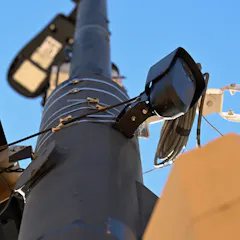
What began as a tool to identify threats to national security is becoming a surveillance infrastructure that can be used to track everyone.

West Midlands and other English police forces have been criticised for over-reliance on AI tools.
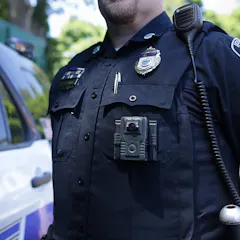
For body cameras to function as transparency tools, wrongdoing would have to be consistently penalized, highlighting the consequences of noncompliance.
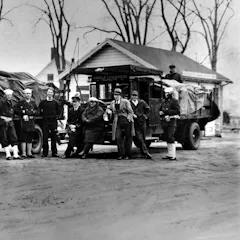
Both Prohibition and current mass deportation efforts were hastily built, staffed by people permitted to use force, and had difficult objectives to achieve.
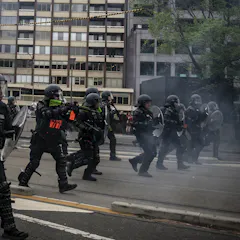
Worrying developments in NSW and Queensland highlight a masculine culture of policing that often fails vulnerable people.
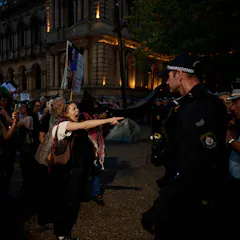
Multiple states have moved to tighten protest rules and increase police powers. But these laws aren’t adequately balancing public safety with human rights.
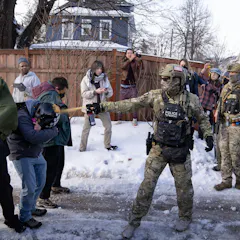
Federal immigration agents tend to receive less training on how to properly deploy crowd-control weapons, research finds.

It’s a common misconception that facial recognition technology captures and stores an image of your face.
Top contributors
-

Associate Professor in Criminal Justice and Criminology, Bond University
-
Professor of Law, University of Technology Sydney
-
Assistant Professor of Criminal Justice and Criminology, Georgia State University
-
Emeritus Professor in Law and Criminal Justice, Adelaide University
-
Senior Lecturer in Law, UNSW
-
Associate Professor, UNSW
-
Assistant Professor, Augusta University
-
Professor (Practice), Faculty of Business and Economics, Monash University
-
Professor Emerita of Criminology, UNSW
-
PhD Candidate in Social Work and Criminology, UNSW
-
Professor, Sociology, University of Alberta
-
Professor of Criminology, University of Leeds
-
Eleanor Rathbone Chair of Sociology, University of Liverpool
-
Assistant Professor of Criminology and Criminal Justice, University of South Carolina
-
Associate Professor in Law, University of Canterbury