
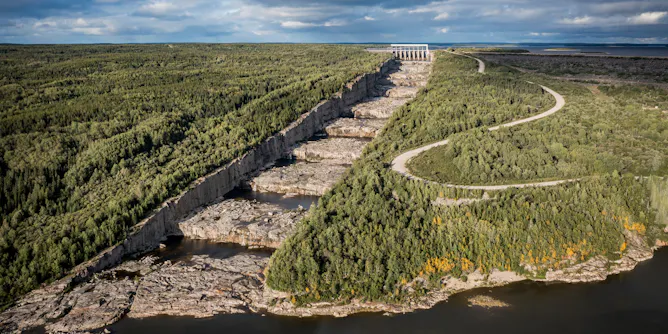
In the face of the energy transition, producing energy will be much more expensive than energy efficiency, which is still largely under-exploited.
Articles on Hydroelectricity
Displaying 1 - 20 of 45 articles

Kenya’s electricity instability is not one problem – it’s an interaction between network capacity and system reliability.

Snowy 2.0 will bring something genuinely new to Australia’s electricity system: large and long lasting energy storage
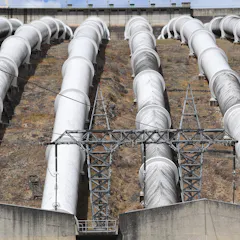
As the cost of Snowy 2.0 rises yet again, defenders claim the scheme can store energy cheaper than batteries. But this doesn’t stack up.
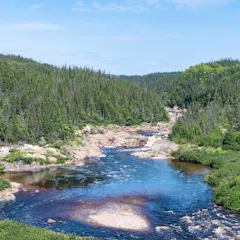
The agreement with the Innu comes at a time when Québec seeks to develop its battery industry. The resources required for this production are often located on Indigenous territories.
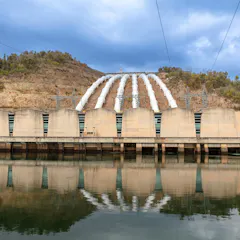
Research reveals most of the sites the Coalition has earmarked for nuclear power plants would be suitable for pumped hydropower plants.

The Canada-U.S. Columbia River is relied upon by millions and governed by a treaty in desperate need of updating. Here is how a modern Columbia River Treaty could work.
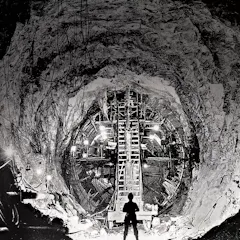
Workers tunnelling through mountains and redirecting rivers, powering and irrigating the nation. We think of the Snowy scheme as a successful nationbuilding project – but it wasn’t always that way

A combination of climate change, a strong El Niño and an insistence on works of enormous impact are contributing to an unprecedented and extremely urgent situation in the region
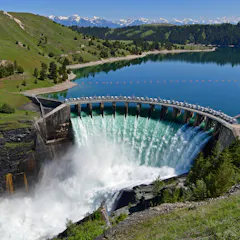
How does flowing water make electricity? An engineer explains hydroelectric generation.
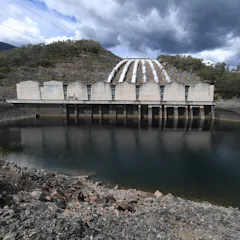
To get to 82% renewables by decade’s end means storage - and that’s where we hope our new atlas of sites for pumped hydro storage can help
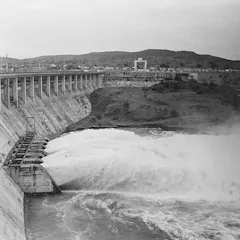
The mega dam in Jinja was meant to give Uganda energy independence, but this was constrained by Britain’s agricultural interests in Egypt.
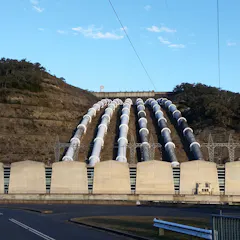
Pumped hydro offers us large scale energy storage. If we do it carefully, we can make sure these dams don’t cause the damage of the past.

If South Africa fails to implement the 2019 Integrated Resource Plan, it will lead to the demise of Eskom as an energy producer as users turn to alternative electricity sources.
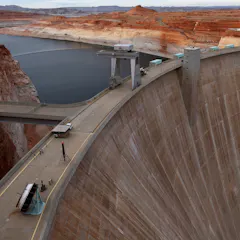
Climate change is affecting hydropower in different ways across the country.
Nigeria’s national electricity grid has collapsed more than 200 times since 2010, regularly resulting in widespread blackouts.

In an effort to save Lake Pedder from a hydro-electricity scheme, the world’s first political party with a foundation in environmental values was formed in Tasmania.

Diverting water to a hydroelectric dam might seem eco-friendly, but the devastating consequences to local ecosystems cannot be ignored.
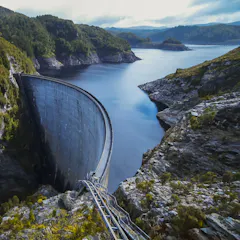
The world hydropower industry has public relations work to do, if its global expansion is to be realised. But stringent oversight is urgently needed.
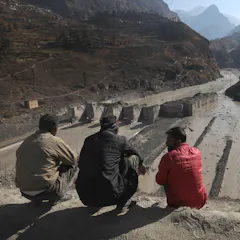
Dams built in an earlier age are suddenly vulnerable as the climate shifts.
Top contributors
-

Professor of Engineering, Australian National University
-
Research Officer, School of Engineering, Australian National University
-
Professor, Fenner School of Environment & Society, Australian National University
-
Senior Research Associate, Renewable Energy & Energy Systems Analyst, UNSW
-
Senior Lecturer Environmental Management, Australian National University
-
Energy Advisor, formerly, The University of Melbourne
-
Associate professor, Fenner School of Environment and Society, Australian National University
-
Professor Emeritus and Former Deputy Vice Chancellor, The University of Melbourne
-
Lecturer in International Development, University of Sussex
-
ARC Future Fellow, Fenner School of Environment and Society, Australian National University
-
Honorary Associate Professor, Centre for Climate Economics and Policy, Australian National University
-
Professor in Physical Geography, Northumbria University, Newcastle
-
Assoc Prof. Renewable Energy, Monash University
-
University of Southern Queensland
-
Professor, School of Natural Sciences, Macquarie University