
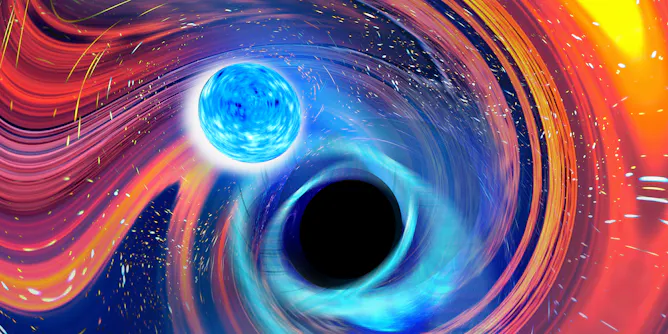
The aftermath of a black hole colliding with a neutron star has been recorded on Earth.
Articles on Gravitational waves
Displaying 21 - 40 of 96 articles
Gravitational waves reveal the demise of super-dense neutron stars spiralling into their black hole companions - the first time such strange and exotic star systems have ever been observed.
The world’s biggest gravitational wave observatory is now probing the limits of quantum mechanics.

A small add-on to existing gravitational wave detectors could reveal what happens to matter as it becomes a black hole, a process like the big bang in reverse.
The 2020 Prime Minister’s Prizes for Science have recognised momentous achievements in astrophysics, sustainability innovation, epigenetics and primary and secondary teaching excellence.
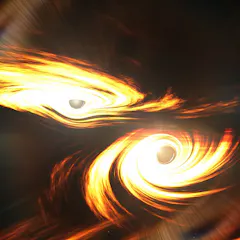
New discovery settles a wager between astrophysicists: black holes can merge repeatedly.
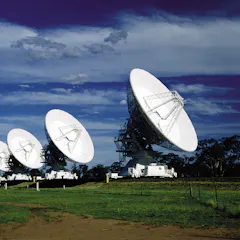
An upgrade for the Australia Telescope Compact Array will enable major new discoveries about the universe
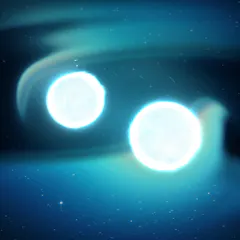
The signal came in on ANZAC Day, ripples in space-time from the merger of two neutron stars an estimated 500-million light years away. But where it happened is still a mystery.
More ripples in space-time have been detected from merging pairs of black holes, one of which was the most massive and distant gravitational-wave source ever observed.
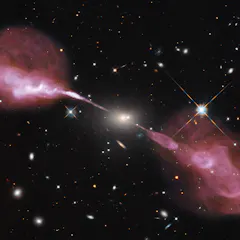
Merging supermassive black holes would emit gravitational waves, allowing scientists to detect them.
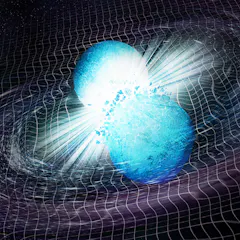
Astronomers are now able to detect a host of signals streaming through the universe. This newfound ability is like gaining new senses and it’s opening the door to understanding the cosmos.
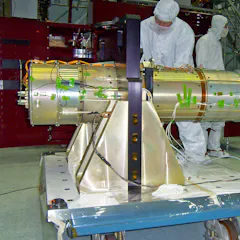
The Swift Observatory passed a milestone: 1 million snapshots of the universe. These exquisite and revealing pictures have captured the births and deaths of stars, gravitational waves and comets.
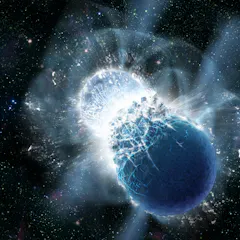
To better detect gravitational waves, we need to build the quietest and most isolated thing on Earth. And make sure we don’t drop those 40kg mirrors.
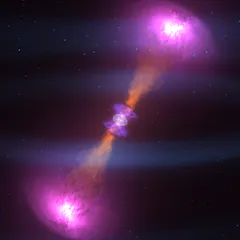
Astronomers are getting ready to say good bye to the radio emission from a neutron star merger – one of the most energetic events in the universe – that was detected last year.
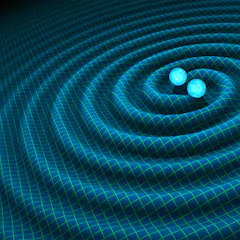
From a slow hum to a chirp or a bleep, what is that sound you hear whenever there’s a new detection of gravitational waves?
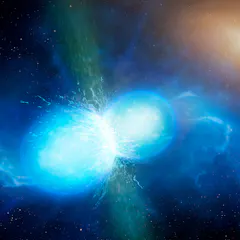
Cosmologists who were hoping to be the next Einstein have had to bin their theories.
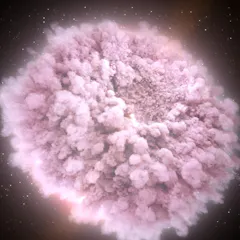
Until the recent observation of merging neutron stars, how the heaviest elements come to be was a mystery. But their fingerprints are all over this cosmic collision.
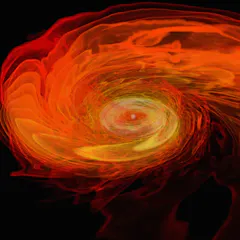
A LIGO team member describes how the detection of a gravitational wave from a new source – merging neutron stars – vaults astronomy into a new era of ‘multi-messenger’ observations.
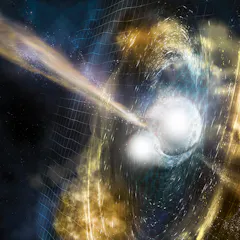
Astronomers have finally confirmed the source of the latest detected gravitational waves was the collission of a pair of neutron stars, what they’d been searching for all along.
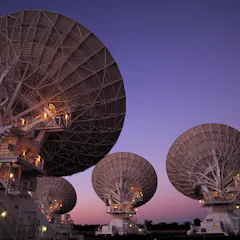
All it took was a single email alert to send the world’s astronomers searching for the source of the latest gravitational wave detected.
Top contributors
-

Emeritus Professor, ARC Centre of Excellence for Gravitational Wave Discovery, OzGrav, The University of Western Australia
-
Senior Lecturer and ARC Future Fellow, Monash University
-
Pro Vice-Chancellor Flagship Initiatives, Swinburne University of Technology
-
Professor of Physics, Penn State
-
Professor, Monash University
-
Professor, Radio Astronomy, University of Sydney
-
Reader in Physics, University of Sheffield
-
Professor of Gravitational Astrophysics and Cosmology, University of Glasgow
-
Cosmologist, University of Tasmania
-
South African Research Chair in Physical Cosmology, Department of Mathematics and Applied Mathematics, University of Cape Town
-
OzGrav Associate Investigator; Research Fellow in Astrophysics, The University of Western Australia
-
Professor of Physics, University of Wisconsin-Milwaukee
-
Research fellow, The University of Western Australia
-
Professor of Physics and Mathematics, Queen's University Belfast
-
Professor of Mathematical Physics, University of Cape Town