
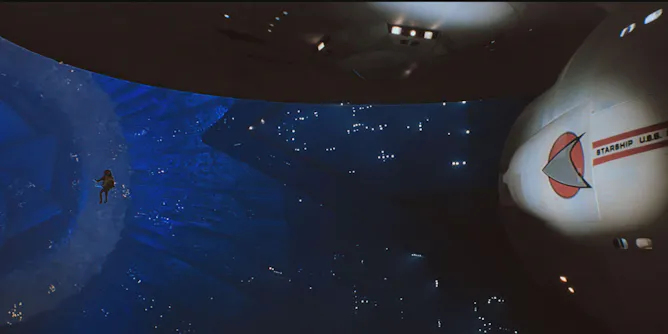
The first appearance of a wormhole in Star Trek was a typically pioneering reference to what was then a niche research topic.
Articles on General Relativity
Displaying 1 - 20 of 79 articles
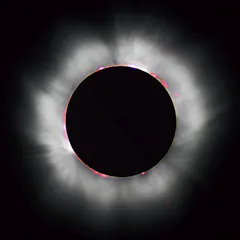
What’s the most impressive natural phenomenon known to humankind? Probably a solar eclipse! Here’s a brief overview ahead of this summer’s big celestial event.
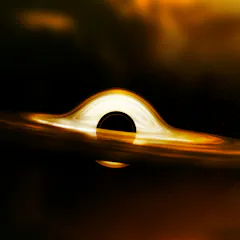
For the first time, scientists have gained information from the very surface of a newborn black hole.

Physicists long believed time was a basic feature of the universe. But it may just emerge from cosmic information.
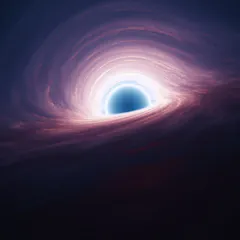
Science fiction imagines wormholes as shortcuts through spacetime. But the original idea suggests they could be something far stranger.
Is time real, or an illusion? The best answer may be neither: Both physics and philosophy suggest that time is a projection of the mind onto a timeless reality.
The universe appears to expand in a way that is consistent with string theory.

Space-time isn’t an actual object or event, it’s a conceptual framework for understanding reality.
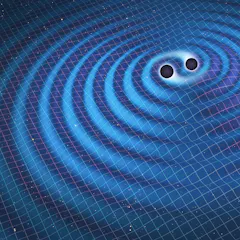
A decade after the first discovery, scientists have used these waves to find a unique merger, a massive binary system and a crystal-clear gravitational wave signal.
First, gravitational waves proved Einstein correct. Now, they’ve confirmed Stephen Hawking was right about black holes.
Stephen Hawking’s prediction about what happens when two black holes merge has finally been verified.
Physicists often say space-time “exists,” but what does that really mean? A hidden confusion between happening and being could be warping our view of reality.
The speed of light is the fastest anything can travel. What happens to a photon from a galaxy 25 million light years away on its journey toward Earth?
A new measurement of gravity at small scales hints at an alternative to billion-dollar experiments for the future of physics.

It seems there isn’t a sci-fi part if the universe in which everything is made of antimatter.
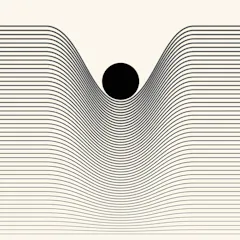
Einstein’s theory of general relativity suggests that our universe originated in a Big Bang. But black holes, and their gravitational forces, challenge the limits of Einstein’s work.
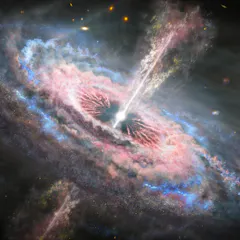
Bright, flickering galaxies called quasars were thought to pose a problem for our understanding of the cosmos – but new research shows Einstein was right yet again.
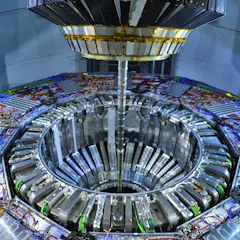
Our two best theories of nature, quantum mechanics and general relativity, are incompatible with each other in many ways – leaving physicists to dig deeper.
Your experience of time is relative because it depends on motion – more specifically, your speed and acceleration.
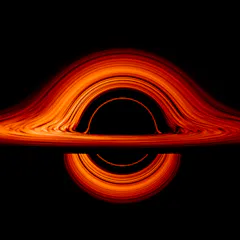
Black holes could take us to the future, and maybe even the past. The hard part would be surviving the trip.
Top contributors
-

Professor of Astrophysics, University of Sydney
-
Professor, Philosophy of Science, The University of Melbourne
-
Observatory Manager and Instructor, Astronomy, University of Saskatchewan
-
Associate Professor of Physics, Oklahoma State University
-
Pro Vice-Chancellor Flagship Initiatives, Swinburne University of Technology
-
Professor and Director of the Centre of Excellence for Data Science, AI and Modelling, University of Hull
-
Professor of Gravitational Astrophysics and Cosmology, University of Glasgow
-
Senior Lecturer in Astronomy & Astrophysics, Coordinator of Swinburne Astronomy Online, Swinburne University of Technology
-
Emeritus Professor, ARC Centre of Excellence for Gravitational Wave Discovery, OzGrav, The University of Western Australia
-
Professor of Astrophysics and Royal Society University Research Fellow, University of Hertfordshire
-
Professor of Physics, Penn State
-
Co-Founder of BQI@UNSW and PhD Student, UNSW
-
Professor of Theoretical Physics, University of Canterbury
-
Professor in mathematical physics, Lancaster University
-
Cosmologist, University of Tasmania