
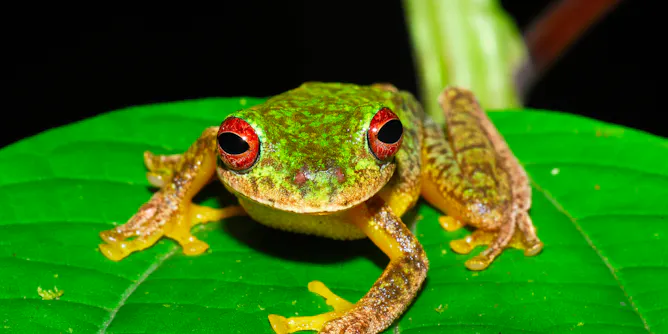
Chytrid fungus has caused declines in 501 amphibian species, according to a new analysis. Most of the damage happened in the 1980s, before the fungus itself was even discovered.
Articles on Frogs
Displaying 61 - 80 of 108 articles
The largest of these frogs could sit happily on your thumbnail. The smallest is just longer than a grain of rice.
A barrier just 50km wide might stop water-reliant cane toads in their tracks.
How do you pack butterflies for shipping, or frogs for an overland hike to a new habitat? Three scientists explain how they keep threatened species safe on the road and in the air.

Lee’s research identified the cause of mysterious and devastating mass frog extinctions that spread across the world starting in the 1970s: it was a skin fungus.
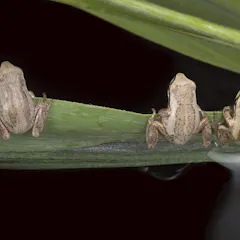
Climate change can seem far removed from our everyday lives, which is why a citizen science program measuring how frogs are dealing with a warming world is so important.

As ponds dry up, so too does our connection to nature.
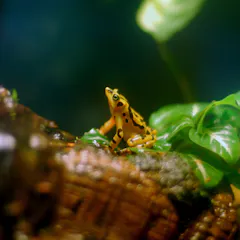
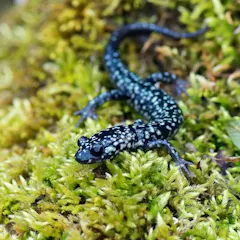
Chytrid fungus has caused a global “amphibian apocalypse,” killing frogs worldwide. Now some appear to be evolving resistance – but a closely related fungus threatens newts and salamanders.
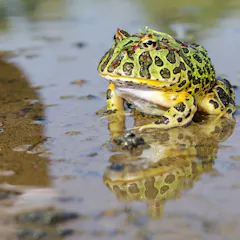
The South American horned frogs are ambush predators and use their powerful jaws to prey on large animals.

Frogs and toads are declining around the world, with many species on the brink of extinction. Acting in time means trying strategies without complete information about how likely they are to work.

A recent study shows how the number of vulnerable and endangered amphibians is nearly double that of birds or mammals. Strategies need to be put in place, and fast.
A collection of The Conversation Global’s best articles on animals, from glow-in-the-dark frogs to the wood beetles that do humanity’s dirty work.

Fossils of the lowly frog indicate that the evolution of South Africa’s west coast winter rainfall pattern is more complex, and possibly occurred much later, than previously thought

Tiny frogs that have spread across New Guinea’s isolated mountains could face an uncertain future if a warming climate pushes them higher up the peaks.

Scientists in Argentina have discovered a frog that glows in moonlight and at twilight.
The fascination and admiration of the natural environment may draw people closer to it, but it’s crucial to remain responsible about any desire to own a piece.

How do a frog’s tongue and saliva work together to be sticky enough to lift 1.4 times the animal’s body weight? Painstaking lab work found their spit switches between two distinct phases to nab prey.

A robust technique using the wonders of digital media has helped researchers understand how threatened species like frogs are faring on our globally changing planet.

A nasty fungus killed 85% of Dominica’s mountain chicken frogs in just 18 months – but the species lives on.

Scientists are working to bring this large, unique frog back from the brink of extinction.
Top contributors
-

Curator, Amphibian & Reptile Conservation Biology, Australian Museum, UNSW
-
Senior Lecturer, School of Environment, Science & Engineering, Southern Cross University
-
Senior Researcher at the CIB based in the Department of Botany and Zoology, Stellenbosch University
-
Research Fellow in Ecology, Australian National University
-
Professor, College of Science & Engineering, James Cook University
-
The University of Melbourne
-
The University of Melbourne
-
Profesor Titular de Zoología / Associate Professor of Zoology, Universidad de Oviedo
-
Postdoctoral fellow, Stellenbosch University
-
Senior Lecturer, Griffith University
-
Australian Registry of Wildlife Health - Taronga Conservation Society Australia, University of Sydney
-
Postdoctoral research fellow, Muséum national d’histoire naturelle (MNHN)
-
Associate Professor in Zoology and Ecology, University of New England
-
Professor, Department of Biology, L’Université d’Ottawa/University of Ottawa
-
PhD Candidate, University of Wollongong