
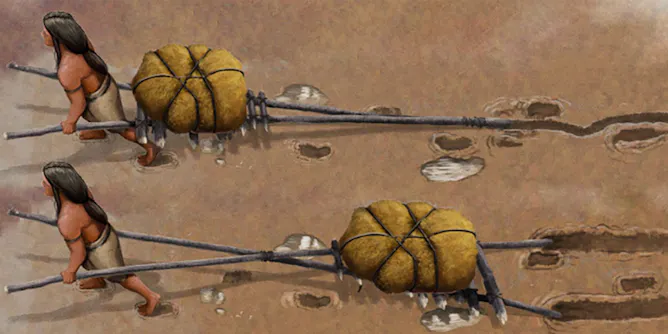
How people got stuff around before wheels.
Articles on Footprints
Displaying all articles

Tracks and traces from long ago are preserved in cemented dune surfaces.
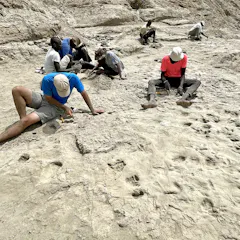
Ancient fossil footprints are the first evidence of two different hominin species − Homo erectus and Paranthropus boisei − living in the same place at the same time.

At a global level it is rare to find fossilised hominin tracks.
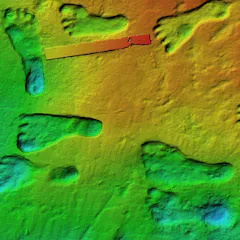
The early settlement of the Americas is hugely contested area of archaeology.

This was an area in which early anatomically modern humans survived, evolved and thrived, before spreading out of Africa to other continents.
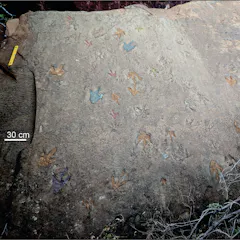
Fossil footprints are a treasure chest of information.

Human tracks registered in aeolianites - cemented dune surfaces - are rare at a global level.

A new study finds more than one early human species lived on the landscape in Northern Tanzania 3.66 million years ago. But there are reasons to be cautious about the findings.
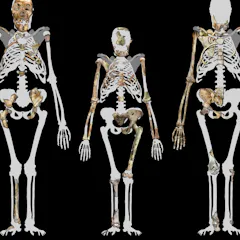
Walking has taken a very long time to develop, with evidence of bipedalism among early humans in Africa roughly 4.4 million years ago.
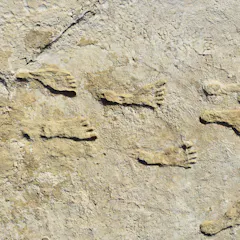
The New Mexico findings could rewrite the history of human migration to the Americas.

Artificial intelligence could help police catch criminals – but we need human experts for the big cases.

These ancient surfaces, which often preserve the tracks in remarkable detail, are now amenable to inspection and interpretation.
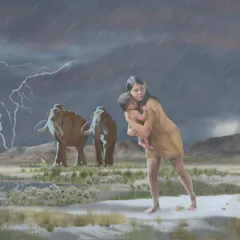
Some 13,000 years ago, an adult carrying in a child walked 1.5km in mud at great speed in the presence of hungry predators.
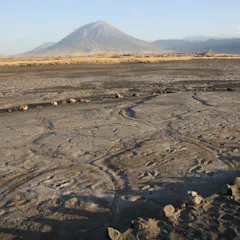
The footprints of over 20 different prehistoric people, pressed into volcanic ash thousands of years ago in Tanzania, show possible evidence for sexual division of labor in this ancient community.
Top contributors
-

Professor of Environmental and Geographical Sciences, Bournemouth University; University of Reading
-
Research Associate, African Centre for Coastal Palaeoscience, Nelson Mandela University
-
Associate Professor in Hominin Palaeoecology, Bournemouth University
-
Research Scientist and Museum Educator, Smithsonian Institution
-
Professor of Anthropology, University of Tennessee
-
Lecturer, University of Cape Town
-
Associate Professor of Biology, Chatham University
-
Senior Lecturer, University of Leicester
-
Senior Research Geologist and Curator of Vertebrate Paleontology, Smithsonian Institution
-
Specialist Scientist, Council for Geoscience
-
Honorary researcher, Evolutionary Studies Institute, University of the Witwatersrand
-
Emeritus Chief Scientist, NRF-SAIAB, National Research Foundation
-
Chief Research Scientist in Archaeology and Heritage, National Museums of Kenya
-
Research Associate, Division of Paleontology, American Museum of Natural History, and Associate Professor in Anthropology, Lehman College, CUNY
-
Professor of Data Science, Bournemouth University