

More fossil tracks of vertebrates have come to light on the South African coast, adding to the picture of an ancient plain full of wildlife.
Articles on Cape south coast
Displaying all articles
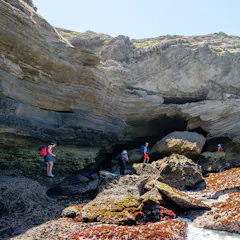
South Africa is home to some remarkable geoheritage.
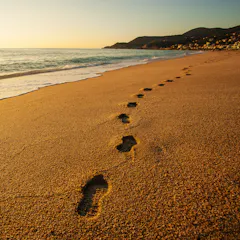
Tracks and traces from long ago are preserved in cemented dune surfaces.

At a global level it is rare to find fossilised hominin tracks.

The sculpture might have begun with tracing a blue stingray specimen in the sand.
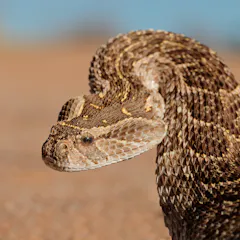
The trace was probably made between 93,000 and 83,000 years ago, almost certainly by a puff adder.

Trackway findings support the notion of southern Africa being one region where human cognitive and practical ability developed a very long time ago.

This was an area in which early anatomically modern humans survived, evolved and thrived, before spreading out of Africa to other continents.

It hasn’t been clear how common the species was on the Cape south coast because its body fossils are predominantly from southern Africa’s west coast.
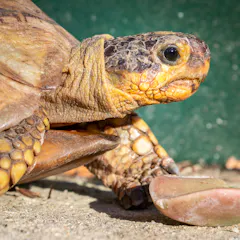
Track marks are a way to fill in the blanks that sometimes exist in the body fossil record.

Without intervention, the rock may have been destroyed by high tides and storm surges.
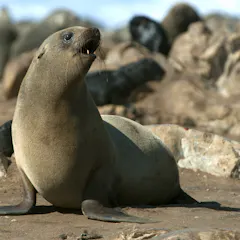
The fossilised seal traces date back about 75,000 years.
Top contributors
-

Research Associate, African Centre for Coastal Palaeoscience, Nelson Mandela University
-
Emeritus Chief Scientist, NRF-SAIAB, National Research Foundation
-
Specialist Scientist, Council for Geoscience
-
Honorary researcher, Evolutionary Studies Institute, University of the Witwatersrand
-
Senior Lecturer, University of Leicester