
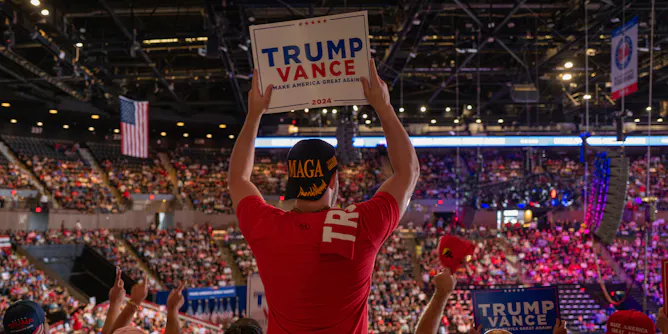
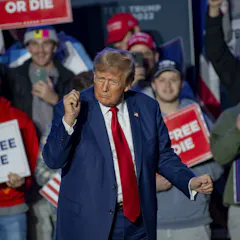
An anthropologist who studies polarization asked people why they supported Trump. Here’s what they said about immigration, the economy and his ‘bull in a china shop’ style.
Articles on Fake news
Displaying 21 - 40 of 375 articles
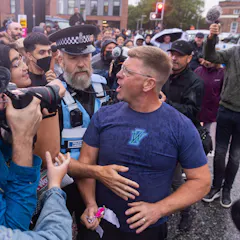
Researchers are trying to understand what makes this group so vulnerable to falling for fake news online.

Library scientists offer tips and tricks to figure out if a particular online news article is reliable or fake.
This phenomenon can help us understand polarisation in society.
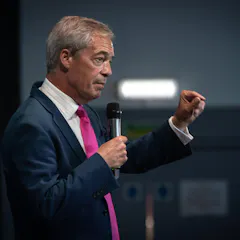
Farage may be setting the scene for complaints of election rigging when the results come in.

While labelling satire seems like a fine idea in theory, in reality it probably wouldn’t work. It also takes away from my right (and yours) to be fooled.

The prime minister attempted to play the populist and ended up playing into the hands of Nigel Farage.

Modelling bolsters idea that fact checking is a useful defence against the flow of disinformation.
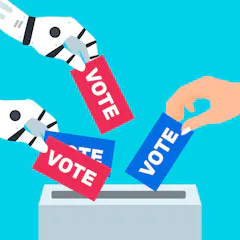
Understanding how to spot a bot is essential, especially for anyone voting in an election.

Vague definitions and heavy penalties mean that legislation could be used to stifle a free press.

Algorithms that amplify or suppress particular kinds of messages should be seen as a source of harm.
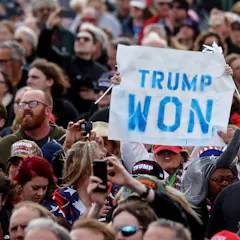
Nearly a third of Americans say they believe that Donald Trump was the real winner of the last election, and the ratio is twice as high among Republican voters.
It’s increasingly hard to tell which content online is fake. As malicious actors use generative AI to fuel disinformation, governments must regulate now before it’s too late.
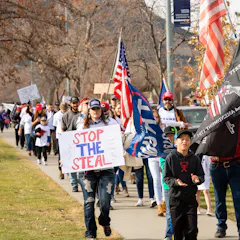
Scientists estimate that for every 100,000 people targeted with specific political ads, several thousand can be persuaded.
With an unprecedented number of votes happening around the world, the information environment will be chaotic, to say the least.
Most studies suggests that fake news is more likely to enhance existing beliefs and views rather than radically change voting intentions of those who are undecided.
We asked people why they shared misinformation and a lot of people do it with good intentions.
Artificial intelligence is likely to make the ‘fake news’ problem worse. But it can also be used to help us counter misinformation.
Trust in brands may be eroded as awareness of misinformation increases according to new research.
We found the number of “big lies” – also known as fake news – didn’t increase in 2023 compared to 2020. But we did spot more “small lies” this time. Here’s what to look out for in coming elections.
Top contributors
-

Professor of Social Psychology in Society, University of Cambridge
-
Professor and Chair, Department of Journalism, Stellenbosch University
-
Professor of Political Communication; Director CAJII, The University of Melbourne
-
Professor in Digital Media, Western Sydney University
-
Senior Research Fellow, Centre for Advancing Journalism, The University of Melbourne
-
Lecturer in Psychology, University of Cambridge
-
Associate Professor of Interdisciplinary Studies, Royal Roads University
-
Associate Professor, News, Social Media, and Public Communication, Simon Fraser University
-
Professor of Media Industries, University of Nottingham
-
Professor of Policy Impact, University of Leeds
-
Vice-Chancellor and Principal of the University, University of Pretoria
-
Associate Professor of Psychology, Vanderbilt University
-
Associate professor in the Faculty of Business, Government, and Law, University of Canberra, University of Canberra
-
Professor, Digital Media Research Centre, Queensland University of Technology
-
Caxton Professor of Journalism, University of the Witwatersrand