
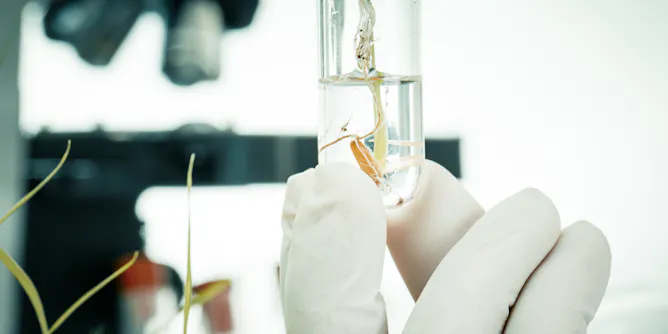
Are genetically engineered crops safe for human health and the environment? A new report says yes but points out problems and regulatory gaps. Three members of the study panel offer their takeaways.
Articles on Environmental health
Displaying 161 - 180 of 202 articles

A growing number of communities in upstate New York and New England are discovering the chemical PFOA in their water supply. Here’s what you should know about the health effects of PFOA.

The way data is currently collected has limited use for environmental health researchers when it comes to understanding health problems at a localised level.

Manufacturers have removed the industrial chemical BPA from many products over concerns that it mimics hormones in the body. Now studies show that BPS, a popular substitute, has similar effects.

Global warming is often seen as a problem for future generations, but focusing on the immediate – and substantial – health benefits of clean energy can change public perception of climate change.
For the first time, researchers have shown that feeding vervet monkeys a toxin produced by blue-green algae resulted in protein deposits in the brain, consistent with those seen in human Alzheimer’s.

Children in mining and smelting towns who are exposed high levels of lead, arsenic and cadmium are more than twice as likely to have developmental disorders than the national average.

Volkswagen’s cheating allowed its vehicles to pass rigorous emissions testing, giving customers maximum driving performance at the cost of the environment and our health.

Understanding genetics isn’t enough to solve our health problems – we need to look at where people live, too.

If you work in an office, chances are you or the person sitting next to you has grumbled about it being too hot or cold.

Tackling climate change is the greatest global health opportunity of the 21st century, a team of 60 international experts today declared in a special report for the medical journal The Lancet.

Soil, dust and air-based exposure to lead can interfere with a child’s developing nervous systems and cause behavioural and developmental problems.
Our world is becoming increasingly urbanised. In 1950, just 30% of the world’s population lived in urban areas. This number is now over 50% and rising. By 2050, two-thirds of the world’s population are…

In the shadows of Broken Hill’s rich mining history lies a legacy of contamination and regulatory failure that will likely outlive any benefits locals derive from mining. One in five children aged under…

After decades of use in some of the most well-known hygiene and cleaning products in our bathrooms and kitchens, concerns about the safety of triclosan – an anti-germ chemical used in products including…

It’s that time of year again. The 101st Tour de France begins this Saturday July 5 in the Yorkshire city of Leeds, and three days later it returns to French home soil for Stage 4 (Le Touquet-Paris-Plage…

The biodiversity of our planet sustains us. From the air we breathe and the water we drink, to the soil we sow and the fuel we use. But Earth does more than provide the basic necessities that allow humans…

A long-awaited report on environmental failures at the biggest port along the Great Barrier Reef coastline and today’s federal budget may not seem connected – but if you read the report, it’s clear just…

In the lead-up to the budget, the story of crisis has been hammered home, but there’s more to a country than its structural deficit. So how is Australia doing overall? In this special series, ten writers…
Children in the mining towns of Mount Isa in Queensland and Port Pirie in South Australia are exposed to harmful levels of pollutants that increase their risk of learning and developmental disorders, and…
Top contributors
-

Honorary Professor, School of Natural Sciences, Macquarie University
-
Assistant Professor of Environmental Health, Middlebury College
-
Associate Professor of Environmental and Occupation Health, University of California, Irvine; University of Southern California
-
Senior Lecturer in Pharmacology, Adelaide University
-
Professor of Environmental Health Sciences, UMass Amherst
-
Professor, Environmental Studies Program at UC Santa Barbara
-
Associate Professor of Environmental and Occupational Health Sciences, University of Washington
-
Postdoctoral research fellow, Macquarie University
-
Chief Specialist Scientist (Public Health), South African Medical Research Council
-
Associate Professor of Sociology; Co-Founder, Center for Environmental Justice at CSU, Colorado State University
-
Professor of Earth Sciences and Executive Director, Environmental Resilience Institute, Indiana University
-
Emeritus Professor of Medicine, Adelaide University
-
Honorary Associate Professor in Environmental Health, Australian National University
-
Specialist scientist, South African Medical Research Council
-
Professor of Environmental Health Sciences, Johns Hopkins University