

While the pandemic undoubtedly sped up the uptake of educational technology in higher education, it doesn’t point to an entirely online future.
Articles on Educational technology
Displaying 21 - 40 of 56 articles

Hearing technologies combined with artificial intelligence can be used to enrich the learning environment.

The pandemic education shock has raised five critical issues that demonstrate how student learning and achievement and social well-being are far from mutually exclusive.

Insights of neuroscientist Ian McGilchrist, philosopher Nel Noddings and physicist Ursula Franklin help centre students and our collective future in debates about education and technology.

It is morally unjustifiable for tech companies to walk away from the pandemic with massive profits while schools are burdened with debt.
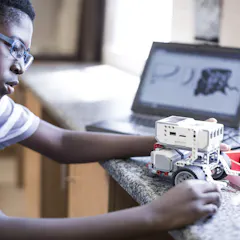
Data underlies the kinds of applications that are proposed for use in the country’s education system.

Students prefer videos that are simply produced, convenient to watch and with a narrative that’s delivered in an informal conversational way.

Children in our schools are the latest at risk in a brave new age of surveillance and data control that is being catalyzed by hasty educational technology decisions under COVID-19.

An expert predicts a rethink on technology access, reconnecting with the working class, and more.

An educational technology scholar illuminates some of odd feelings people experience when they communicate through cameras on the web.

Be prepared to learn along with your kids, take a break when you need to – and have fun.

With parents trying to work from home while schools and daycare services are closed, some children may get more screen time than usual during COVID-19 social distancing.

Online learning can help universities quickly adapt to COVID-19, but policy makers must pay careful attention to student experiences and take a critical view of technology companies’ claims.
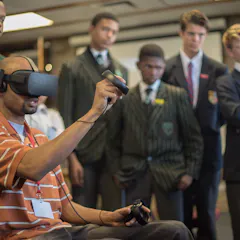
A clearer understanding of teachers’ needs is required if schools and universities are to be better prepared for a future where technology is key to teaching and learning.

For high school students, e-learning is best introduced in face-to-face classes where teachers can meet a greater range of learning needs – not as a completely online experience.

Teacher training and support, appropriate localised content, technical support and safety and security must all be prioritised.

The supervised, structured and balanced use of Minecraft could allow students to fully benefit from the potential of this game to build skills and increase motivation.

ClassDojo, the popular classroom behaviour management and communication system, is said to facilitate community and message-sharing. But who is asking how children are impacted?

Schools should consider offering mobile learning technology in multiple languages to help pupils learn better in subjects like maths and science

Laptops have introduced the children of Nosy Komba in Madagascar to previously inaccessible tools.
Top contributors
-

Associate Professor in Education & Technology, University of KwaZulu-Natal
-
Associate Professor in Information Systems, University of the Western Cape
-
Professor of learning technologies, University of Minnesota
-
Associate Professor for Digital Innovation, University of the Western Cape
-
Postdoctoral Fellow, School of Education and Technology, Royal Roads University
-
PhD Candidate, Faculty of Education, Lakehead University
-
Associate Professor, University of the Free State
-
Emeritus Professor of Education, University of Derby
-
PhD, économiste « Développement Humain » / "Human Development" economist, Agence Française de Développement (AFD)
-
Professeure associée en Psychologie de l'éducation, CY Cergy Paris Université
-
Emeritus Professor, MTN Solution Space Graduate School of Business, University of Cape Town
-
Assistant Professor, Educational Policy and Equity, University of Toronto
-
Director of the Learning, Instruction & Technology Lab and Professor of Educational Psychology, School of Education, The University of Queensland
-
Dean, Syphax School of Education, Psychology & Interdisciplinary Studies, Virginia Union University
-
Chef de projet « Éducation, formation, emploi », Agence Française de Développement (AFD)